
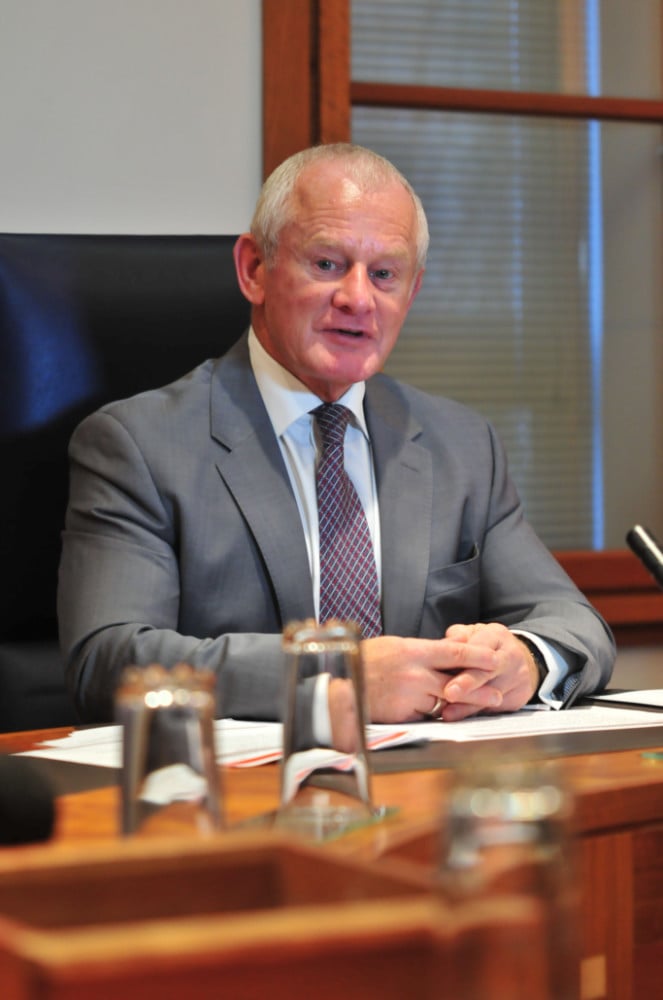
Former Chief Minister Allan Bell has told a Tynwald committee that the island made ’a lot’ of money from its film industry.
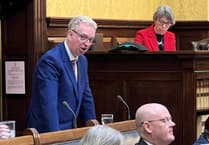
Mr Bell was appearing alongside former Treasury Minister Eddie Teare, former Economic Development Minister John Shimmin and former Trade and Industry Minister David Cretney MLC.
The publics account committee, chaired by Clare Barber (nee Bettison) MHK, is currently taking evidence ahead of making a recommendation to Tynwald about whether there is a need for further investigations into the loss.
The former Chief Minister said the focus on the film industry in recent years was not looking at the whole picture or history of media development in the island.
.jpg?width=209&height=140&crop=209:145,smart&quality=75)

He said the focus had been on the money lost in films, such as the more than £9m lost on the Zac Efron film ’Me and Orson Welles’.
But he said: ’I believe it has been very successful.’
He added: ’While some films did lose money, if you put the equation as a whole, the island made a lot of money from this.’
The former Chief Minister said that the ’over 100 films or TV shows’ produced to varying levels in the island and ’over £300m’ in VAT and other tax returns had benefitted the island and needed highlighting.
Mr Bell told the committee that the island was struggling financially in the 1980s and as the then Minister for Tourism, he looked to TV for inspiration.
He said he saw how the John Nettles TV series Bergerac led to an increase in tourism in Jersey and he thought it ’could be something worth doing’ in the island following the decline of tourism up to that point.
It led to years of discussions with media organisations across the British Isles.
Mr Bell added that the governments in the 1980s and 90s avoided grants for films as the island was in a poor financial state and that ’we had to do our best to avoid government grants to films’.
A report by Oxford Economics in 2012 found that the island’s film industry supported a cumulative total of £375m (2011 prices) in tax revenue for the government overwhelmingly through VAT receipts, but also National Insurance contributions, income tax and other indirectly paid taxes.
This was because, before 2007, the Isle of Man was able to keep all of the output tax accrued on film-making activities that had taken place on the island.
But in 2007 the relationship changed and the VAT revenue was instead shared between the UK and the Isle of Man on the basis of the relative sizes of the two economies.
The effect of this was to substantially reduce the VAT revenue received by the Manx government, notes the report.
It also had a big impact on the number of films made.
Comments
This article has no comments yet. Be the first to leave a comment.