
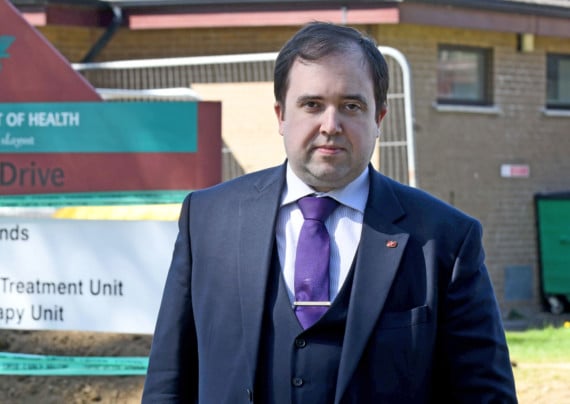
The Health Minister told Tynwald that the suspension of elective surgery in November was ’an urgent operational decision’.
A question was put to David Ashford by Juan Watterson (Rushen).
He wanted to know who was consulted before the announcement of the suspension of an element of elective (scheduled but not urgent) surgery within the Department of Health and Social Care.
Mr Ashford said that on November 25 a decision was made by the executive team in line with the immediate bed pressures, patient transfers, repatriations from the UK and staffing issues.
.jpeg?width=209&height=140&crop=209:145,smart&quality=75)

.JPG?width=209&height=140&crop=209:145,smart&quality=75)
He said: ’In order to create immediate acute medical capacity, the operational senior management team and a number of the executives discussed and agreed the actions needed in order to keep patients safe.
’This included a focus on discharge flow and the reduction in planned inpatient activity and a shift to day-case activity and orthopaedics.
’The position was supported by the director of nursing and the medical director.’
’After the immediate safety issues were addressed, a final programme to document the change around elective inpatients to elective day-case activity was then agreed with the DHSC executive team and at the earliest departmental meeting thereafter.’
This programme included input from the senior clinical leaders within the direct surgical teams affected.
Mr Ashford said an initial review will take place on January 4.
’Decisions like this were not taken lightly by the DHSC, but not uncommon in peak demand particularly around winter and amplified this year around Covid-19 and workplace pressures,’ he said.
Mr Watterson also asked whether he could confirm if the orthopaedic surgeons were not consulted until after the announcement was made publicly and whether he regretted it and if he saw procedures to change this.
Mr Ashford replied that the clinical directors should have communicated this to their teams, saying that he was contacted by one of the orthopeadic consultants who was not made aware until the public announcement, which the minister said ’was completely and utterly unacceptable.’
openness
’I have asked the chief executive of the department to go back and check who knew what and when, because I have made it very clear since I became minister of this department that we need to have a culture of openness, and one of the key lines of communication has got to be that people on the ground need to know decisions before they are publicly announced,’ he said.
Bill Shimmins (Middle) asked whether the suspension of surgery wasn’t due to a shortage of beds, but due to a lack of medical staff to look after them.
Mr Ashford replied that it was a mixture of dealing with day-cases, staffing and the number of beds. He said that there were clearly issues around bed pressures due to the high number of patients requiring one-to-one care.
Julie Edge (Onchan) asked Mr Ashford if he could give the definition of elective surgery in orthopeadics and where the priority lies in providing beds.
Mr Ashford said: ’In terms of elective surgery in this instance, it means those who require an overnight stay. In relation to day cases, there’s currently 196 on the list.’
He then listed the number of inpatients at 364, 44 being urgent and 320 routine and the average waiting time was 262 days, with cases dealt with in terms of priority.
Mr Shimmins asked him what beds or wards had been taken out of Noble’s Hospital and what impact this had on availability, to which Mr Ashford responded by saying that Ward 12, which amounted to 15 beds, had been unavailable and staff were moved elsewhere in the hospital.
Comments
This article has no comments yet. Be the first to leave a comment.