
Manx National Heritage has started significant conservation works at Harry Kelly’s Cottage in Cregneash.
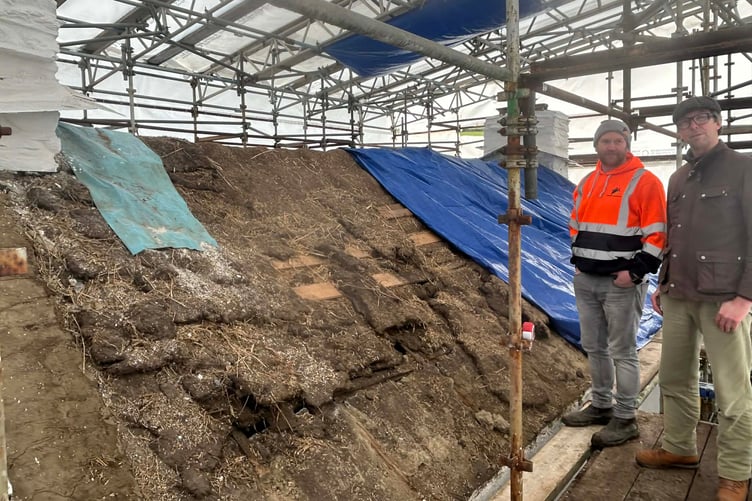
Specialist conservation craftsmen have started the careful process of stripping back the existing roof thatch to assess the condition of the structure beneath.
Before the new thatch can be laid, the team must ensure the integrity of the building as a whole, addressing any issues uncovered.
The cottage is a registered ancient monument, recognised for its close association with Harry Kelly, a renowned Manx speaker.
.jpeg?width=209&height=140&crop=209:145,smart&quality=75)

~2-(1).jpeg?width=209&height=140&crop=209:145,smart&quality=75)
-and-Tim-Foster-(right)-out-on-the-Atlantic-Ocean.png?width=209&height=140&crop=209:145,smart&quality=75)
Following his death in 1938, his family gifted the cottage to the Manx Museum. This directly led to the creation of the Cregneash Folk Village, the first open-air folk museum in the British Isles.
An MNH spokesperson said: ‘The comprehensive scaffolding currently surrounding the cottage not only provides safe and unprecedented access to all areas of the building but also allows work to continue regardless of weather conditions.
‘As with many traditional buildings, the conservation team has encountered challenges that require time and specialist care to resolve.
‘Poorly adhering layers of historic lime-wash have been carefully removed, revealing cracks in the masonry that will now be packed and re-pointed using traditional lime mortar.
‘Repairs are also being undertaken to the tops of the chimney stacks to ensure they remain weatherproof while allowing the flues to ventilate effectively. Once these repairs are complete, the stacks and eaves will be re-whitewashed before re-thatching begins.’
Inspector of ancient monuments at MNH Andy Johnson added: ‘Caring for a traditional building of this importance is never straightforward.
‘Every intervention must preserve the cottage for future generations while retaining as much historic fabric as possible.
‘Our work is guided by sound conservation principles, doing the minimum necessary, using appropriate traditional materials, and documenting each stage carefully. Fortunately, our in-house expertise allows us to recognise and interpret what we uncover and to replicate traditional materials and techniques faithfully.’
Research has played a key role in informing the works. Old photographs show that the slate flashings which protect the junction between thatch and chimney stacks were altered during the 1950s to accommodate unusually deep layers of straw. As part of the current project, these flashings will be reset to reflect a more traditional approach.
Investigations have confirmed that the cottage walls are constructed of stone bonded with clay, with lime pointing applied to weatherproof the joints.
Archive images also reveal that lime-wash was historically was often allowed to weather naturally, creating the mottled appearance seen in many early photo. In some cases, only the most visible elevations were lime-washed annually, with particular attention paid to window and door surrounds to reflect light indoors and discourage insects.
As part of preparations for re-thatching, the straw thatch has been removed to assess the condition of the traditional turf under-thatch, known as ‘scraa’.
Around the gable verges, this has revealed how the wall heads were originally sealed using a thick mixture of clay and lime, forming a bond with the adjacent scraa and creating an even base for the thatching straw.
Mr Johnson added: ‘We have sourced locally recycled clay for repairs to the wall heads and are currently planning additional repairs to the roof timbers, which require further attention.
‘With projects of this nature, it is not always possible to anticipate every discovery in advance. Manx National Heritage extends its thanks to the team at Sulbrick Conservation for their careful and professional approach to these repairs.’