
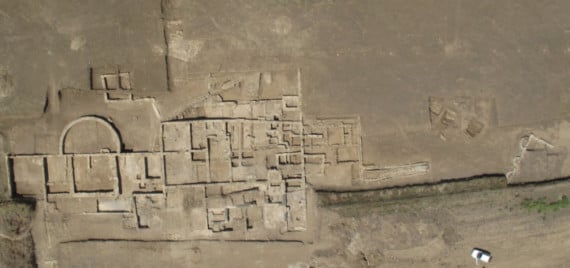
Next week’s history and heritage public lecture at University College Isle of Man takes on a European flavour as Dr Richard Fletcher explores the discovery and excavation of a Roman villa and a medieval farmhouse in a hidden valley in southern Italy.
The Vultur Archaeological Project was established to survey and excavate the site of Torre degli Embrici in the Vulture region of Basilicata in southern Italy, known in antiquity as Lucania.
The area takes its name from an extinct volcano called "Il Vulture", which dominates the landscape.
In the first century BC, the region was home to the Roman poet Horace, who described it as wild and trackless.
.png?width=209&height=140&crop=209:145,smart&quality=75)

Today, it is one of the poorest parts of Italy, has a high level of youth unemployment and out-migration, and is little known or visited by tourists.
Before the Vultur project began, the valley was also considered archaeologically uninteresting, if not barren.
However, the project has succeeded in proving that Horace’s ’trackless Vultur’ was, in fact, an area of large farms, villas and bathhouses, and has been continuously occupied from the Palaeolithic through to the present.
The people who lived in this valley span Homo erectus, Neanderthals and Cro-Magnons, Mesolithic hunters, Neolithic farmers and all the people of Italic history.
In pre-Roman times, southern Italy was a strategically important area.
Local elites saw themselves as the crème of Mediterranean society, and many people wanted to control the region.
Alexander the Great planned to invade after he had finished with Persia.
Pyrrhus of Epirus did invade (giving us the term "Pyrrhic victory" after his bloodied wins over Roman armies). Hannibal marched about the region for 15 years, slaughtering every Roman army that came near him.
The archaeology of the area is immensely wealthy.
People who think the Etruscans were the pinnacle of Italian culture haven’t looked carefully at south Italy.
Artefacts
Burials here can be bursting with precious artefacts and chieftain’s houses can be incredibly rich.
One tomb from near the area of this project was of a woman with hundreds of items buried with her: scores of silver broaches, gold and amber jewellery, ivory ornaments, bronze cauldrons, iron feasting equipment, pottery, horse trappings and many other artefacts.
Male burials sometimes included entire suits of armour and chariots. These were clearly important people.
The arrival of the Romans changed all this.
When the Romans finally subdued the Lucanians at the end of the 3rd century BC, they set up their first big colony at Horace’s hometown, Venusia.
They then began a process which has been followed ever since of keeping Lucania trackless and backward.
The Roman Empire is usually depicted as the bringer of peace, of prosperity, of culture, of law and government, but for the Lucanians it brought only neglect.
By Caesar’s time, the pattern was set for the next 2,000 years: ambitious people left Lucania, usually by going into the Roman army or into the service of the Roman state.
However, there was a brief return to prosperity under the Holy Roman Emperor, Frederick II.
In the 13th century, Frederick liked to hunt in Lucania.
He also liked to live in Palermo and surround himself with the educated men of his time, often Arabs.
He built churches and castles and settled his Arab bodyguards and their families in south Italy when they had retired.
Frederick was always accompanied by his court and his bodyguards.
The odd appearance of blond and red-haired people in this region is taken as evidence of Norman blood, confirmation that the men of his court had some interaction with locals.
The central excavation of the Vulture Archaeological Project is a Roman Villa at Torre degli Embrici.
The excavation has revealed a site that was initially a Lucanian household of some importance in the 5th century BC.
It then became a Roman Villa of truly monumental proportions that survived the fall of Rome and continued into the late 6th and maybe even into the 7th century AD.
Its last incarnation, however, was as a farm in the 13th century.
It looks as though one of Frederick’s Arab bodyguards may have been given the land and used the ruins of the Roman Villa to build a farmhouse in the North African style, even importing Egyptian foodstuffs in stamped transport pots.
Richard Fletcher specialises in Middle Eastern and Mediterranean archaeology and has worked on archaeological projects around the world.
He is currently a senior research fellow at University College London undertaking research in Qatar and Morocco.
He hopes to return to the Vulture next year.
In his lecture, Dr Fletcher will take us through the history of this remarkable area and the wealth of finds that have been uncovered, with a particular focus on the excavation of the Roman Villa.
Dr Fletcher’s lecture on ’The Vultur: A Hidden Valley in Italy’ will take place at 6pm on Wednesday, January 17, in the main hall at University College Isle of Man, Homefield Road, Douglas.
All are welcome, and no booking is required. The lecture will be recorded and made available online
â?¢ Further details about the History & Heritage lecture series, together with videos of last year’s lectures, can be found online at http://catrionamackie.net/lectures/
Comments
This article has no comments yet. Be the first to leave a comment.