

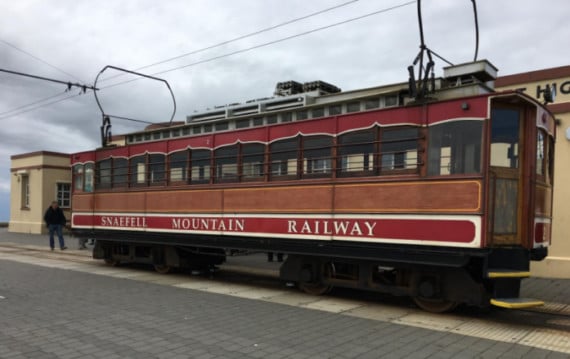
A tram careered out of control 1,400m down Snaefell mountain, reaching a speed of 44mph, after its brakes failed shortly after leaving the summit, an accident report reveals.
The crew, anticipating a catastrophic derailment, told passengers to ’brace’, but their actions in wrestling with the manual brake and ensuring the warning lights came on at the Bungalow road crossing averted a much more serious incident, confirms the report.
It also highlights significant failings in the management, training and monitoring of staff including the maintenance of safety-critical equipment.
A report by the Health and Safety at Work Inspectorate into the runaway tram incident has finally been released following a Freedom of Information request by Isle of Man Newspapers.

.jpeg?width=209&height=140&crop=209:145,smart&quality=75)
It took more than three months for the Department of the Environment, Food and Agriculture to publish the report, due to consultation being carried out with the DoI and the Attorney General’s chambers over how much information should be withheld.
And it took the intervention of the Chief Minister before the report was finally released, together with an independent consultant’s report, two inspection reports and an interim report.
There were 48 passengers and two crew members on board when tram no.2 set off from the Summit station at just before 2.40pm on August 4, 2017.
Shortly afterwards, the motorman attempted to operate the main rheostatic brake controls and soon realised that this was having little effect on the speed or control of the tram.
The crew, assisted by a passenger, made desperate attempts to slow the tram by turning the fell brake to its full extent.
They radioed the station master at Bungalow to warn him. He reported that he was concerned that there was something amiss with tram 2 because of the noise it was making. When it came into sight he realised it was travelling too fast and was ’rattling around’.
He switched on the wig-wag warning lights to alert motorists that a tram was about to cross and then cleared members of the public from the station platform before moving to a place of safety.
A GPS system on the ticketing machine recorded on computers in the Banks Circus office in Douglas showed that the tram rocketed across the Mountain Road crossing at a speed of about 44.1mph. The speed limit on the line is 12mph. ’Both crew members were concerned that the tram would derail leading to a catastrophic incident,’ notes the report.
With the main rheostatic brake having failed, and up until the Bungalow the manual fell brake having little or no effect, crew were left with no choice but to apply the parking brake, normally reserved for braking at very low speeds.
The tram slowed and finally halted some 500m beyond the crossing, and 1.4km from where the problem was first detected.
Many of the passengers were traumatised.
One told the HSWI team: ’We flew through Bungalow at what must have been 50mph at least. As the tram left the tarmac it had a violent lurch to the right and by this time there was pandemonium among the passengers as the violence of the events and the nearby vertical drop into Laxey Valley was seemingly certain.’ Another said: ’I realised that indeed we may be about to die. I hope that none of us will be in that much danger or so close to such a complete catastrophe again.’
Passengers were transferred to another tram and taken back down to Laxey where staff checked that no one was injured. But no steps were taken to obtain contact details.
The investigation determined that the failure of a microswitch connected to the compressor pump was the initial cause of the incident.
This prevented the pressure in the system from being recharged, and the resulting fall in pressure disabled the rheostatic brake control which is the tram’s primary braking and speed regulation system.
Senior management of the SMR and the DoI have stated that - in their opinion - that the motorman was late in applying the fell brake.
And the independent report by Smarttrams, while not apportioning blame to anybody, says a crew member, despite his training, failed to notice or comprehend the low air pressure displayed on the cab gauges and set off with insufficient air tank levels for the journey down the mountain,
But the HSWI found there is significant evidence to suggest that the efforts of the crew prevented a much more serious incident from occurring.
Failure of the low pressure monitor switch, which is designed to operate the compressor pump motor when the pressure falls to 80psi, was probably due to age and the number of times it has operated over its life, the HSWI found. The pressure gauges were confusing, located away from the motorman’s line of sight and in different places on different trams and with no clear markings to indicate safe working pressure.
An interim report said it was clear there have been ’significant failings in the management, training and monitoring of staff’.
The fell brake components were found to be excessively worn. When they were examined by two independent experts, it was discovered that the fell brake mechanism was badly adjusted and there were signs of excessive wear which meant that the brakes did not clamp correctly onto the sides of the fell rail.
Prior to the date of the incident, risk assessments - a legal requirement - had not been conducted for Snaefell Mountain Railway operations.
’Had the management of the SMR carried out adequate risk assessments the risks associated with the aging nature of the trams and equipment would have been identified and they would have been better informed to minimise the possibility of safety critical failures,’ notes the HSWI report.
Pressure vessels on the tram had not been examined for over three years. There were no records of maintenance for the air pressure switch that failed.
Previous tram equipment failures were not investigated, the report found.
Failures of safety critical equipment such as the fell brakes, communication buzzers and the rheostatic control systems had been reported by motormen to engineering staff on numerous occasions but these failures were not considered by senior management. Just three months earlier, on May 12, tram no.1 suffered an electric brake failure and had to return on its fell brake. This could have resulted in a runaway incident had it occurred one month earlier when the fell brakes needed attending to.
In December last year, the DoI was fined £18,000 after admitting five breaches of health and safety regulations in relation to the Snaefell Mountain Railway.
The department pointed out that none related to the trams’ braking systems.
But the DoI had initially faced 12 further charges which were subsequently withdrawn and it is clear from the HSWI report that a number of these did refer to failure to maintain the fell brakes to a standard that was safe for employees and passengers, not only on tram no.2 but on numbers 1, 5 and 6 too.
Since the incident, Isle of Man Transport has taken steps to ensure the risk of it happening again has been significantly reduced.
And an improvement notice has been served on the DoI by the HSWI obliging the department to fit ’fail to safe’ brakes on the trams before the Snaefell Mountain Railway reopens for the 2019 season.
The service is due to begin again on Tuesday next week. Two of the trams have been fitted with the new ’fail to safe’ brakes.
A DoI spokesman said the other trams’ braking systems would be ’updated shortly’.
Comments
This article has no comments yet. Be the first to leave a comment.