
Is photography an art or just a mechanical process of ’pressing the button’? As a member of the Isle of Man Photographic Society, the answer has to be that it is an art.
Just just like drawing or painting, photography is subject to the same ’rules’, or more correctly, guidelines on composition.
Even if you have no knowledge of the physics of a camera and its lens in taking a photograph and do just ’press the button’, taking time to consider what is included and excluded in your composition is perhaps the easiest way of adding impact and improving your images.
The guidelines are also universal to the world of art. Good composition is all about creating a balance between the various elements in your shot, of having a focal point, interest throughout the image and excluding the redundant or unnecessary.


.jpeg?width=209&height=140&crop=209:145,smart&quality=75)
The Rule of Thirds is often a good starting point.
The drawing below shows two vertical and two horizontal imaginary lines in a composition, rather like a noughts and crosses layout, with the intersections the key areas to place the main subjects of your image to ensure a harmonious and balanced result.
The grid could apply to a variety of images.
Photographers, for example, will often place the horizon in a landscape on either the upper or lower horizontal line as shown, or the main subject placed on one of the intersecting thirds.
Similarly, in a portrait, a photographer might place the subject on one of the verticals and their eyes on a third.
Light or strong colours draw the eye, so it helps if the main focus of your image is highlighted either by natural light or with a light or strong colour such as red or yellow.
Use lead-in lines to encourage the eye towards the main subject of your images.
Use a feature in your image such as a path, a river or a wall to direct your eye towards the main subject or to lead the eye around the details in the image.
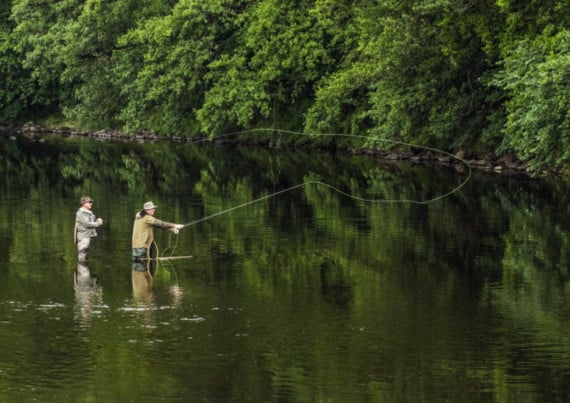
The image accompanying this article is not a competition shot nor one with great impact, but does illustrate the guidelines suggested above.
It was taken at a ’decisive moment’ when the angler was caught at the peak of the action, he and his ghillie are ideally placed on a lower third, their clothing light against the background so immediately drawn to the viewer’s attention.
The river bank placed on the upper horizontal and the curl of the fishing line lead the eye around the detail of the scene.
A tranquil moment almost timeless in its action, giving a pleasing balance and harmony to the image.
While I hope you would agree with the above analysis, the ’rules’ are only guidelines and breaking them can also produce images with great impact.
At the end of the day, if you like the result and are pleased with your efforts, then good enough.
Have a look at the club website (www.iomps.com) and check out the latest news, reports and members’ galleries for inspiration and more ideas on photography.
CHRIS BLYTH