

For just over three hours on Tuesday afternoon, the Isle of Man found itself at the centre of the royal spotlight.
From schoolchildren waving Union and Manx flags outside Tynwald to cheering crowds lining King Edward Road, King Charles III's first official visit to the island as Lord of Mann brought together centuries of tradition, a celebration of Manx heritage and countless memorable moments.
His Majesty arrived shortly before midday aboard the Royal Flight, a Dassault Falcon 900LX, before travelling to the Legislative Buildings in Douglas, where the constitutional significance of the visit quickly became clear.
As Head of State of the Isle of Man, the King holds the historic title of Lord of Mann, making his address to Tynwald a rare and important occasion. It continued a tradition begun by Queen Elizabeth II during her first visit as Lord of Mann in 1955.
Outside, the atmosphere had been building for hours.
Despite temperatures climbing into the summer sunshine, some well-wishers had secured their spots as early as 10am, determined not to miss the chance of seeing the monarch.
Children from local primary schools lined Bucks Road, eagerly waving flags before erupting into cheers as the royal convoy swept into view.
The heat did take its toll on one spectator, who briefly collapsed while waiting for the King's arrival. Thanks to the quick response of Isle of Man Constabulary officers and St John Ambulance volunteers, she was soon back on her feet, with the incident doing little to dampen the spirits of those gathered.
Security for the visit was unmistakable.
Hundreds of police officers could be seen throughout Douglas, while specialist firearms officers and rooftop security teams kept watch over proceedings as one of the most significant royal visits in recent Manx history unfolded.
.jpeg?width=209&height=140&crop=209:145,smart&quality=75)

Inside Tynwald, history and modern constitutional life came together.
Following a Loyal Address from President of Tynwald Laurence Skelly OBE MLC, the King delivered his own speech, reflecting on the island's unique identity and praising its landscapes.
Speaking to members of the ancient parliament, His Majesty said: ‘On this occasion, I am fortunately able to reiterate how extremely disappointed I was not to have been with you in 2024, but I know that Her Majesty greatly enjoyed that visit.’
He also spoke warmly of the Isle of Man's ‘natural beauty’, a sentiment unlikely to have been disputed on what proved to be another glorious July afternoon.
The formal proceedings were soon replaced by something altogether more relaxed.
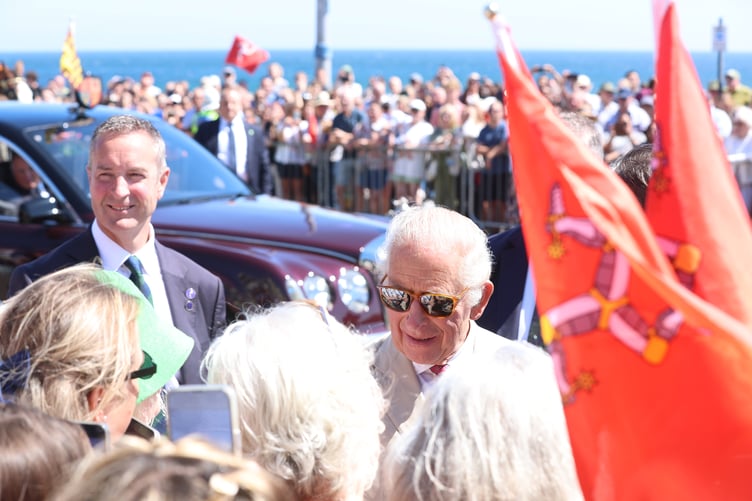
Stepping outside onto Bucks Road, the King spent time meeting members of the public, shaking hands and chatting with those who had waited patiently in the sunshine. Youngsters were among the most enthusiastic members of the crowd, many clutching homemade flags and hoping for a brief encounter with the monarch.
Some got a handshake, others a big grin, while one shouted: ‘I just met the blooming King’, met with a chorus of laughter.
From there, the royal convoy slipped quietly, or as quietly as you can do in a Royal car with no number plate followed by Police bikes, to Government House in Onchan for a private garden party celebrating the Manx community.
Away from the crowds, guests representing all walks of island life had been invited to meet the King, from Manx speakers and representatives of Culture Vannin to local farmers, wool producers and volunteers.
One particularly Manx moment came when His Majesty was introduced to a small flock of Loaghtan sheep.
The distinctive four-horned native breed attracted plenty of attention, providing a reminder that the visit was as much about celebrating the island's unique heritage as it was fulfilling constitutional duties.
Attention then shifted back to near Queens Promenade, where another sizeable crowd had gathered beside the Douglas Bay Horse Tramway terminus.
This year marks the tramway's 150th anniversary, making it a fitting stop on the King's itinerary.
.jpeg?trim=0,0,0,0&width=752&height=501&crop=752:501)
After meeting tram staff and unveiling a commemorative plaque, His Majesty boarded No. 18, the world's oldest horse tram still in regular passenger service.
Waiting patiently to pull the royal passenger was Bobby, a 16-year-old Clydesdale whose calm temperament seemed perfectly suited to the occasion.
As the tram rolled gently along the promenade towards the foot of Summer Hill, hundreds of spectators applauded and waved.
For many, it was one of the defining images of the day, the monarch travelling aboard one of the island's most recognisable and cherished attractions beneath clear blue skies.
There were lighter moments too.
The King appeared relaxed throughout the afternoon, smiling frequently as he greeted well-wishers. Among those to catch his attention was baby Martha, earning one of several warm interactions that delighted the watching crowds.
Edward James Harrington told us of a particular quote King Charles III shared with him: ‘Having long held a profound admiration for the unique, and indeed extraordinary, heritage of the Isle of Man, I am deeply mindful of the immense historical significance of the Douglas Bay Horse Tramway.
‘As we mark its remarkable 150th anniversary in this very year of 2026, it stands as a magnificent testament to Victorian ingenuity and a living, breathing connection to our shared past.’
If there was one irony, it was that the tram still stops well short of the Sea Terminal, an issue that has fuelled debate for years.
Yet on Tuesday afternoon, few seemed interested in politics. Instead, attention remained fixed on the smiling monarch making his way along the promenade.
While many assumed the royal visit had drawn to a close after Douglas, one final engagement remained.
Away from the big crowds, the King travelled to Port Soderick to visit Heroes on the Water Isle of Man.
The volunteer-led charity supports veterans, emergency service personnel and other uniformed public servants through activities including kayaking, sea dipping and outdoor wellbeing programmes.
There, the King met service users before spending time hearing their stories of rehabilitation and recovery.
One particularly poignant encounter came with 104-year-old World War Two veteran James Fenton from Port Erin.
Mr Fenton served as a Bombardier with the 178 Field Regiment of the Royal Artillery during the war. During their conversation, the King reflected with characteristic humour that life could be challenging enough at the age of 77, ‘let alone’ at 104, prompting smiles from those nearby as the pair shared a memorable exchange.
Outside, a Royal Navy security vessel remained stationed offshore while the royal vehicle carefully reversed down towards the waterfront, highlighting the detailed planning behind a visit that appeared effortless to the thousands watching.
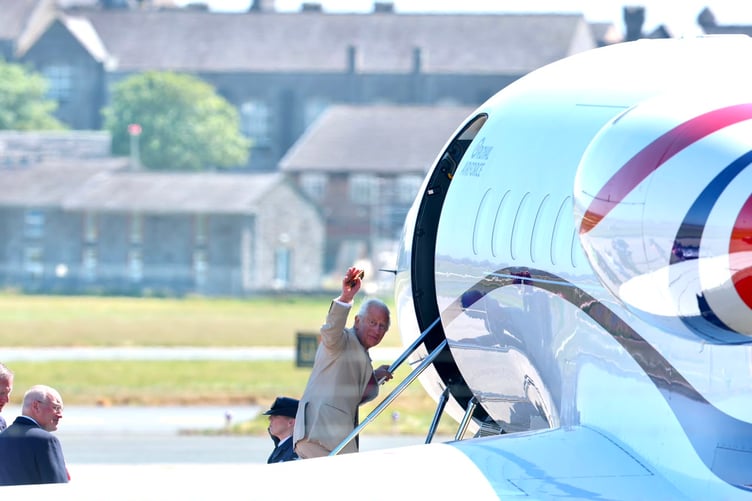
By around 3.35pm, the King's official programme had come to an end as he departed from the Jet Centre, bringing to a close a visit that had packed four engagements into little more than three hours.
In that short time, he addressed one of the world's oldest continuous parliaments, greeted hundreds of islanders, celebrated one of the island's best-loved attractions, met volunteers changing lives through outdoor therapy and celebrated the people and traditions that make the Isle of Man distinctive.
It was the day the Lord of Mann came to the island, and, in doing so, shone a national spotlight on its history, its heritage and, above all, its people.