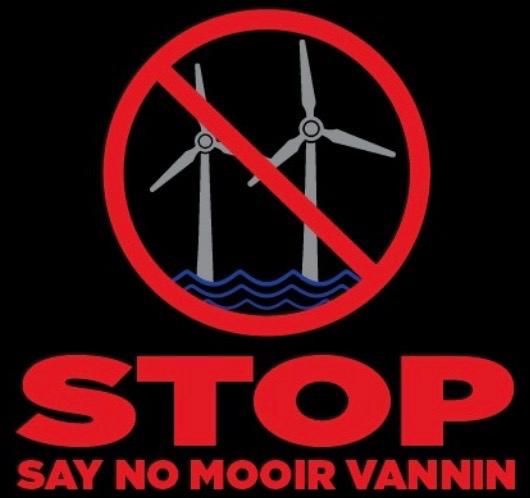

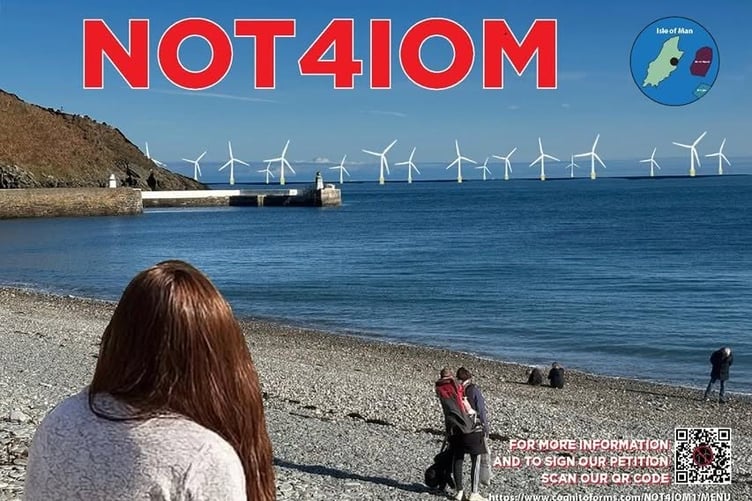
Many of us who treasure our unspoilt coastal views and who believe in the island’s long-term economic, energy and environmental security look at the proposed Mooir Vannin offshore wind farm with a degree of concern.
Earlier this year, that concern led a handful of residents to form NOT4IOM, a community group that aims to share information and explain what Mooir Vannin could mean for generations to come.
And, at a time when no former or soon-to-be elected MHKs can discuss Mooir Vannin in parliament, it is ordinary residents who are left to challenge Orsted’s claims and to demand transparency and accountability.
To be clear, we are for renewables, but we are against a bad deal and right now - Mooir Vannin does not look like such a great deal for many reasons.
The promised money? Not guaranteed, not independently verified
Ørsted claims that Mooir Vannin will generate £2.4 billion into Government revenue over its 35-year lifetime—averaging £57 million a year.
But Ørsted is not guaranteeing this revenue and it has not been independently verified.
Treasury’s models are far more conservative, putting revenue between £0.7 billion and £1.9 billion.
Now there is a BIG difference between £700 million and £2.4 billion in revenue.
What’s more, any revenue depends entirely on the wind farm operating and staying profitable for 35 years. Yet, no offshore wind farm anywhere in the world has run for 35 years and industry norms put the average lifespan at just 20 to 25 years.
Decommissioning costs?
This is perhaps the single biggest financial threat to the economy.
Using UK government guidelines, the clean-up bill for Mooir Vannin could reach up to £740 million.
Ørsted has not provided any financial security, like a bond or parent company guarantee, but instead says it will provide details in a ‘confidential annex’.
That’s it.
Make no mistake, if Mooir Vannin goes bankrupt with no financial security in place, the public will pay for the clean-up.
Contribution to the island’s 2030 climate goals
There is a common misconception that Mooir Vannin will help the Island reach its net-zero goals.
However, as Ørsted has confirmed, the Government policy is ‘to have an offshore wind farm to decarbonise the UK grid’, meaning Mooir Vannin is a pure energy export project.
The cheaper electricity myth
Mooir Vannin has been marketed as a way to lower household electricity bills, however, Manx Utilities has distanced itself from Ørsted’s claims, stating that any promises of customer savings are purely ‘speculative’.
And Ørsted has since admitted that any Power Purchase Agreement (a contract to buy back subsidised electricity from the UK grid) has no certainty of being delivered.
The ‘Island link’: who will pay to upgrade the grid?
As for the ‘Island Link’, a cable to bring 100 MW of electricity onshore, Manx Utilities has confirmed that the capital costs are completely unknown, as are the costs of grid upgrades.
The impact on wildlife?
Manx Wildlife Trust has described Ørsted’s baseline ecological assessments as ‘inadequate’ thus casting doubt on Ørsted’s predicted 660 bird deaths a year.
While beneath the waves, vital herring spawning grounds and scallop beds are at risk.
The bottom line
Mooir Vannin is being pushed forward on unverified financial promises, future liabilities, and serious environmental question marks.
Before the Isle of Man agrees to a 35-year commitment, the public deserves real financial guarantees, transparency, and independent facts.
We deserve a SAY. We deserve a better DEAL. Learn more at NOT4IOM.COM.