
Scientists have found that cats develop dementia in a similar way to humans with Alzheimer’s disease, leading to hopes of a breakthrough in research that may lead to new treatments for both humans and animals.
The research is being pioneered by the University of Edinburgh where scientists have carried out post-mortem brain examinations on 25 cats who exhibited symptoms of dementia while they were alive.
These symptoms included confusion and disorientation, sleep disruption, pacing, behavioural changes and increased vocalisation.
Microscopy images showed that synapses in the cats’ brains had developed a build-up of a toxic protein called amyloid-beta, which is also found in the brains of humans suffering from Alzheimer’s.
.jpeg?width=209&height=140&crop=209:145,smart&quality=75)
.jpeg?width=209&height=140&crop=209:145,smart&quality=75)

The researchers are defining this as a scientific breakthrough because it is a ‘perfect natural model for Alzheimer’s’.
Synapses allow the flow of messages between brain cells, and their impairment causes reduced memory and thinking abilities in humans.
Previously, scientists studying Alzheimer’s relied on genetically modified rats and mice, but rodents do not naturally suffer from dementia and so this limited what could be achieved in the research. Studying feline dementia has the potential to develop human treatments because it is naturally occurring, and therefore provides a more accurate model of the disease.
Of course, exciting as this scientific development sounds, a massive caveat has to be that all further research in cats with dementia should be carried out in an appropriate manner – i.e. live cats must not used in scientific experiments that compromise their wellbeing in any way.
Owners of elderly cats and dogs frequently observe incremental and ongoing changes in their pets, from signs of dementia through to physical deterioration and a general ‘slowing down’. Enjoying this phase of pet companionship can require a change in an owner’s attitude – that five mile walk, or run, might be doing more harm than good, for example.
Whilst dementia in both humans and animals is not curable, and there’s no vaccine for it, pet owners can mitigate the ill effects of the disease by implementing some environmental changes. These include:
- Keeping feeding stations, litter trays and sleeping areas in the same place
- Trying not to add a new pet to the household
- Avoiding moving furniture
- Placing your cat in a separate, quieter room when you have visiting guests
- Providing enrichment such as toys and scratching posts to keep your cat active as much as possible.
Dementia in cats is not anthropomorphic nonsense, although other age-related issues such as diabetes can disguise its symptoms.
Indeed, it is estimated that almost 30 per cent of cats between 11 and 14 years of age develop some form of cognitive disfunction, and the rate goes up to 50 per cent in cats over 15 years of age.
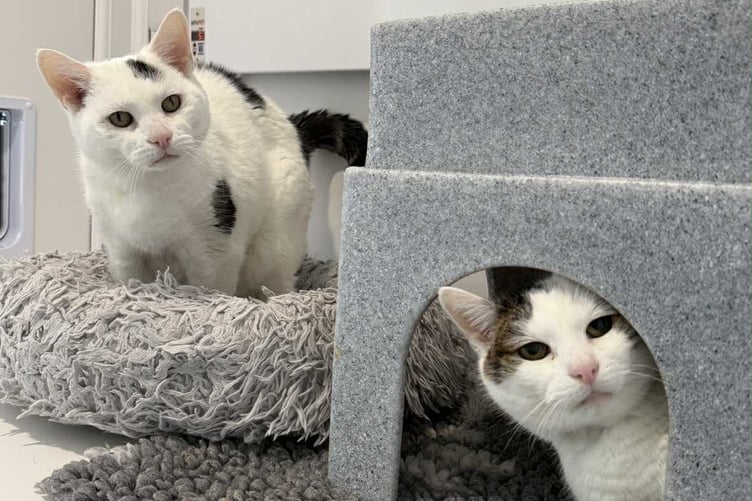
Our elderly 13-year-old cats, Mollie and Millie, are still of sound mind - as far as we can tell within the confines of a cattery environment – and they enjoy good health apart from the odd bout of conjunctivitis.
They have been with us for more than four months now, and have been continuously overlooked for adoption in favour of younger cats and kittens.
They are gentle, sweet cats who need a quiet place to call their retirement home. They have always lived as indoor only cats and so they could be the perfect companions for, say, someone who lives in a flat or next to a busy road.
Mollie and Millie (who has more white in her coat) are sisters and very bonded, and so they need to be rehomed together.
If you have room in your home and your heart for them, please contact the cattery team on 851672 (option 2) or [email protected].