
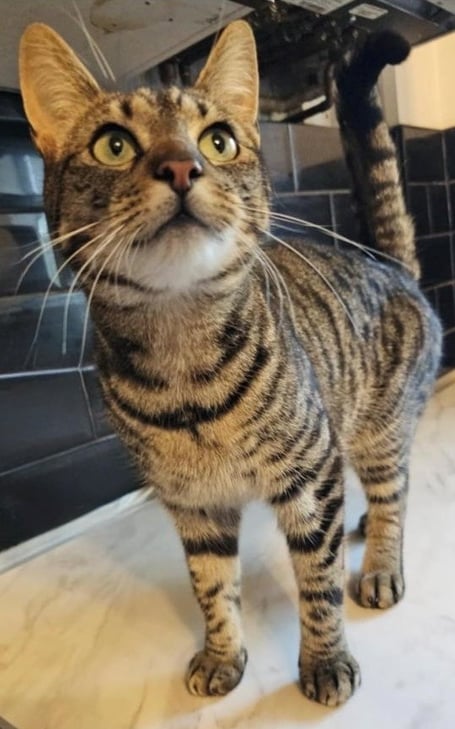
This week’s article is inspired by Indy the cat, or rather Indy’s family, who are desperately trying to find out what has happened to him.
He went missing from the Harcroft Meadow area of Douglas on October 31, and hasn’t been seen since.
His owners have done everything they can to find him – from putting his photo all over social media (including the MSPCA’s Lost and Found Pets Facebook page) to putting flyers through doors and placing posters on noticeboards across the island.
Indy’s owners wonder if someone has ‘unintentionally’ taken him into their home, thinking he is a stray, started to feed him and then he’s simply stayed put.



They also wonder whether the person looking after him hasn’t taken him for a microchip check (he is chipped and his details are up-to-date), perhaps because they don’t drive.
Our standard advice for anyone worried about a cat being stray is that they should encourage the cat into a secure box and take it to a local veterinary practice, or bring it to us, for a chip check.
If there are genuine reasons why this can’t be done, our cattery team are able travel out to a suspected stray and scan him or her in situ, as long as the cat is confined until they arrive.
Whist Indy’s owners are left not knowing what’s become of him, we have told them that no news is good news (i.e. Indy hasn’t been found dead) and that cats can often be missing for months, even years.
Cats like Bobby who disappeared from the Grenaby area in 2022, only to be taken into Strand vets in Port Erin last month as a stray. Where has he spent the last three years? We’ll probably never find out, but at least he’s now safely back with his owner under ‘house arrest’ for a few weeks.
We receive lots of calls from people who don’t intentionally feed a strange cat but can’t avoid doing so because the cat comes through their cat flap and eats the food put down for the household cat.
Most pet shops sell magnetic cat flaps, which only open for a cat who is wearing a collar with a small magnetic device attached to it, and so they keep out unwanted visitors. But if your cat doesn’t wear a collar, you could try a microchip-activated cat flap which is programmed to open only when your cat’s microchip is near it. These flaps cost about £60 but they are well worth it.
Hundreds of cats go missing in the island every year because it’s in a cat’s nature to enjoy roaming and exploring their surroundings, particularly if they are not neutered or spayed, and they are notoriously fickle when it comes to where they sleep.
Microchipping really is the most effective way to make sure your precious feline is able to be identified, and so please ensure your cat is chipped and that your details are up-to-date on the microchip company’s database.
Your veterinary practice will be able to microchip your cat, or alternatively you can bring him or her to our cattery and one of the team will undertake this quick, painless procedure at a cost of only £20.
Please call ahead, though, on 851672 and use ‘option two’ to be taken through to the cattery telephone; and please leave a message on the answer machine if there’s no-one to take your call immediately.
We re-united another cat with its owner last week, this time in Ramsey, but sadly we were not able to persuade the owner that his cat should be neutered – not least to lessen the likelihood of him roaming.
The owner said he ‘didn’t want to ruin’ his cat. It’s unbelievable that this ill-informed and old fashioned attitude still prevails in some quarters.
And on the subject or neutering, if you come across a cat has the tip of one ear missing (a quarter of an inch, cut in a straight line, on the left ear), this means he or she has been neutered or spayed as a feral in the past and is still likely to be feral, and therefore won’t have an owner.
If you are interested in providing an environment for feral or semi-feral cats, where they have sufficient food and shelter, please contact the cattery team. We use the term ‘house a mouser’ because these cats are a great method of natural rodent control.