
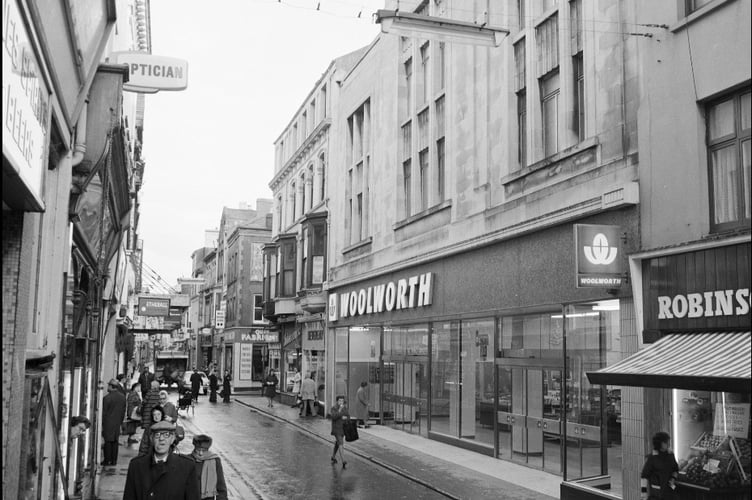
I predate colour TV by some way.
It is really interesting how things have developed in so many areas over the decades.
Up until the 1950s, the only broadcaster was the BBC Television Service. In 1955, ITV was launched in the London area, followed by an expanded reach in 1956.
BBC Two came along in 1964 and Channel 4 in 1982.


I remember my mother renting her TV from Colebourns in Victoria Street (of course, other outlets were available).
TVs were unreliable. Can you remember trying to adjust the set from the peculiar antennae on top, or in frustration giving the set a knock with your hand to ‘help’ it work properly?
Colour TV was launched in 1967 on BBC Two; BBC One and ITV followed in 1969, though it took until 1976 for there to be more colour than black-and-white TVs.
They were in ‘fashionable’ wooden cabinets, and today they are super-slim, super-sized, and with Sky, well over 140 channels are available.
Similarly with music mediums. I remember my dad had old 78 rpm records with artists and bands that I had never heard of, and which I don’t remember him playing, even though he had a nice radiogram with a record facility.
Maybe he played them when I wasn’t visiting! He certainly was not fussy about my 33⅓ rpm LP records of the Rolling Stones or Jimi Hendrix. They were then called long-playing records, but the title changed to the more catchy ‘albums’.
Like most of my era, I had a large collection of 45 rpm singles, which would be regularly updated when the next week’s chart came out and we all went to Woolies, Kellys Records, or Jim Mitchells (others available!).
In 1979, Millennium Year in the Isle of Man, I was working for George and Viv Henthorn at the Grasmere next to the Palace Hotel, and at that time the disco decks were set up for vinyl.
It was quite a challenge to try and find track three on side two of an LP in a dark room! Who remembers the slight crackle when you would carefully place the needle on the record as it fired into life?
Many of us were brought up smuggling our transistor radios into our bedrooms, under the covers, and tuning in to Radio Luxembourg for the latest hit records.
As things moved on to cassette tapes, we would have them ready next to the radio or TV for Top of the Pops, hoping that those around us - including pets - would not interrupt our recording! What a difference to how music is consumed and enjoyed these days, with digital streaming services and algorithm-driven discovery through Spotify, YouTube Music, and Apple Music amongst others.
As a lifelong fan of Tony Christie, it was great to see ‘Is This the Way to Amarillo’ become the first number-one single on the UK’s combined physical sales and download chart in 2005.
The song has more than 30 million streams on Spotify (combined versions), and during 2005, when it featured so successfully with Peter Kay and the Children in Need charity, the track spent seven consecutive weeks at number one and sold more than one million copies in the UK.
The 1960s and 1970s saw the first of the big outdoor music festivals, starting with Woodstock in 1969, with iconic performances from over 30 artists, including Jimi Hendrix, The Who, Janis Joplin, Crosby, Stills, Nash & Young, Jefferson Airplane, Joan Baez, The Band, Country Joe and the Fish, and for me, the standout performance was Joe Cocker’s ‘With a Little Help from My Friends’.
Then came the Isle of Wight Festival in 1970, where over five days there were more than 600,000 attendees entertained by Hendrix, The Who, The Doors, Joni Mitchell, Leonard Cohen, Donovan, The Moody Blues, Joan Baez, Emerson, Lake & Palmer, Free, Chicago, Procol Harum, and more. Wow - I would have loved to have been there with my cousin John!
The 1960s and 1970s were great times for fashion, music, environmental awareness, and social change.
The 1960s brought Carnaby Street and colourful psychedelic fashion trends. In the early to mid part of the decade, fashions were characterised by mini skirts and pencil skirts, later giving way to the tie-dye explosion, paisley prints, and the use of fringes.
For guys, again lots of colour, tailored styles, slim-fitting suits, and turtlenecks. Of course, the Mod movement was very influential, and for both sexes, a fashion ‘must-have’ was bell-bottoms. Key influencers included people like Twiggy and Mary Quant.
And how about 1970s fashion? As well as the continuation of bell-bottoms, there were platform shoes, midi skirts, maxi dresses, and all the tartan-wearing fans of the Bay City Rollers.
Glam rock and disco blended into fashion looks with jumpsuits, halter-neck tops, glitz and glitter, denim, and leather, and obviously in the late 1970s, DIY fashion associated with punk and other rock music - ripped shirts and safety pins. Men’s fashion icons included David Bowie, Elton John, and John Travolta.
I was never a particular follower of fashion (though I did enjoy a great Kinks record!), but I hand-sewed patches all over my bib-and-brace Wranglers, wore a stripy public-school-type blazer, a white collarless shirt, a black tie, and glasses with no glass in them! Best not to dwell on that image! On the island, there were some great fashion shops for younger people. Remind me — what was your favourite? I think mine was the Jimmy Berry boutique, Paraphernalia, in Victoria Street. Adding to the items already mentioned, who recalls crushed velvet trousers or jackets?
Even aged nine at the time, I still recall the assassination of President John F. Kennedy in 1963. Who can forget the optimism for the future at that time? There was a movement towards civil rights and away from hate, liberalisation of outdated legislation, the banning of nuclear testing, and anti-war movements.
A highlight of the 1970s for me was the long-overdue realisation of equal rights, with increased participation of women in higher education and workplace opportunities.
Sadly, in the island we lagged behind some of the social change, but in the UK the Equal Pay Act 1970 and the Sex Discrimination Act 1975 were important moments, as was the Domestic Violence and Matrimonial Proceedings Act 1976, along with environmental protection legislation such as the Clean Air Act 1970.
The 1970 UK general election was the first in which voters aged 18 could participate.
We have since made up ground on these and other issues; indeed, we led the way in the provision of voting for persons aged 16 or over, just as those who went before us had done in 1881 by extending the electoral franchise to women in advance of the UK. But as always, there continues to be a need to improve in the area of social legislation.
And the state of the world in 2026? In my opinion, there has not been a more uncertain global political outlook in my lifetime.
What the world needs now is stability and a move away from the extremes, towards building a more secure and sustainable world to pass on to the next generation.