
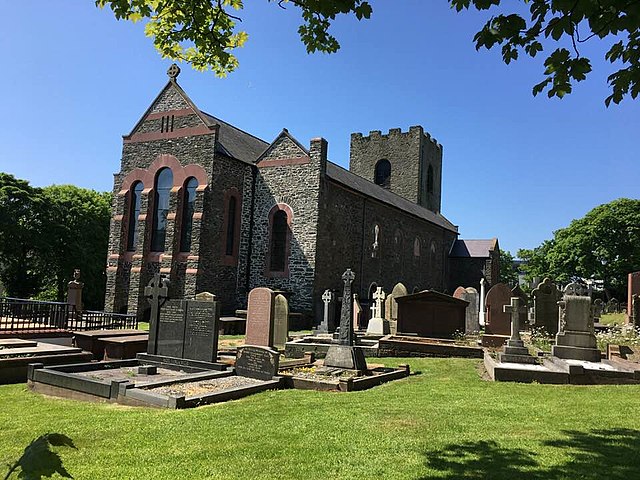
The land for the church and churchyard was donated by Phillip Moore of the Hills Estate. Originally the churchyard had no boundary wall and was open to the surrounding fields until 1809 when the title to the land was granted by John Moore, also of the Hills Estate.
Most Manx people who died in Douglas had a right to burial in Braddan or Onchan, so St George’s churchyard was known as ‘the field of the stranger’. Among the many Manx names on the memorials there are also many English names - the so-called leaders of ‘polite society’ in Douglas at the time - including more than fifty members of the British military who retired here for low taxes.
There are also many unnamed burials of those whose bodies were washed ashore on Douglas Bay after shipwreck, including the SS Minerva.
Although the churchyard was used for burials from 1784, due to a row over unpaid debts with successive bishops, it was not consecrated until 1862.
.jpeg?width=209&height=140&crop=209:145,smart&quality=75)

There are several former vicars buried here, including two Archdeacons of Man.
The churchyard is still used for the interment of cremated remains. Indeed, each time I visit the church I take a moment to pay my respects to those I remember, including a great friend and supporter and larger-than-life Manx character Willie Kneale BEM, who died in 2022.
One of those recognised on a panel in the churchyard is Samuel Harris (1815–1905), Manx advocate and philanthropist, described as ‘a tall commanding figure in constant demand as a speaker’.
He is to be admired for his true-hearted devotion to the welfare of his fellows and the untiring exertions which he put forth on behalf of the public in many spheres of activity.
He was called to the Manx Bar in 1842 and, until 1902, held several public offices including High Bailiff and Vicar General.
He was elected one of the first Douglas Town Commissioners in 1860 and played a major part in the development of Douglas. The town owed the construction of the sewage system to his efforts and the continuing threat of cholera was largely resolved.
In addition to his civic responsibilities he was chairman of the first hospital in Douglas and generously supported the Ladies Soup Dispensary and the Douglas Coal Fund.
He married Ann Bateman Craig in 1839 and they had eight children, all of whom are buried in the churchyard. There is a Harris memorial window inside the church.
Next is Nelly Brennan (1792–1859), described as ‘the best mangle woman in town’.
Orphaned when young, Nelly underwent a religious conversion at one of the 6am services for working people held at the church from 1809.
She earned her living by taking in washing but came to devote her life to caring for the ‘Manx poor’ and the sick of Douglas.
She was eventually appointed matron at the new hospital and dispensary in Strand Street in 1839 despite being unable to read or write.
She is best known for her courage in visiting and nursing cholera victims during the epidemics of 1832 and 1833 in homes where few others would dare to go.
A courageous lady. A power for God.
The epidemics of 1832 and 1833 were described as ‘that destructive calamity’.
When looking at this large open space, how many people realise what this piece of land really is?
Look more closely and you will see that this grassy plot is marked by a small plain cross bearing the words ‘Cholera 1832–1833’.
There are no names marked anywhere, but this space is in fact the resting place of many victims of the outbreaks of this dreadful disease which killed over 200 people.
Some were buried in other parts of the island, but most were living in Douglas. It is thought that approximately 120 victims in total were buried in St George’s.
Ten burials were recorded in St George’s burial register on August 30, 1833 alone.
The disease was almost certainly the result of poor water quality and was highly contagious.
The Isle of Man Weekly Times reported that the cholera ‘baffled all medical skill; many in good health in the morning were interred in the same evening’.
Beds and clothes of those who died were burned.
The dead were wrapped in tarred sheets - no coffins - and buried immediately.
At night in St George’s churchyard the burials took place by dim lanterns, hand-held or suspended from trees, the bodies heaped in one after another.
On December 16, 1809, the Manks Advertiser reported the loss of the ship Minerva.
The vessel had sailed from Norfolk in Virginia, USA on October 9, 1809 bound for Dublin ‘with a valuable cargo consisting of 355 hogsheads of tobacco, 100 bales of cotton and other articles’.
After a difficult crossing she reached Kinsale and then Dublin, but was forced to seek shelter in Douglas Bay on December 8.
However severe gales struck and rescue attempts with lifeboats failed.
The Minerva drifted onto the Pollock Rocks - now the site of the King Edward Pier - and immediately broke apart.
Seventeen of the 19 people on board perished.
One of the victims was a Douglas man, William McKissack, who had been engaged as pilot to guide the vessel to Dublin.
Only Captain Wheelock and the steward survived.
The St George’s burial register records that Robert Ewing, a young gentleman passenger, and 13 sailors were interred on Christmas Eve 1809 in a grave marked with a simple cross.
The remaining three sailors were buried there on January 13, 1810.
Other unmarked burial places exist for unknown drowning victims whose bodies washed ashore in Douglas on other occasions.
However the only memorial in the churchyard - a simple cross similar to the cholera cross - commemorates the unfortunate victims of the Minerva.
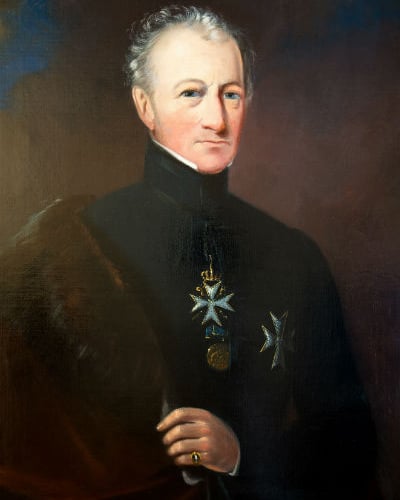
Without doubt the most famous grave in St George’s churchyard is that of Sir William Hillary (1771–1847) - ‘courage in the face of adversity’.
It is my intention to write a fuller account of him on another occasion, but for today just an overview from his resting place.
Living at Fort Anne in Douglas from 1808, his plans for a lifeboat service were formed after the wreck of HMS Racehorse in 1822 and his part in the rescue of 97 men from HMS Vigilant off Langness.
His proposals for a national institution for the preservation of life from shipwreck were adopted in 1824 with King George IV as patron and the first lifeboat stationed in Douglas.
In 1830 he took part in the rescue of the St George, which had foundered on Conister Rock in Douglas Bay.
As a result, he drove the construction of the Tower of Refuge, completed in 1832, and later the breakwater to give Douglas harbour greater shelter in 1862.
Sir William Hillary’s organisation later became the RNLI in 1854.
As Pigot’s Directory recorded in 1837:
‘The humane founder of the Royal National Institution for the Preservation of Life from Shipwreck which has been the means of rescuing upwards of 4,000 individuals from a watery grave since its formation in 1824.’
Yes - in its first 13 years.
More on Sir William Hillary on another occasion.