
Life as a devoted cat owner usually involves a few sacrifices, not least witnessing the ritual destruction of the fabric covering your favourite armchair, or the ripping up of that newly-laid carpet.
Scratching is a natural activity and plays an important part in a cat’s daily life, but it can be frustrating, not to mention costly, for an owner. It can, however, be minimised.
The first step is for an owner to understand why their cat scratches.
Claw maintenance is number one on the list: scratching enables a cat to keep their claws sharp so that they can grip when they climb, or fend off an attack from an adversary. Each claw is made up of layers of keratin and removing the old, dead layers exposes the clean, sharp new ones.

.jpeg?width=209&height=140&crop=209:145,smart&quality=75)

.png?width=209&height=140&crop=209:145,smart&quality=75)
Another important reason why cats scratch is that it enables them to mark their territory, and create a safe space.
Scratches don’t just leave visible marks they also deposit scent signals because cats have scent glands in their paws.
There isn’t a simple quick-fix to discourage a cat from scratching inappropriately, but there are options for an owner to explore.
Not surprisingly the first option is to provide a cat with designated scratching posts and mats that are more appealing than furniture, carpets or wallpaper.
Cats generally love sisal rope, untreated wood and rough fabric. An owner should place a scratching post or pad near to where the cat already scratches, e.g. next to the arm of the sofa, and sprinkle or spray it with catnip.
Vertical scratching posts are ideal because a cat can stretch as they scratch, which means the post should be tall enough to accommodate the length of the cat and have a sturdy base.
Some cats prefer horizontal scratch pads and so it’s worth owners trying one of each to see which type their cat prefers.
The next option is to deploy gentle deterrents. These include thoroughly cleaning the area that the cat is scratching to remove their scent, and then masking any remaining scent with a tiny amount of menthol.
Alternatively, an owner can buy a bespoke deterrent spray, and it’s also possible to purchase double-sided sticky pads that can be attached to the area being scratched (but note - these will, inevitably, become covered in cat hairs!). Or an owner can simply move furniture around to block targeted areas.
Nail clipping is an unacceptable deterrent, both because it deprives a cat of its naturally sharp claws and it can cause significant pain if clippers are used incorrectly; and it goes without saying that declawing is not an option (in fact, it is illegal for a vet to do this unless for very specific medical reasons).
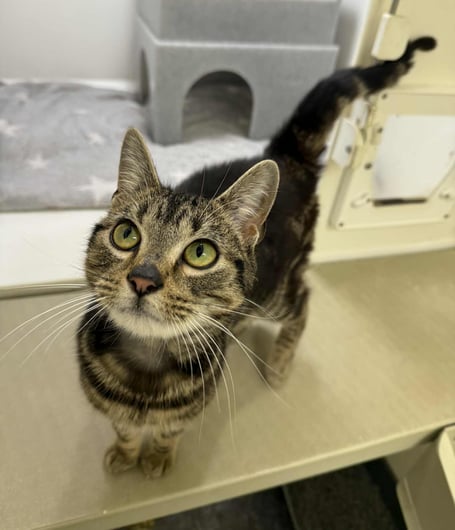
We can’t guarantee that handsome tabby Alan won’t scratch furniture, because he came to us as a stray from Peel and so we don’t know anything about his background.
However, we can be sure that he will make the most amazing feline addition to someone’s home. He’s young (probably no more than 18 months old) and is friendly and affectionate, and so he’s clearly been a much-loved family pet … but one that is no longer wanted.
He has been living ‘rough’ and eating a poor diet during his time as a stray, so his kidneys are not fully functioning at the moment. He’s been on a special renal diet since his arrival in November, and we’re optimistic that his next blood test will show a vast improvement.
If you would like to meet Alan, he’s ready and waiting for you in our cattery, along with more cats and kittens than we have ever had before at this time of year.
Don’t forget to fill out a home-finder form if you want to adopt one of them – you can do this electronically via our website, or in person at Ard Jerkyll (the ManxSPCA’s site in Foxdale).