
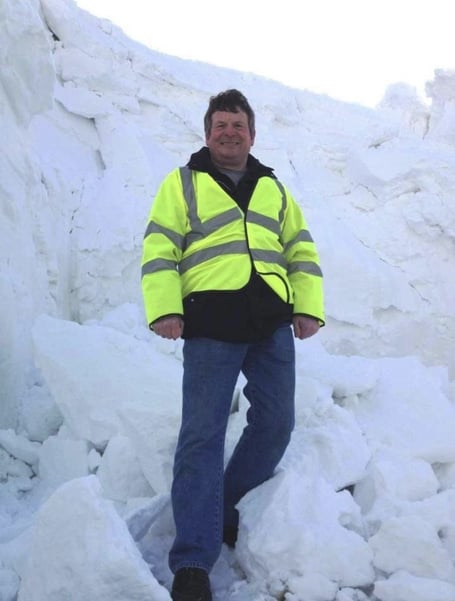
An adaptation from ‘Manx Life’ January 1979 entitled ‘The Great Snow’ referring to the winter of 1894-5 which brought the most devastating weather conditions ever experienced on our island. After hurricane force winds came the snow, completely cutting off all roads and communications. It lay well into March and as it thawed left a trail of appalling damage.
Reports refer to February 1895 and the story states the snowstorm proper began on Wednesday, though a heavy sky with a few falling flakes were apparent on Tuesday. On the following day snow fell continuously and soon the ground was covered to a great depth. As night closed in, prudent people remained indoors. Streets and roads were deserted, while the white flakes fell swiftly and silently, covering the ground to an average depth of 24 inches.
‘In the night the wind rose and formed great drifts, which made the roads impassable in many places, and there was a cessation for a time of all traffic. People were imprisoned in their homes by the masses of snow which formed against the doorways and householders had literally to dig their way out to get to work. The effort in most cases was valueless, for little or no work could be done except to combat with the snow that lay so thickly everywhere.’
‘In Douglas business was suspended on Thursday, only a few shops opening their doors. Every thoroughfare was covered to a considerable depth and at corners of the streets huge drifts, some of them 10 feet deep or more. The scene on Douglas Promenade was romantically described as one of “grandeur and loveliness” with the houses covered in snow.’
.jpeg?width=209&height=140&crop=209:145,smart&quality=75)
.png?width=209&height=140&crop=209:145,smart&quality=75)
‘Several children had narrow escapes from being entombed, and the report states, in the usual fashion of Douglas, all kinds of alarming reports were the consequence.’
A little child which had been sent on an errand was found nearly perished with cold on the Crescent, but was taken care of in the tramway shed and sent safely home. Another got into trouble at Rosemount but was rescued by Mr Craig tobacconist who heard a cry and pulled it out of a snowdrift where only the child’s hand was visible.
A vessel foundered in Ramsey Bay during the night, the wind blowing with unprecedented force. An unsuccessful attempt was made to launch the lifeboat but was launched early the next morning. Despite getting a hole ‘as big as a man’s head’ she went out in the face of a blinding snowstorm and frozen spray and rescued two men who had stood in the rigging since 10pm the previous night. There were icicles on their faces inches long and it was a miracle they stood for so long.
When the storm came on in the afternoon the children were dismissed from Maughold Central School. Most of the youngsters managed to struggle home, but two girls and six boys declined to brave the fierce snowstorm and remained in school where fires were kept burning and they were sustained with tea, bread and butter and potatoes in their jackets and served up warm with butter. A stock of coal arrived and the fire made up to last the night, a thick rug brought in and a shallow well made in front of the fire with three turned down desks, with blackboards laid across for a bed. All were warm and slept soundly throughout the night. In the morning the whole place was blocked with snow, no water was to be had for breakfast, so tea was made out of melted snow, accompanied by fried potatoes and bacon. The writer noted ‘Mr Howarth, the worthy schoolmaster, and his wife, deserve the highest praise for their care of the children in their charge’.
The news story continues ‘it is rumoured that Mr George Thomas Morris, tenant of the Slieu Lewaigue Hotel, who is well known in Douglas and elsewhere, was frozen to death on the road home. It is rumoured also that two shepherds named Jones are dead; but neither this rumour, nor that concerning Morris are confirmed.’
In the country the drifts are of enormous depth and those parts of the Isle of Man Railway which had been cleared on Saturday were either wholly or partially filled up by the storm which sprang up on Sunday morning and blew the light snow in clouds into the cuttings. The roads remain practically blocked with snow, though the intense frost has solidified the mass and given it a better surface for walking. The temperature fell to 14 degrees Fahrenheit, representing 18 degrees of frost. The southern railway line had not been cleared; indeed the cuttings on the line are so deep that the work of clearing them was practically impossible, and it was disheartening to find all the work lost because of the snow. Between Castletown and Ballasalla the drifts were 14 feet high.
In Kirk Michael the depth of the snow was strikingly shown by the story told by the clergyman. He had to travel from Michael to Peel in an open boat, with his wife. He said he walked along a snow drift to the top of the church in Michael, and sat on the roof.
Half-melted snow was tipped into the harbour in Douglas which floated about the harbour and the quantity had to be restricted as there was a danger of the harbour getting too clogged to permit vessels moving. The ferry at the Tongue was run with difficulty as the water was as thick as treacle with the snow. Swarms of seagulls bustled about looking for stray bits of food. Sometimes their feet became frozen to the mass and one seagull was so frozen that it was carried to the fire at the gasworks and thawed out.
Skating was enjoyed on the River Dhoo at Kirby for half a mile on the frozen river courtesy of the Drinkwater family at Kirby Estate. The ice was 4 or 5 inches deep. A roadway was cut from the lodge near the Quarter Bridge to prevent people having to wade knee deep through the snow to get to the frozen river.
Mr Stewart who practised at the Manx Bar journeyed on foot to Douglas from Sulby Bridge, stopping at Peel on the way. For the whole distance the road was level with the hedges. His outfit consisted of waders and for a walking stick a good stout broom handle. His provisions consisted of a bag of biscuits and a bottle of whisky.
In the capital, Castletown, they had no bread left and no yeast. Mr Beck volunteered to walk to the south with a 15lbs bag. He found travelling on the hedge tops with care the best way but despite this more than once floundering on the uneven surface with hidden obstacles.
Birds and animals were in great distress with many lying dead in the snow. The hares and the rabbits were to be seen in the middle of fields which had been swept of snow trying to feed on the turnips. In Sulby the snow was as high as the roofs of the houses.
I am thinking of doing a follow up next week of more recent winter snow events such as 1962-3, 2010 and 2013 which I recall clearly as then Minister for Infrastructure… please get in touch with any memories you have via the usual channels as soon as you can.