
The most common reason for the public to contact the MSPCA is because of a neighbour’s dog that is barking continuously.
Our usual response is as follows: a dog barking is not necessarily a sign that a dog is distressed, and that as long as a dog has water and shelter then its basic needs are being met.
This does not mean that a dog being left alone for hours is something we condone, far from it, and we would always stipulate that the maximum amount of time a dog should be left is no more than four hours.
We always encourage a concerned neighbour to speak to the barking dog’s owner if this is feasible, and let them know about their dog’s behaviour, because they may be blissfully unaware if the barking only takes place when they’re not at home.
There are many reasons why a dog might be barking, whether to express emotions or signal needs, or they may simply yap to show frustration; while on other occasions it’s over nothing – they bark simply because they can!
There are training steps that an owner can take to encourage their dog not to bark incessantly, but these must be applied and practiced consistently and over a period of time.
The way an owner reacts to their dog’s barking is often the first incorrect way to approach the problem, with a common reaction being to shout at the dog with a ‘stop it now’ or a ‘pack it in’.
Shouting commands over the top of the dog is simply mirroring their behaviour – the owner’s body language is the same as the dog’s and so, in the dog’s mind, the owner is barking at the same thing they are barking at.
Rather than shouting, an owner should step between their dog and the thing that they’re barking at to break eye contact with it. Being in front of the dog, facing them, makes it clear that the owner is communicating directly with their dog.
Next, the owner should stick with their choice of command – it could be ‘quiet’ or ‘enough’ or any other appropriate word, but it needs to be consistent. Then the owner needs to wait for a small gap in their dog’s barking, even if this takes some time, and then step in front of them and use the chosen command. By waiting for a gap the owner is associating the command with the dog actually being quiet, rather than ‘pairing’ it with barking.




The owner should not raise their voice, but should use a calm and authoritative tone, and repeat the command if necessary (especially in the early days of training).
It is very important for the dog to associate compliance with the command with a positive reward, like a dog treat or small biscuit, to reinforce good behaviour.
A top tip is to offer this reward to the dog in the opposite direction to what they were barking at, which encourages the dog to disengage and builds a value in coming away from the thing they were barking at.
So, now you have the training technique, would you like to adopt a dog who likes a good bark, especially when he meets other dogs when he’s on lead, and who would be an excellent ‘pupil’?
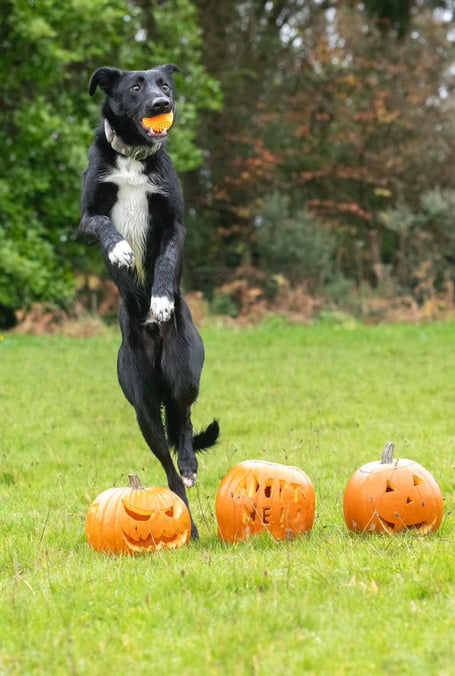
The dog is question is an eight-month-old lurcher cross collie pup called Blue, who has only benefitted from some basic training thus far. As you would expect from Blue’s breed background, he is super energetic and very excitable, and so he needs an active new owner who can keep up with him.
Blue has a very strong prey drive and so he can’t live with cats or small animals, but he could be the perfect addition to a family with children old enough to cope with his bounciness. In fact, his jumping ability and ariel acrobatics are really quite spectacular.
Blue is the most affectionate and friendly dog around people – he’s funny, and he likes to please, and investing in his training will ensure that he becomes an incredible addition to a household.