

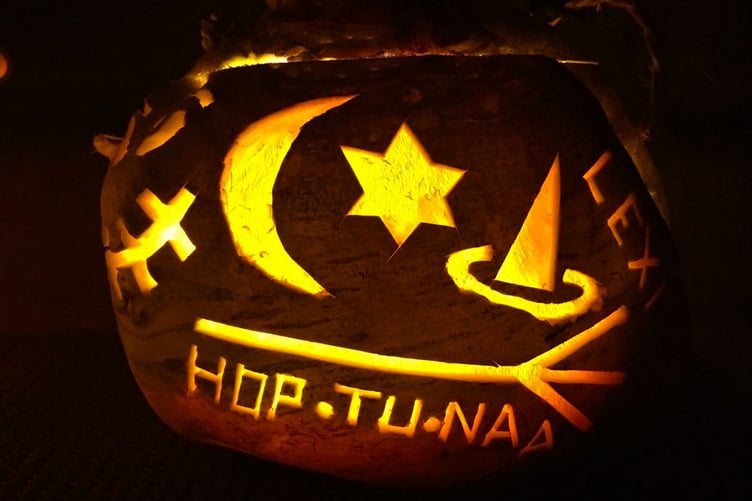
Culture Vannin’s Manx language development officer Ruth Keggin Gell explores the fascinating origins of the name of Hop Tu Naa...
The clocks have gone back, the nights are drawing in, and November is almost upon us. With spooky decorations gracing windows and doors of homes and shops, I thought it would be the perfect time for us to explore some Manx names and calendar customs for this time of year.
‘Hop tu Naa’ is the oldest continuously existing tradition on our Island. Celebrated on 31st October, one of the key features of Hop tu Naa is the ‘moot’ - a Manx-English word for turnip - which is hollowed out, decorated, and used as a lantern.
We have a range of popular traditional songs in Manx and English; a folk dance still practised today; and some unusual customs and superstitions that link back to ancient Celtic beliefs about this time of year.
But what about the name itself?
The exact origins of ‘Hop tu Naa’ are uncertain, and various spellings of the name were recorded in the 19th and 20th centuries. Some interpretations range from it being a garbled version of ‘Shoh yn oie’ - Manx for ‘this is the night’ - through to it being linked to ‘Hogmanay’, the Scottish name for ‘New Year’s Eve’.
To me, the first explanation feels tenuous at best, and the origins of the word ‘Hogmanay’ are obscure - it could have Greek, French, Norse or Gaelic roots!
I’m most convinced by the theory that 31st October became known as ‘Hop tu Naa’ thanks to the use of these particular vocables - words used for their sound rather than meaning - in our traditional songs that celebrate the custom.
There are, however, much older Manx names for this time of year, and it is these words that remind us of our deep cultural connections with Ireland and Scotland.
The three Gaelic languages of Irish, Scottish Gaelic and Manx share a similar name for November - ‘Samhain’ / ‘Sauin’ - all roughly pronounced like ‘SOW-in’.



This name is associated with an ancient festival at the beginning of November, which marked the end of the summer half of the year and the arrival of winter. This seasonal turning point was important to communities whose lives depended on the harvest, animals and changing weather.
From the Manx word ‘Sauin’ we get ‘Souney’ and ‘Houney’ (pronounced: SOW-nuh / HOW-nuh).
These words can be found in names like ‘Mee Houney’ - literally ‘the Month of November’ - and the traditional name for 31st October: Oie Houney - essentially ‘Sauin Night’.
Another traditional name for November is ‘Yn Chied Vee jeh’n Gheurey’, and this quite literally spells out that November is considered ‘the first month of the winter’ in the Manx calendar.
This shift from summer into winter was, and still is, regarded as a ‘thin’ time of year, with a veil-like boundary between the human world and the spirit world.
An atmosphere of uncertainty surrounds unsettling stories and curious customs.
Possibility is also in the air and thoughts of divination: you might like to read about other Manx folklore customs such as baking ‘soddag valloo’ (dumb cake) - an intriguing, yet disgusting, way to find out who you might marry!
However you choose to spend 31st October, I hope that you’ll consider carving a moot, learning a traditional song via manxmusic.com, finding out more about Manx calendar customs on culturevannin.im, or simply referring to the day as ‘Hop tu Naa’: it’s all of ours to celebrate and carry forward!
Comments
We've recently changed our login process. If you have an account for commenting, you will need to re-register on the login window.
This article has no comments yet. Be the first to leave a comment.