
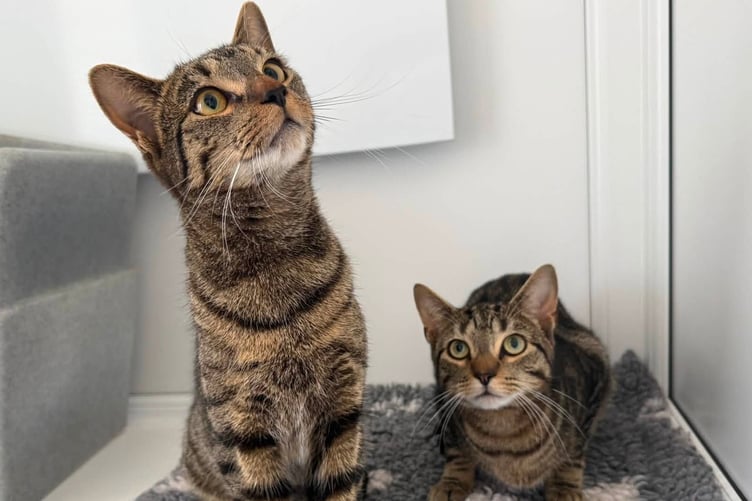
We often say that a ‘single cat is usually a happy cat’ because cats are not innately sociable creatures like dogs.
They evolved as solitary hunters and the presence of another cat can be quite stressful.
If one cat from an elderly pair sadly passes away, it may be tempting to get the remaining cat a new friend.
It’s unlikely that these cats will form a bond with each other, even if the new cat is a kitten.
You might hope that a young cat will bring a new lease of life to the older cat, but a bouncy, inquisitive kitten has much higher energy levels and needs than even the fittest and most active of more senior cats.
The average older cat is looking for a quiet life with no competition for creature comforts like sitting on the boiler or having prime position on an owner’s bed.
They could even blossom after the demise of their previous companion and enjoy having their owner all to themselves, and being able to eat their meals at a leisurely pace without the fear that another cat will steal their food.
Adding another pet to a household is one of the most common reasons why a cat becomes stressed. The signs of stress can be very subtle, and include a cat simply licking their nose, often combined with dilated pupils and ears turned out to the side.
More obvious symptoms include exaggerated gulping, repeated swallowing, urinating inappropriately, destructive behaviour such as scratching wallpaper or furniture, and blocking the other pet’s access to shared spaces.
Sometimes this stand-off can be fairly passive, but it can also develop into a tooth and claw ‘argument’.


.jpeg?width=209&height=140&crop=209:145,smart&quality=75)
.jpeg?width=209&height=140&crop=209:145,smart&quality=75)
Other physical signs of stress are cystitis, and bald patches in a cat’s fur which have been caused by overgrooming.
Vets say that these are very common cat health issues, and so stress is clearly not being understood and managed by a significant number of owners.
Conversely, a happy cat will often display the following behaviours: sleeping in exposed places such as windowsills or table tops (rather than hiding away); twitching in their sleep (which is usually a sign that they are dreaming in deep sleep); and stretching very slowly, often exposing their underbelly (a sign that in showing their vulnerability they feel safe).
To minimise cat conflict, it is absolutely essential to have one set of resources (food and water bowls, beds, litter trays, scratch posts, etc) per cat, ideally with an extra one for added choice.
Ideally these should be spread out around the house, and the larger the house the better.
Cats from the same litter are not guaranteed to remain bonded (due, in part, to the fact that they may not have the same fathers), and mothers and their offspring don’t always get along with each other once the kittens are weaned.
If you want a pair of cats who come with a ‘bonded guarantee’ the look no further than lovely one-year-old brothers, Flash and Maui (who is a slightly darker tabby).
They came to us because their previous owner moved house and couldn’t take them along with her, which must have been heart-breaking because the boys are confident and affectionate cats and have clearly been much loved.
They are used to having outdoor access and so this will be a requirement in their new home, which can’t be within a three-mile radius of Anagh Coar in case they wander back to familiar territory.
We’re confident that Flash and Maui will make the most purr-fect addition to a new family, with or without children and other pets in the household.
As the saying goes: ‘A house is not a home without a cat’, and so it stands to reason that two cats (provided they get one with each other of course) make for an even better home.