
The month of May is a beautiful one: the blossom is in full bloom; the spring sunshine is getting warmer; and we have two bank holidays to enjoy.
But, best of all, May sees the return of welcome visitors in the form of swallows, swifts and house martins. Can you tell which is which?
Swallows have long tail streamers, red throats and glossy blue-black backs.
They are known as the ‘bird of freedom’ because they cannot endure captivity and will only mate in the wild.
.jpeg?width=209&height=140&crop=209:145,smart&quality=75)

.jpeg?width=209&height=140&crop=209:145,smart&quality=75)
They can often be seen perched on overhead wires in small groups, with their tails stretched out below them, and they have a chattering call that often gives them away before you see them.
Swifts spend most of their lives on the wing – they catch insects in the air, and drink by swooping low over water to take a sip.
They even sleep whilst flying (the only bird known to do this), and they have the perfect bodies for being air born for so long, with their long wings and slender bodies.
Nor are they encumbered by long legs (in fact their legs are so short they can’t take off from the ground) or tail feathers, which is the best way to tell them apart from swallows.
In fact, the swift is not related in any way to the swallow, and in terms of taxonomy it is related to another highly aerial bird that it looks nothing like – the hummingbird.
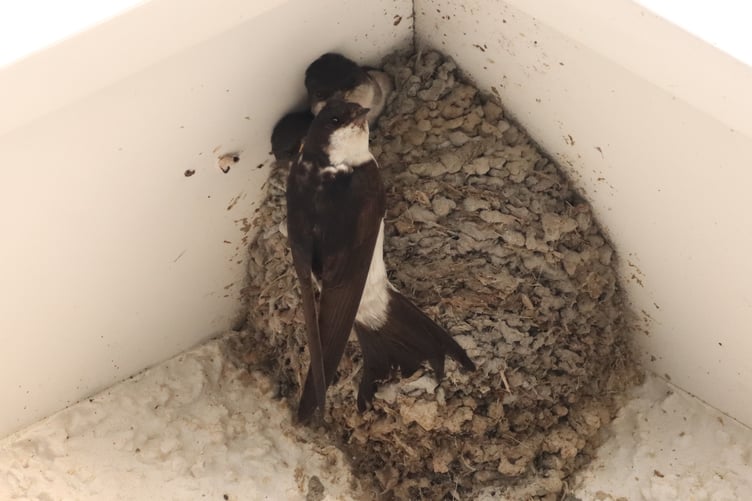
The house martin can be identified by its slightly curved tail, and by its white underbelly and rump which can just about be glimpsed as the bird flashes by in its mission to catch insects.
Swallows, swifts and house martins have to overcome starvation, exhaustion and storms in order to return to our shores at this time of year, in a journey lasting about six weeks.
They fly hundreds of miles from Southern Africa at a cruising speed of 22mph, often covering more than 200 miles a day.
Not bad going for such small birds. They either cross the Sahara or navigate their way along the coastline of Africa. Once they’ve survived this challenge they begin their journey over Spain, climbing high over the Pyrenees and travelling through Western France before hitting UK soil.
Flying at a high altitude of 10,000 feet (the same as a small plane) seems to help them navigate whilst they are asleep, using wind drift and automatically adjusting their flight to stay on a specific course.
Swallows, swifts and house martins traditionally nested in cliffs, caves and hollow trees, but they have adapted to urban environments and they will make their nests under the eaves of buildings.
A swift’s nest is built within a small crevice or hollow using feathers and plant matter; and swallows and house martins carefully craft their cup or oval shaped nests out of mud.
Sometimes these nests break apart, or sometimes a hatchling can slip over the edge. Our recent hot summers have meant that soft mud is harder to come by, and modern plastic soffit boards make it difficult for mud to stick, and so nests are more likely to crack.
If you find a hatchling on the floor and you can’t put it back in the nest, pop it in an empty margarine tub and place it as high up as possible (out of the reach of cats) so that the parents can continue to feed it.
Another way to help is to place artificial nests (available from various suppliers such as www.nestbox.co.uk) near to where naturally built ones are situated.
Swallows, swifts and house martins have a strong tendency to return to the same nesting site every year, and they often repair and refurbish old nests.
By returning to familiar areas they increase their breeding success, further highlighting the phenomenal natural skills these amazing birds possess.