
As we look towards a new year, it’s encouraging to see that the English government is planning to introduce more robust animal welfare legislation in its ‘animal welfare strategy for England’ which was published last week.
Whilst this doesn’t directly affect Isle of Man law it will influence our approach to animal welfare in the longer term, particularly where coordinated action is required.
The proposed changes affect domestic, commercial and wild animals and are wide ranging.
Highlights include the licensing of all dog breeding (instead of just for people who breed three or more litters a year, as is the case now); the banning of electric shock collars (please note that you can still sign the ManxSPCA’s e-petition calling for such a ban at www.change.org/ban-electric-shock-collars-IOM); the phasing out of cages for all laying hens (approximately 20% of the UK’s egg production comes from hens who live in ‘colony’ cages); and putting an end to trail hunting as early as 2026.

.png?width=209&height=140&crop=209:145,smart&quality=75)
Of all the proposals contained in the strategy, the plans to ban trail hunting have attracted the most media interest.
Trail hunting was created in response to the 2004 Hunting Act which was intended to end the hunting of wild animals with dogs.
There is much debate as to whether trail hunting encourages the ‘accidental’ killing of wild animals (foxes and hares, in particular) given the dogs follow an animal-based scent trail.
The use of such trails undoubtedly increases the risk of the scents of wild animals, and sometimes pets, being picked up by the dogs who then chase down and rip apart their quarry.
Drag hunting existed alongside fox hunting for hundreds of years and is, surely, the way forward – allowing the hunts and their traditions to continue without injury to wildlife.
Drag hunting involves a human scent trail, with one or more runners setting off shortly before the hounds in an attempt to outwit them.
The Isle of Man had a very active drag hunt until earlier this year, when the hunt stables closed, and the Boxing Day meet was a well-attended festive tradition in Castletown square. Let’s hope it returns.
The Isle of Man has also been ‘ahead of the game’ when it comes to the hunting and shooting of hares, in that it already has a ‘close season’ (February 1 to September 30) when hares cannot be killed during their breeding months.
The UK strategy paper is seeking to introduce such a ‘close season’ which will lessen the likelihood of leverets being orphaned and left to die, and stem the decline in the hare population (the Game Conservancy Trust estimates that a February hare shoot can remove 60% of the breeding stock).
Another concerning statistic is that it’s estimated that more than 200,000 hares are shot every February and March in England in organised, commercial shoots often attended by foreign nationals. It’s a lucrative sport.
On the Isle of Man it is still legal to shoot a mountain hare without a licence, leaving it unprotected, whereas the common or brown hare must be shot with a license.
The MSPCA would like there to be a heavier burden of proof for hares to be considered as pests, and a much higher cost for licenses.
It may surprise, and even shock, some readers to know that 12 hares were shot on Ronaldsway airport land during 2024 as part of its aircraft safety culling programme – see Freedom of Information request number 4598981. A total of 88 rabbits were also killed as part of this programme.
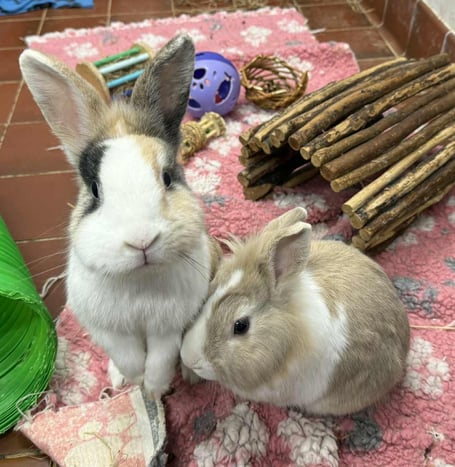
But in happier rabbit news, we have several pairs of bunnies looking for new homes, including Sophira (two) and Sven (one).
They came to us separately for rehoming because they were fighting with their original partners, but once they were neutered they went through a bonding process with each other and now they are friendly and sociable.
If you would like them to hop into your life in 2026 then please fill out a home finder questionnaire on our website.