
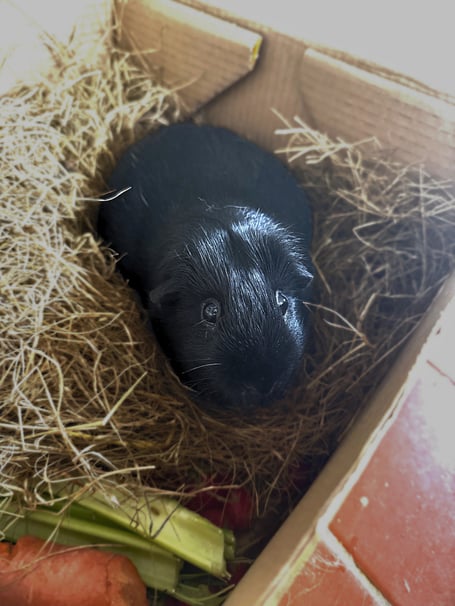
ManxSPCA general manager Juana Warburton explains why rabbits and guinea pigs are far from being ‘easy first pets’ and introduces adorable Percy, who is looking for a new home....
We think it’s a good thing that rabbits and guinea pigs seem to be less popular as pets (and therefore we see fewer coming in for rehoming) than they were, say, ten years ago when you could easily purchase them in pet shops. They were promoted as a ‘great first pet’ – simple to care for, relatively cheap, and easy to handle. Nothing could be further from the truth.
Undersized hutches were routinely sold alongside their prospective ‘inmates’, and whilst the luckier rabbits and guinea pigs had large outdoor pens to run around in and hutches they could fully stand up in, many did not. A domestic rabbit’s life expectancy is at least ten years, and a guinea pig’s is six, but poorly housed animals die well before they should do. Not only do these animals require quite sophisticated accommodation and exercise set-ups, their living space also needs to be cleaned out daily – a chore that quickly loses its appeal, even with the keenest of children, especially in the winter months.
Rabbits should be spayed/neutered, and vaccinated annually against myxomatosis and HRD, and so they are not cheap to maintain. Rabbits and guinea pigs need to be given fresh hay daily, and an appropriate diet including fresh vegetables. Guinea pigs are one of the few animals (humans are another) that cannot manufacture their own vitamin C, and so they need to get it from their food. They should be given a vitamin C supplement as well as fresh vegetables.
Young children should never be left alone to handle rabbits or guinea pigs. If either species is picked up incorrectly, it can cause pain and even damage the spine – this is bad enough for the animal but it may also result in the child being bitten or being badly scratched (a rabbit’s back legs can do a lot of damage).
Another myth about these pets that needs to be dispelled is that a rabbit and a guinea pig make good companions for each other. They are, indeed, highly social creatures but they need to be paired with their own species; and in the case of guinea pigs they need to be kept as same sex pairs to prevent unwanted litters. Females happily co-exist, as do males.
We have an adorable young guinea pig with us for rehoming at the moment. He’s called Percy and he needs another boy to call his best friend, along with a knowledgeable and committed new owner.
Given we’re promoting a guinea pig this week, exploring the species’ origins as pets takes us on quite a journey: their wild ancestors lived in high-altitude grasslands in South America, and evidence suggest that their domestication began around 5,000 BC when the indigenous people of the Andes kept them as livestock for food. The Inca people used them in religious ceremonies; and folk medicine traditions (such as using guinea pigs to ‘absorb’ illness) continued into modern times.
Guinea pigs arrived in Europe in the 16th century, most likely transported by Spanish, Dutch and English traders after the Americas were explored. They were considered to be exotic and, as such, they were kept as status symbols, with Queen Elizabeth 1 being an early enthusiast.
The name ‘guinea pig’ is thought to come from their 16th century price of one guinea each, with the ‘pig’ part possibly attributed to their squeals. They have eleven different sounds: for example, they make a distinctive wheeking or whistling type of sound, often in anticipation of being fed. They also purr when they are happy; but if they’re upset they will hiss or whine, and if they’re scared they will shriek.

.jpeg?width=209&height=140&crop=209:145,smart&quality=75)

.jpeg?width=209&height=140&crop=209:145,smart&quality=75)
Given their southern hemisphere origins, it should come as no surprise that guinea pigs don’t cope well in cold, windy or damp conditions. Temperatures below about 10 degrees increase the risk of illness, particularly respiratory infections. They need to be moved indoors in the winter months, ideally into a utility room, porch or conservatory, and placed back in their outdoor runs for a few hours every day, weather permitting.
Proof, if needed, that these adorable creatures are definitely not easy first pets.