.jpg?width=94&height=94&crop=1:1,smart&quality=75)

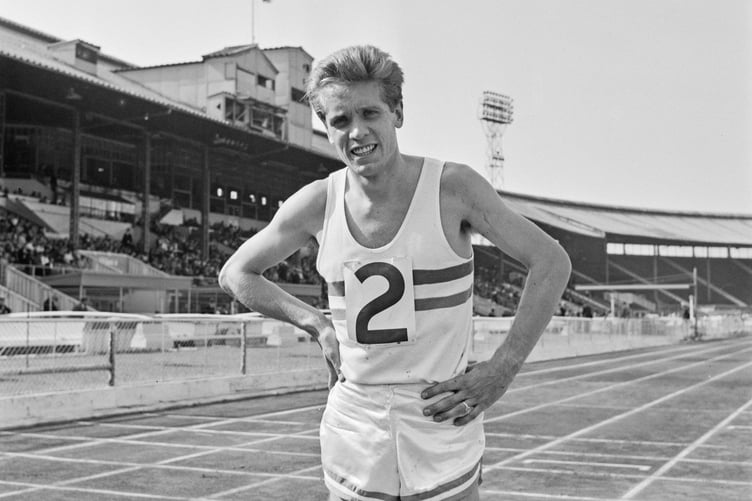
Olympic Games steeplechase silver medallist Maurice Herriott, a long-time island resident, died on Monday at the age of 86.
Born and raised in Great Wyrley, South Staffordshire, his potential as an athlete was spotted before he left school by a man named Tom Heeley who became his coach.
‘His only stipulation was that I gave it my all - he taught me everything, but most of all he showed me how to hurdle from nothing,’ said Maurice.
A handy footballer when he was young, athletics took over in his late teens and he rose through the ranks at club and national level as a strong steeplechaser.
Representing Sparkhill Harriers he became the British 3000 metres steeplechase champion after winning the British AAA Championships title in 1959 and claimed two more AAA titles in 1961 and 1962.
He represented England at the 1962 British Empire and Commonwealth Games in Perth, taking the silver medal in the steeplechase.
Selected for the Olympic Games in Tokyo two years later he won his qualifying heat on a cinder track in an Olympic record time of 8min 33.0sec. But that lasted only half an hour until a Russian athlete bettered it by more than one second.
Legendary Belgian Gaston Roelants, who ultimately won the gold medal, was four tenths of a second slower than Maurice in the heats in what were damp and clammy conditions, but it would all change 24 hours later in the final.
Roelants made the better start and ran the perfect race to win in a time of 8m 30.8s, lowering the Olympic record for a third time in two days.
Herriott again finished strongly, but he was 1.8 seconds adrift at the finish, with Russia’s Ivan Belyayev third in 8m 33.8.



Away from home six weeks for the long return trip to the Far East, his memories of being in Tokyo were mostly happy ones: ‘The team all got on extremely well, but it was tough being away from home for so long.
‘We agreed that if any of us were fortunate enough to win a medal, we would not celebrate until we had all completed our events.
‘The only occasions we left the Games campus was to train at the track, which was a bus ride away.
‘The Japanese people were very accommodating and helpful, but everything was highly regimented and run to a strict time schedule - even the buses.
‘When we did finally go out socially, it was for a meal with a drink, but we had to be smartly dressed with blazer and tie.’
Voted British Male Athlete of the Year in 1963 and 1965, Maurice also travelled to the 1966 Commonwealth Games in Jamaica where he was just outside the medals in fourth, and the 1968 Olympics in Mexico City where he was eighth.
He met his wife-to-be, Marina Coffey of Port St Mary, when working as an engineer at Birmingham Small Arms (BSA). The pair were married prior to the Tokyo Games and their eldest daughter Michelle was born in Birmingham.
The family moved to the Isle of Man to live when the BSA factory closed down in the early 1970s and their other two daughters, Andrea and Lisa, were both born here. He latterly lived in Port Erin.
Comments
We've recently changed our login process. If you have an account for commenting, you will need to re-register on the login window.
This article has no comments yet. Be the first to leave a comment.