

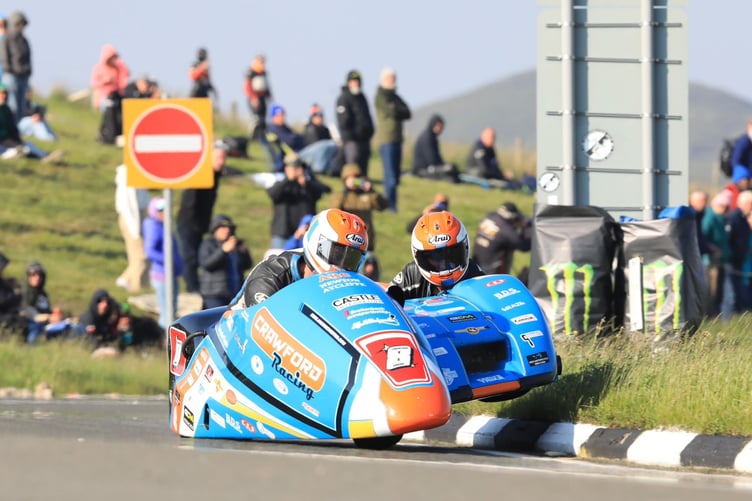
Sidecar teams and competitors have raised concerns about changes to the class at next year's Isle of Man TT Races, with several indicating they do not currently intend to take part in the 2027 meeting.
The reaction has followed the publication of the new technical regulations, which introduce a different engine formula and a series of changes to the construction and specification of competing outfits.
Among those to have spoken out is Team ARC | Crawford Racing, which has confirmed it does not plan to compete at next year's event.
Lee Crawford and passenger Scott Hardie finished third in both TT 2025’s races.
In a lengthy social media statement, the team said it had concerns about the 'significant' changes being introduced and the time available for competitors to adapt their machinery.
It said the move to a British Superbike (BSB) Sportbike-derived engine formula and controlled electronics package represented a 'fundamental departure' from the technical rules under which existing teams had invested in their outfits.
Team ARC said it recognised the need for sidecar racing to evolve, but argued that changes of this scale should involve the people competing in the sport.
'Meaningful change must involve the people who compete, invest and contribute to that future,' the statement said.
The team added that it was not opposed to improvements to the class, but called on organisers to reconsider the immediate introduction of the regulations and hold further discussions with existing competitors.
It also raised questions about the financial implications for teams, the lack of a transition period and the extent to which competitors had been represented in the decision-making process.



The statement concluded by confirming: 'We will not be competing at the event or participating in any of the changes that are required to compete in the event.'
However, Team ARC said it was working with the Southern 100 to help find and support a sustainable future for sidecar racing.
It is not the only team to have expressed reservations about the new direction.
Gibson Racing has also said it does not currently plan to compete at the 2027 TT, explaining that it had already committed to a particular direction for next season.
In an update, the team said it 'can't justify or afford another engine change, especially with all the additional modifications that would come with it'.
Driver Michael Russell, who competes in solos and sidecars, has also indicated he intends to be absent from next year's races.
He described the planned Sportbike regulations as 'way outside my financial remit' and said, in his opinion, the new rules were 'not a cost effective solution for the sport'.
The strength of the reaction comes after the sidecar class was suspended for the remainder of this year's TT following safety concerns.
The plans included a move away from the existing 600cc Supersport-based formula towards Sportbike engines, alongside changes to the technical regulations and race format.
The return was also presented as part of a three-year commitment to the class, running up to and including 2029.
But what exactly is changing, and why has it prompted such concern among competitors?
A new engine formula
One of the biggest changes is the move away from the engine rules used at the 2026 TT.
Under this year's regulations, teams could use production-based engines of up to 600cc for four-cylinder machines, 675cc for three-cylinder engines or 900cc for parallel twins.
Engine, gearbox and clutch modifications were permitted, provided the bore and stroke remained as found on the production-based engine. Teams were also free to use their own engine control units (ECUs) and wiring looms.
For 2027, only engine platforms homologated for the BSB Sportbike category and meeting its technical specifications will be eligible.
The new rules require engine parts to remain as homologated, apart from modifications expressly permitted by the relevant authorised parts list or the TT regulations.
That means teams will have considerably less freedom to develop and modify their engines than under the previous formula.
The regulations also introduce restrictions on engine positioning. The engine must be mounted within 25 degrees of its position in the original solo motorcycle, with the previously used 'lay down' arrangement no longer permitted.
For existing teams, changing to a different engine platform could mean more than simply purchasing a new motor.
Team ARC has warned that the change could require substantial alterations to engine installations, exhaust systems, airboxes, engine mounts and associated components.
Controlled electronics and new fuel requirements
The electronics package is another significant change.
Previously, the ECU and wiring loom were free, allowing teams to use their own systems.
Under the 2027 regulations, the ECU, dashboard, harness and left-hand switchgear must follow the Sportbike Control Electronic System, using the specified SPTBK_A ECU.
Solo Engineering is named as the sole official supplier of the control electronics system.
There is some flexibility over the wiring loom itself. It does not have to be manufactured by Solo Engineering, but it must follow the exact wiring schematic for the chosen engine model. A Solo loom can also be used and modified to fit the particular outfit.
The regulations also place restrictions on additional electronic modules and specify which sensors must be connected directly to the ECU.
Fuel arrangements are changing too.
The 2026 rules required sidecar teams to use 97/99 RON fuel purchased from an Isle of Man petrol station. That requirement remains for 2027, although the new regulations make provision for imported pump fuel to be sampled and tested before the first practice session.
More significantly, all outfits must now be fitted with an FIA-approved fuel cell meeting or exceeding FT3 approval.
It must be housed in an enclosure made from aluminium at least 1.5mm thick or steel at least 1mm thick. Carbon fibre composites cannot be used for the enclosure, and the fuel tank must be independently protected from the ground.
The new rules also retain requirements for a non-return valve on the tank breather pipe, which must discharge into a catch tank with a minimum capacity of 500ml.

Heavier outfits and changes to bodywork
There are also changes to the minimum weights.
Under the 2026 regulations, a sidecar outfit had to weigh at least 220kg.
For 2027, the minimum weight of the outfit, known as the 'hard weight', increases to 245kg.
The new regulations also introduce a minimum combined weight for the driver and passenger, known as the 'soft weight', of 160kg.
Together, those requirements create a combined minimum weight of 305kg for the outfit and crew.
The rules allow ballast to be used to meet the combined minimum, but only with the express approval of the event’s technical director. The outfit itself must never fall below the 245kg hard minimum.
Bodywork and driver visibility are also addressed in the new regulations.
Under the 2026 rules, the driver had to be completely visible from above, with the exception of their arms, legs and feet.
The 2027 regulations go further, requiring the driver to be completely visible, apart from their forearms, from the side opposite the sidecar as well as from above. They also explicitly state that the driver's legs cannot be enclosed.
The new rules prohibit aerofoils and spoilers, as well as splitters, air diffusers and vortex generators of any kind.
Other requirements include the use of an airbox with a single circular intake restricted to a maximum internal diameter of 100mm.
What does it mean for the races?
The technical changes are accompanied by alterations to the race format.
Both sidecar races at the 2027 TT are due to be reduced from three laps to two, with changes also announced to the qualifying arrangements.
For fans, that means shorter races in a class which has traditionally provided some of the most distinctive action around the Mountain Course.
For competitors, the immediate concern is how to meet the new requirements in time for next year's event.
The regulations do not require every team to replace its existing chassis, but the changes to the engine, electronics, fuel system and other components could still mean substantial work to outfits built around the previous formula.
Teams have also questioned the amount of time available to source parts, carry out modifications and test their machines before the event.
With the new regulations now published in November and the TT taking place in May, competitors have a single winter to prepare.
Team ARC has argued that the changes should have been introduced with a reasonable transition period, while Gibson Racing has pointed to the additional expense of changing engine and adapting its existing machinery.
The Southern 100 has also featured in the debate.
This will allow competitors to continue using standard Supersport 600cc engines.
That raises a further question for teams which compete across multiple road-racing meetings: whether the cost of building to the new TT specification can be justified if the same outfit cannot be used under the rules at other events.

Response from the promoters
The Department for Enterprise, promoters of the TT, have commented on the concerns raised by competitors.
A spokesperson said: ‘The direction of the revised Sidecar technical regulations for the Isle of Man TT Races was announced on 9 September, following the Sidecar Sustainability Review, which drew on contributions from competitors, constructors and technical experts. The detailed technical requirements were subsequently published on 11 November.
‘We recognise the commitment and investment that competitors and teams have made to Sidecar racing, and appreciate that these changes represent a significant adjustment.
‘Safety has been and continues to be the overriding consideration throughout this process, and the revised regulations establish the technical framework for the safety-led and controlled return of Sidecar racing to the TT Mountain Course in 2027.
‘The TT's position remains as outlined in the September announcement, which is available here: https://www.iomttraces.com/latest/news/tt-sets-out-new-future-for-sidecar-racing/’