
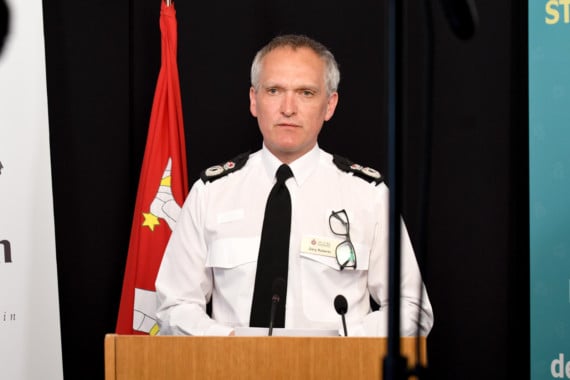
More police enforcement action was needed than first thought at the start of the Covid-19 lockdown.
Chief Constable Gary Roberts, writing for the website Policing Insight, has outlined the challenges the island’s police force have experienced during the pandemic.
Public compliance was largely as expected, with the vast majority adhering to the regulations.
Mr Roberts said that the public ’were highly vocal in their praise for the efforts of the police’.
.jpeg?width=209&height=140&crop=209:145,smart&quality=75) 13 arrested already for drink or drug driving as festive police patrols step up
13 arrested already for drink or drug driving as festive police patrols step up 'Of course I was drunk': Fine for man seen stumbling across roads
 Three accused of being part of a human trafficking gang on the Isle of Man
.jpeg?width=209&height=140&crop=209:145,smart&quality=75) Dad jailed for nine years after trying to smuggle drugs worth up to £74,000 on ferry
Dad jailed for nine years after trying to smuggle drugs worth up to £74,000 on ferry
He added: ’However, people whose lives are chaotic in normal times and who offend, or who live in a thoroughly anti-social way, behaved as if nothing has happened.
’As a result, more enforcement action was needed than had been expected.
’In the course of four weeks over 50 people were arrested and charged with breaching the emergency legislation and many of them, including people who had tested positive for the virus, were imprisoned.’
Mr Roberts added that the police had followed the approach taken by the National Police Chiefs Council of ’engage, explain, encourage and explain’.
He outlined that the island’s police changed its configuration to create special Covid response teams, created home working using technology for non-essential and vulnerable staff, dispersed its workforce across the island and aligned itself to efforts being made across the public service to tackle the spread of the virus.
These efforts included creating a special cross-agency Covid-19 call centre, working with testing and contact tracing teams and playing a part in strategic planning.
Since the relaxation, the police have moved to focusing on four things: the policing of illegal gatherings; responding to breaches of the law by infected or potentially infected people; the policing of the new speed limits and dealing with criminal offending, particularly drug-dealing through the postal services, domestic abuse and digital offending.
He added: ’The biggest issue is this: imposing a lockdown is actually pretty easy. It is simple, unambiguous and understood by most of the public. Easing a lockdown is considerably harder to do.’
Mr Roberts also outlined some of the trickiest issues his officers have faced:
â?¢ Messaging from the government: the changes need to be simply and clearly articulated. If they are not, problems arise.
There also needs to be ample time between government policy on lockdown being made and the changes becoming effective.
â?¢ Call handling: call volumes will initially increase as lockdown changes. There are two drivers: people don’t necessarily understand the changes and many people are highly anxious about the virus and they feel threatened by the changes. They then seek advice or support from the police, or they seek to report people they believe to be breaching the new laws.
â?¢ Law versus guidance: it is critically important that the law is tied tightly to government guidance. If it isn’t, then the public expect the police to do things that we cannot do, or which we do not see as being important. Ultimately, we police the law, not guidance.
â?¢ There has to be a response plan for breaches of the law or of guidance on building sites and in shops. These are not things for the police to do. Here, the health and safety inspectorate was given extra staff to do this work.
â?¢ Normal policing demands (if ever they went away) resume as soon as restrictions are eased.
â?¢ The 4Es approach has actually assumed even greater importance as restrictions have relaxed.