
The final lecture in this year’s history and heritage public lecture series at University College Isle of Man takes place on Wednesday, June 28, in an event jointly organised with Isle of Architecture.
Doctoral student Andrew Walters will be speaking about the nature and meaning of ’weightless’ architecture.
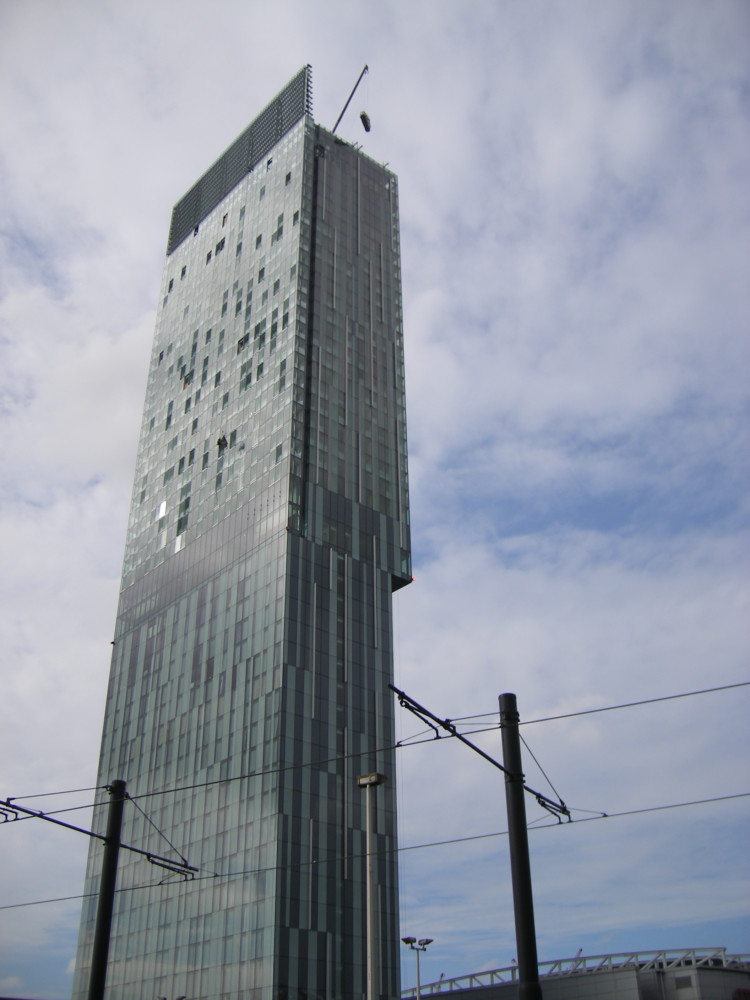
Weightless architecture refers to those buildings and structures which appear to defy gravity. One such structure is Beetham Tower in Manchester, which has loomed above the city skyline for just over a decade, since its completion in 2006. Forty-seven stories tall, Beetham Tower is no ordinary skyscraper.
Where other, less ’weightless’ buildings, might follow the convention of being bigger at the bottom and smaller at the top, Beetham Tower is akin to a giant letter P, dominating the skyline of Manchester’s outer-limits. About 20 floors from its base, the upper half of the building juts out and protrudes into nothingness, apparently unsupported and visibly insubstantial.




Andrew said: ’It was as I passed this particular architectural phenomenon, on my way back to the north-east of England in 2013, that I was struck by a vital question: Why would anyone want to build something like that?
’In the course of a 7,000-year history, architecture has helped to protect us from a number of ills, has kept us safe from harsh weather, has protected us from invaders and aggressors, has provided social space, and has become a huge part of religious ceremony and ritual. In the process, architecture has become not only a bearer of the symbolic meaning, but also something which, in itself, gives meaning to society and to the social order.
’It is this recognition of the significance of architecture that makes it all the more important to ask the questions of how and why, at this point in the 21st century, we have reached a moment when an architect should decide to design a building that quite literally looks ready to keel over in the wind, and to further ask what such a building can possibly mean.
’On returning to the University of Hull, I began to look deeper into the Beetham Tower, and into other buildings like it, trying to find a good reason why architects across the world would be inclined towards the construction of buildings so visually, if not actually, fallible. The more I read, the more buildings I began to find, and the more buildings I found, the more questions I had.
’However, answers were not easy to come by. The question of weightlessness, or rather the appearance of weightlessness, seemed bizarrely absent from either the architectural literature or the media discussion around the buildings.
’Eventually, I began to theorise outside the realm of architecture. As part-time theologian and part-time philosopher, it is my job to try to look at things from other angles. So I turned from architecture to philosophy and history in search of a new way of finding an answer.
’I had recently read a paper by a colleague who had bravely speculated a new brand of philosophical investigation, which was yet to be tested and which needed a complex and extensive social object to be the subject of an experiment.
’Could this provide the answer to my questions? I decided to take on the model my colleague had provided and put weightlessness to a philosophical test.
’The outcome of this experiment spans a trajectory across nearly half a century of architectural development, taking into account geographical, social and political instabilities and rapid ideological changes. And after four years of study, I’m pleased to say that I have found an answer. It is an answer that encompasses not just the most ardent architect of weightlessness, Thom Mayne of Morphosis Architects, whose Diamond Ranch High School holds the key, but a whole swathe of architects and the promises that were made to them in their youth. It is an answer that addresses the future, the past, and visions of past futures.’
Andrew Walters’ lecture on ’A History of Futures Past: Morphosis, Diamond Ranch and the Architecture of Weightlessness’ is part sci-fi, part philosophical intrigue, and part-architectural controversy.
It takes place in Elmwood House (behind the St John Ambulance Centre, off Glencrutchery Road) at 6pm on Wednesday, June 28. All are welcome, and no booking is required.
Isle of Architecture is a year-long celebration of the island’s built environment, supported by Culture Vannin, Manx National Heritage, and the Isle of Man Society of Architects.
The past year has seen competitions, children’s workshops, music in unusual spaces, tours, and lectures, all aimed at encouraging people to think about the important role that the built environment plays in our everyday lives.
Further details about the history and heritage lecture series, together with videos of previous lectures, can be found online at http://catrionamackie.net/lectures/. Follow Isle of Architecture on social media and online at www.isleofarchitecture.com
Comments
This article has no comments yet. Be the first to leave a comment.