
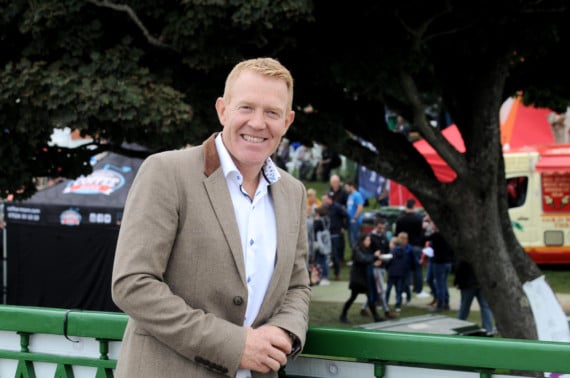
He’s the nation’s favourite farmer, one of the stars of Countryfile and the special guest at this year’s Isle of Man Food and Drink festival. Julie Blackburn meets Adam Henson.
In the midst of the hustle and bustle of the food and drink festival it’s not easy to find a quiet corner in the Villa gardens to talk. Adam, who is immaculately dressed and every bit as wholesome in the flesh as he is on TV, spots a bench that’s tucked behind the radio tent.
We are just sitting down for a chat when a woman approaches: ’I really enjoy your programme Adam,’ she tells him and hurries off again.
’I expect that happens to you a lot,’ I say and he agrees with a smile, that, yes, it does.
.png?width=209&height=140&crop=209:145,smart&quality=75)
.jpeg?width=209&height=140&crop=209:145,smart&quality=75)
It’s hardly surprising when you consider that Countryfile is one of the BBC’s top-rated shows, regularly scoring audiences of seven million.
’It must be amazing, talking to seven million people,’ I suggest.
’I know it’s extraordinary isn’t it?’ he agrees, and he goes on: ’It’s something I’m really proud to be part of: I love doing it.
’The diversity of places I go to is extraordinary and the wonderful people I meet, but to be able to tell the story in my little section about food and farming is exciting.
’I think sometimes farmers get a bit frustrated that we don’t shout enough and think that perhaps we dumb it down a bit but what they have to remember is that we might be talking to an eight year old or an eighty year old in a flat in Manchester that’s never been on to a farm.
’It’s a magazine show, there’s something in there for everybody so you can just turn the page and hopefully there’s something there that you’re interested in.’
The previous day Adam had been taken around the island visiting a number of farmers and growers. As a long time champion of rare breeds he was especially delighted to meet Jenny Shepherd and Rawdon Hayne and see their flock of 900 Manx Loaghtans.
He says: ’We used to have Loaghtans on the farm at home because my dad was really into rare breeds conservation so it was really lovely to see such a big flock of them.’
Having had a chance to meet local farmers and growers and to have a look around the food and drink festival and meet people there, I ask him where he thinks our food sector sits in comparison with other parts of the UK and the best ways for local producers to grow their businesses.
He explains that, for himself and his family, the rare breeds and ’telling the story’ is very much a part of marketing the end product.
His late father, Joe, started the Cotswold Farm Park back in the 70s: it’s a rare breeds tourist enterprise which champions rare breeds conservation and food and farming. The park now has 50 different breeds of seven different species and has 150,000 visitors a year.
Adam says: ’My dad was a trailblazer and there were many other people like him but really within the last 15-20 years lots of farms have diversified, because they’ve had to, to get another income stream. And, in doing so they’ve learned about marketing and branding and brand values and telling the story.
’Being here I don’t think the Isle of Man is behind the times as far as selling local produce. Today I’ve been around the whole of the food and drink festival, seeing everything that’s here and chatted to some really interesting people. I think of some of the food and drink festivals I’ve been to over on the adjacent isle and the stalls here would fit in very easily.’
He goes on to explain what he has learned about growing a local food business: ’I think it’s very much about communication and I think modern day farming, large or small, is about getting the right messages out there, about the way we produce food and how well we do it.
It’s about getting the right messages across so that people buy Manx and, going around here, people are nailing it. They’ve got some fantastic branding, they’ve got some really professional outfits and stalls, wonderful packaging and are telling the story with passion and enthusiasm.
’The tips I’ve learned are it’s about communication, it’s about displays and branding and then being passionate about telling your story.
’If you can sell produce to the local community and then also to the tourists it’s a win win situation.’
Another thing Adam is passionate about is dogs. As has been documented in Countryfile, Adam has used Australian kelpies as working dogs in the past but is currently using the more traditional border collies.
His best dog, Peg, is pictured on the cover of his latest book ’A Farmer and his Dog’ which describes his relationship with his own working dogs and others that he has encountered.
’It’s just a story about the people and the characters and the animals that I’ve met. I never want to be without a dog: I think they’re extraordinary animals and I think we’re learning more and about how intelligent they are.’
We talk a little more about how farms have been changing and divisifying and opening their gates more to the public.
Adam says: ’It was incredibly sociable when people were using scythes and threshing machines and then came the introduction of the combustion engine and the tractor things and became more mechanised so now we’re running 4,000 acres of arable with basically three people. That would have employed hundreds of people years ago so it can be isolated and it can be lonely and so I think for farmers to come to events like this to be able to show off their produce and be proud of it and passionate about it is a good thing.
’For the consumers and the general public, although there is a void of knowledge, I think they’re keen and hungry to learn about it.
’Cities have grown so vast and the way food has become so readily available [has meant] that people of all walks of life, particularly brought up in a city, may not see sheep or cows or know that carrots come from the ground and that’s a sad thing. But as farmers that’s again our challenge and it’s our job to help bridge that divide.’
For himself, Adam admits that he ’probably doesn’t spend enough time’ on his own farm because of filming and other commitments.
He explains his schedule: ’Every Monday and Tuesday I’m filming pretty much all year round and then half a day in the studio on a Wednesday. Then the rest of the time I’m farming or, more so now, doing corporate work and bits and pieces so I do a theatre and I’ve written a few books and I come to events like this.’
And he adds with a grin: ’But I’m just making hay while the sun shines: the BBC will drop me in the bin one of these days and then I’ll go back to being farmer.’
Comments
This article has no comments yet. Be the first to leave a comment.