

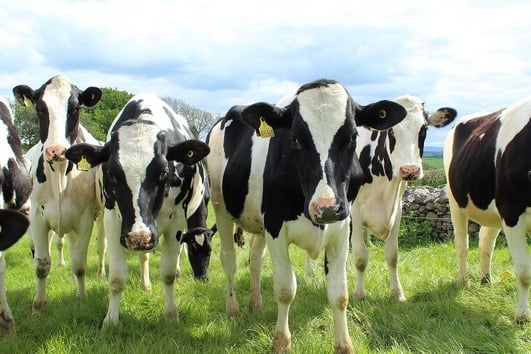
A restriction zone has been introduced across the island after cattle on a Manx farm were found to have the Blue Tongue Virus (BTV).
The Isle of Man’s chief veterinary officer has confirmed BTV antibodies have been identified in the cattle.
The Department of Environment, Food and Agriculture (DEFA) said surveillance was carried out after a farmer reported several abortions in the herd. Tests indicate some animals have been exposed to BTV and further testing will be undertaken to confirm the strain.
An ‘all-Island Bluetongue Restriction Zone’ has been introduced as a precaution. But animals can be moved unless they are showing clinical signs of the disease — including lethargy, swelling of the face, lips or tongue, excessive salivation, nasal discharge, fever, lameness or abortion.
.jpeg?width=209&height=140&crop=209:145,smart&quality=75)
.jpeg?width=209&height=140&crop=209:145,smart&quality=75)
-(1).jpeg?width=209&height=140&crop=209:145,smart&quality=75)
Livestock exports to the UK can continue on the normal basis, with no additional requirements. However, the Isle of Man must now comply with the same restrictions as UK farmers, which will limit direct trade with Scotland.
BTV, which has been reported in parts of the UK in recent years, poses no risk to the public or food safety, but it can have serious consequences for cloven-hoofed animals such as sheep and cattle, affecting their health and productivity.
Dr Amy Beckett said: ‘Finding antibodies means the animals have been exposed to BTV, but it does not mean they are currently infected. We advise farmers to review their biosecurity measures, and they may also wish to speak to their vet about the option of vaccination.
‘Bluetongue is a notifiable disease, so anyone worried their animals may be affected should contact the DEFA Animal Health team straight away.’
Minister for Environment, Food and Agriculture Clare Barber added: ‘I would like to thank our veterinary team, who are working closely with industry and relevant authorities.’
The Manx National Farmers’ Union has also responded to the latest news.
The union said: ‘We offer our support to the farm that will be experiencing a difficult time right now.
‘Blue tongue has been present in the UK for some time and was recently confirmed in an isolated case in Northern Ireland. It is important to clarify that blue tongue is spread by infected midges and not from animal to animal.
‘Though this restriction has presented its own difficulties for the farming industry in the Isle of Man, the priority now is to maintain the health and welfare of the livestock in island and enable trade to continue safely.
‘Vaccinations are now approved for use on-island which is currently a voluntary programme.
‘We would like to thank the chief government vet, Dr Amy Beckett, the animal health team and the agricultural directorate at DEFA for their efforts to support the industry at this time.’
Farmers are advised to monitor their livestock and report any concerns to DEFA’s animal health team on 685844. Further testing and investigations are planned to better understand the situation.