
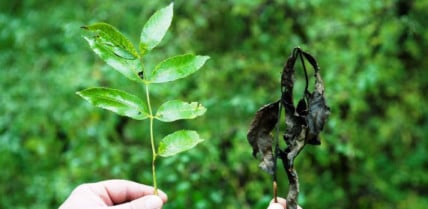
Ash dieback has spread throughout the island since the first confirmed sighting here in 2017.
Young trees are particularly vulnerable to the disease and die back quickly once they are infected.
Dieback rates in older trees are more variable but tend to be slower.
Here, DEFA explains the symptoms of the disease and what it is doing to prevent it from spreading further.

-and-Tim-Foster-(right)-out-on-the-Atlantic-Ocean.png?width=209&height=140&crop=209:145,smart&quality=75)
What is ash dieback?
Ash dieback is caused by the fungus Hymenoscyphus fraxineus. This fungus was previously known as Chalara fraxinea, which is why you may see or hear the disease referred to as ’Chalara ash dieback’. It blocks the water transport system in the tree causing the leaves to wilt and die. This is followed by the development of lesions (discolourations) on the bark and the dieback of branches within the crown of the tree.
This disease was first described in Poland in 1992 and has since moved westwards throughout Europe.
What are the symptoms?
â?¢ Dark long thin and diamond shaped lesions on the main stem at the base of dead side shoots
â?¢ Shoot tips blackened and shrivelled
â?¢ Leaves blackened and dead
â?¢ Saplings have dead tops and side shoots
â?¢ Dieback of branches in the crown of mature trees, often accompanied by new growth further down the stem
â?¢ In late summer and early autumn (July to October), small white fruiting bodies can be found on the blackened leaf stalks.
What is DEFA doing about it?
The disease is spread by tiny spores released from the fruiting bodies of the fungus, which grow on the dead leaves of infected ash.
Two factors make it very difficult to control the spread of the disease:
â?¢ The practical problem of collecting all the dead leaves which might end up producing spores.
â?¢ The spores disperse naturally via wind over tens of kilometres.
Because of these issues DEFA currently has no plans to execute a disease control programme. Research into control methods have been unsuccessful, so the UK and European focus has shifted towards producing disease resistant ash species.
DEFA will continue to monitor the disease and will be working with UK and European agencies to keep up-to-date of developments. .
My ash trees look infected. What should I do?
All visual symptoms can be associated with other plant health problems. Try and establish whether the symptoms you can see are being caused by ash dieback using the UK Foresty Commission’s identification guide. See www.youtube.com/watch?v=UuU8_e0Vw8Q
The disease can be difficult to diagnose, particularly in mature trees.
If you are worried about the condition of a tree contact a professional arborist.
What are the requirements of the island’s Plant Health Act?
The Plant Health Act 1983 restricts the importation of ash trees to the island and does not require you to fell a diseased ash tree.
Do DEFA need to be notified?
There is no requirement to notify DEFA of sightings but the UK Forestry Commission encourages people to use their Tree Alert website to aid their research.
Do I need to fell my diseased trees?
We advise a general presumption against felling living ash trees, whether infected or not. There is good evidence that a small proportion will be able to tolerate H. fraxineus infection. There is also the possibility that a proportion of ash trees can become diseased, but then recover to good health.
Public safety is the priority. Keep an eye on the trees as the disease progresses and prune or fell them if they or their branches threaten to cause injury or damage.
Who pays for the felling of infected ash trees?
The tree owner.
Can infected wood be used for timber or fuel?
There is a low risk of the disease spreading via infected logs. Whilst we would encourage you to avoid moving timber from infected trees away from the site of felling, there is no legal restriction on the movement of diseased ash. Its use on site as fuel is not a problem.
I have a healthy ash tree in my garden. What can I do to prevent infection?
Collecting and burning as much ash leaves as possible may help reduce repeat infections.
If the disease is present in trees adjacent to your garden, however, this is unlikely to be effective because the spores may be carried by the wind in to your garden.
There is no effective treatment for infected trees. Research suggests infection will be fatal in 90% of cases.
What should I plant instead of ash?
We wouldn’t recommend planting any species of ash (Fraxinus).
A replacement tree which will provide similar benefits for wildlife are alder, poplar or field maple.
In a garden setting seek advice from a tree nursery to ensure you select a tree suited to the local environment.
Comments
This article has no comments yet. Be the first to leave a comment.