

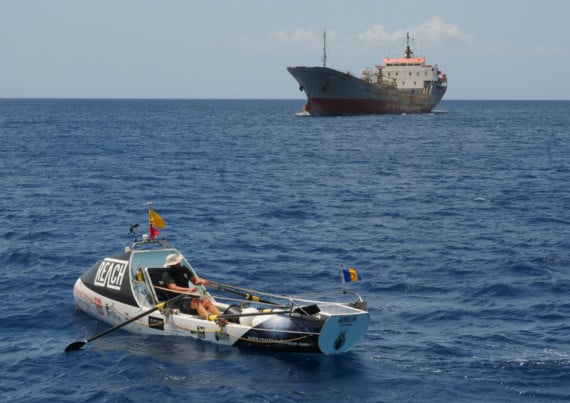
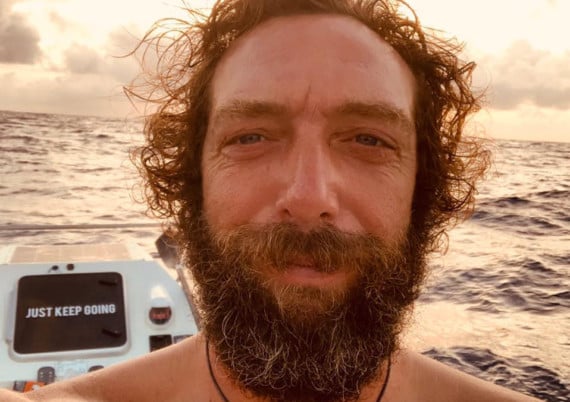
In December Manx advocate Andrew Baker set off from Lagos, Portugal in a 6.5m ocean rowing boat ’Aurelia’ - crossing the Atlantic to arrive three months and more than 4,600 miles later in Barbados in March.
Now back in his home in Santon, Andrew, aged 41, told us that the idea to row the ocean dated back to around 1997, when he read about Jim Shekhdar, the first person to complete a solo row of the Pacific.
He said that the most difficult period of the voyage was the ’brutal’ first five weeks between Portugal and the Canary islands, where he encountered ’huge waves, like rolling hills’ that he estimated at around 50 to 60ft high, or ’as high as the flats in Lord Street’.
These were accompanied by winds of up to 40 knots.
.jpeg?width=209&height=140&crop=209:145,smart&quality=75) Best pictures as 'special' Guys and Dolls show captivates Gaiety audience
Best pictures as 'special' Guys and Dolls show captivates Gaiety audience Offensive graffiti daubed outside the home of Michelle Mone and Doug Barrowman
 Charity appeal for information after barrier removed from playing fields
 After days of normality, bus drivers will return to the picket line on Friday
During such storms, Andrew could only either stay bound to Aurelia’s small sleeping cabin with a nylon ’parachute’ anchor deployed to slow the boat from being pushed in the wrong direction, or be out on the oars ’just absolutely battling the waves’.
However, he said that it was arguably safer to be secured by his lifejacket to the boat out on deck, as there were ’less things to hit your head on’ than in the cabin where he said he was ’clinging to the floor, trying not to throw up - it was like being in a tumble dryer.’
At one point in a storm, a container ship - which would usually speed right past him - even stayed put and seemed to watch him for hours until he was able to exit the cabin and activate his VHF radio, at which point it left.
Once he passed the Gran Canaria shipping lanes he didn’t see a single boat or plane until Barbados, but in addition to the radio he also had a satellite phone and GPS tracker which could send out a distress call, though it would have taken a few days for anyone to get to him.
It was one of these storms that lead to one of the only times where he briefly contemplated quitting, when he was forced so close to the coast of Lanzarote that he could see beachgoers drinking beer in bars and eating pizza. He thought how easily he could have joined them, but it was being able to switch on his mobile phone data and see a message of support, from someone he hardly knew - gave him the boost to continue.
Things were vastly different once he got out into the open ocean of the Atlantic, where the waves became steadier, allowing him to get into a better rhythm.
He aimed to clock at least 12 hours of rowing each day.
Asked how he trained his body to be confident he could cope with the demands of non-stop rowing over three months, Andrew said: ’I don’t think you can sit on a rowing machine, or go to the gym and be able to fully condition yourself to do this.
’I’d cycle as often as possible, and I did loads of squats - it was all about the legs’.
And once Covid restrictions were eased in the island last June, Andrew got out on the boat and began rowing between Peel and Port Erin, or Ramsey to Castletown.
He also said that he felt that mental resilience and preparation was probably more important than being super fit, adding that ’You don’t have to be like Christian Varley [Manx marathon runner] to row the Atlantic’.
’The best thing [you can do] to become an ocean rower is meditation and yoga’.
’I was also really fortunate that throughout the entire time I didn’t have any bother with my body at all.
’My back hurt a little bit after the first three days, but I rested it because I was stuck in the cabin being pushed back towards Gibraltar [by waves]’.
He said that then, once he passed North Africa he was simply being ’conditioned by the sea to do it’.
Fresh water was provided for by an electronic desalination watermaker system built into the boat which sucked in and filtered sea water.
Should this fail, he also had a US military-issue manual watermaker and an emergency supply of 150 litres of fresh water stored in the boat’s hull which also acted as ballast.
Food was also well accounted for, although Andrew said that he often did not have the stomach for the calorie-dense ration packs.
One of the things that helped pass the time was experimenting with mixing different flavour combinations of rations and adding spices, blogging about how he only just ran out of his favourite lunches of mac and cheese and cinnamon rice pudding five miles off the Barbados coast.
Andrew also thought that he must have been one of the only ocean rowers to still fit into his jeans when he got back, having not lost much weight.
Surprisingly, Andrew said there was not one moment where he was bored, and that each of the 98 days out on the water were different.
He gained a newfound appreciation for the natural world, saying that he could find entertainment simply by watching the sunrises and skygazing - ’the clouds and stars were my TV screen’, he added.
Andrew also had a stockpile of recorded albums, podcast and audiobooks to listen to - including inspiring stories such as that of the man who completed the world’s longest 157-day sea swim.
Something else that kept his mind focused was to be totally mindful of every physical action - be it perfecting his rowing technique, or going through the ritual of making a cup of tea.
’Everything just became this obsession - to do it as efficiently as possible.
’In that sense it was a trance, it was meditation - I wasn’t thinking about things.’
He said that in the first few weeks he was introspective: ’I really went over all my past, my regrets, and my future - I spent a lot of time in my own head.’
But this then changed: ’By the time I got to the Atlantic I’d done all that thinking, and I was just completely present in the moment.
’I think about six weeks went by without me even realising, almost in the blink of an eye’.
’It was beautiful to not have any of the distractions of society, I felt blessed every single day’.
People can still donate to Andrew’s fundraiser at: www.justgiving.com/crowdfunding/reachintotheblue.
Part two of Andrew’s journey, including the surreal readjustment of his landfall in Barbados and his plans now he’s back in the island will be published in this week's Manx Independent - on sale Thursday.
Comments
We've recently changed our login process. If you have an account for commenting, you will need to re-register on the login window.
This article has no comments yet. Be the first to leave a comment.