
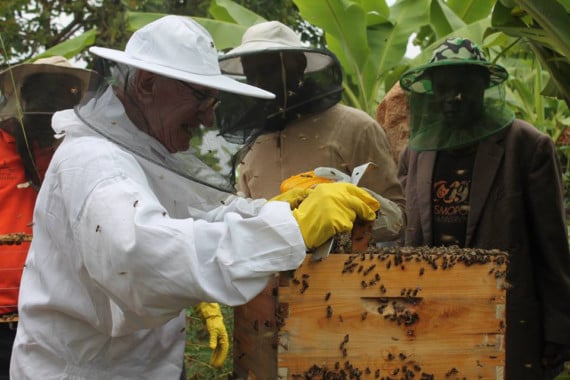
Harry Owens has played a massive role in developing practices in Burundi that will help feed families and maintain the country’s bee population for generations.
The island’s bee disease officer arrived in the country in late February for a two-week mission with Christian Aid Isle of Man, where he delivered lessons in modern beekeeping to hundreds of eager learners.
Speaking to the Manx beekeeper in his St John’s home, he described the methods people were using in the African nation as ’ancient’.
’No wonder they were having difficulties with bees - their methods were primitive. The way they were kept dated back to the ancient Egyptian times,’ he said.
.jpeg?width=209&height=140&crop=209:145,smart&quality=75)

’To make their hives they would use grass and rope to make a small, cylinder-type bung. The trouble with that is that they had to take the whole cylinder apart and the colony would suffer. The honey they got would be very minimal.’
Despite this, Harry was heartened by the natural conditions and resources in the country, stating that there is ’brilliant potential’ to improve honey yields and the culture around beekeeping.
Traditionally it’s older men who carry out the practice in Burundi, but thanks to Harry’s workshops men and women of many ages will now take on the trade using modern techniques to create sustainable hives using local timber and also protective outfits.
’The women wanted to do the beekeeping, but didn’t have the veils to protect themselves and were scared of being stung,’ he said. ’I wanted to help the women and they took to it. They were keen to get something out of it.’
The skills were like ’another string to people’s bow’, Harry said. ’They can make stuff and sell it and make some income out of it. Hopefully with the new information they will improve the quality of life because I’ve never seen poverty like it before.’
’One of the things that struck me about the place was that everyone was smiling and quite happy, despite the poverty.’
Another surprise was the shocked reaction he got from the locals when they found out Harry’s age.
’They couldn’t believe how old I was because the life expectancy there is about 57,’ he said.
They were equally shocked to hear that Harry had been married to his late wife for nearly 60 years, which is again more than the average life expectancy in their country.
He explained that his mission was organised when Louise Whitelegg, of Christian Aid Isle of Man, recognised there was an opportunity to improve beekeeping there when visiting.
’She spoke to me and said: "We need someone to go out, can you talk to anyone?" I said: "I’ll go out". I’m pleased she did, I was honoured to go,’ Harry said.
’When you can make so much of a difference for people like that in the long run it’s an achievement.’
Louise said: ’For Harry it was an opportunity to pay back all the knowledge he’s been able to gain over the years and knowing he’s passing on information that will keep going down the generations in Burundi.
’They need it. They are starving so to have the honey as added nutrition to their diet is going to stop them from dying and help them get on their feet.’
She added: ’He’s not going to stop either. Hopefully this is the start of a project in the island.
’It’s absolutely inspirational. We often let things stop us and come up with reasons to stop us. Harry doesn’t. If we were all like that the world would be a better place.’
There were a few incidents that nearly prevented the trip from happening. The trip had to be postponed after the Burundi government banned foreign non-governmental agencies from entering the country.
The Manxman then had a knee replacement but managed to heal just in time for his mission. While on the trip, he had amoebic dysentery - a parasitic infection that causes a fever, diarrhoea and abdominal discomfort.
Initially he worried it could be malaria but tests came back clear and antibiotics were given.
Another glitch happened when some equipment was accidentally sent north rather than south where Harry was.
’I was furious at the time,’ he said.
Now home, Harry is determined to continue the good works.
When first arriving to Burundi Harry was surprised to hear that a community had been given modern hives three-and-a-half-years ago by a scheme but they had got nothing out of them.
The problem was the hives had no wax inside so no bees were being attracted.
’They were expecting bees to go in it, but it had been sitting there unproductive,’ Harry said. ’Since I’ve been back I’ve sent a diagram on how to put wax into frames and it will be translated into Burundian. It’s a step-by-step guide.’
Harry shared his adventure at a talk yesterday (Monday) at St Ninian’s Church.
For more details and photos, search @ChristianAidIsleofMan on Facebook.
Comments
This article has no comments yet. Be the first to leave a comment.