
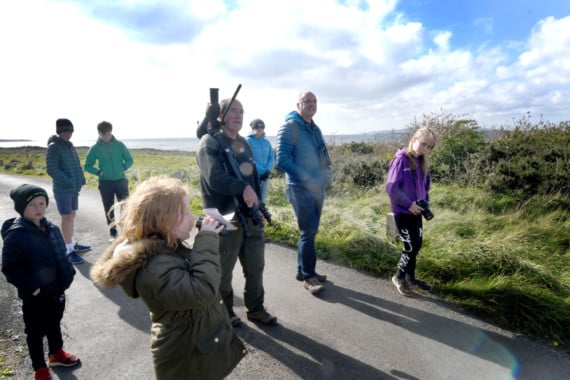
Groups of young wildlife enthusiasts were treated to an afternoon of guided bird watching at a local wildlife hotspot.
Organised by the Manx Ornithological Society, the 13 potential bird spotters were taken to Langness and given expert tuition on how to spot and identify the many species of bird life that can be found around the shoreline.
After two hours spent in the blustery conditions, the youngsters, aged between eight and 12 years old, managed to spot about 20 species of birds from the common, such as the herring gull and the mallard, to the rarely-seen or noticed birds, such as flocks of small wigeon and a rare glimpse of a merlin.
The group, taken under the expert guidance of local birders Andrew Johnston, Richard Norris and Neil Morris, spotted two bright white little egrets, which caused no little excitement, as spotting just one can be the highlight of a bird spotter’s day.

.png?width=209&height=140&crop=209:145,smart&quality=75)

.jpeg?width=209&height=140&crop=209:145,smart&quality=75)
The large, stationary herons were easier to spot, unlike a flock of curlews, who were heard, rather than seen with their distinctive call. Murmuring of starlings suddenly appeared in dramatic groups, and a kestrel hovered in place long enough to allow the children to train their binoculars on it.
The experts gave the children advice on how to use binoculars, and also allowed them to peer through expensive field telescopes to gain crystal-clear views of the furthest of birds.
Angela Guest, from the Manx Ornithological Society, said that the group were hoping to attract more young people into the world of bird watching.
’This the second of three events that we are running this year, aimed at getting children involved in bird watching,’ said Angela.
’Our organisation has been going for many years on the Isle of Man and we realised that we have got a lot of older and aging members.
’ To help address that, a few of us thought that it would be a good idea to get some children involved with a series of specially-tailored events.
’We thought that if we could get young children to feel passionately about the local wildlife at an early age, it is something that will stay with them throughout their lives, and it then becomes something they will be able to pass onto their children in the future and so on.
’Traditionally, bird watchers tend to go to one location and will stay for a long while.
’We don’t want children to get bored, so we need to go to places where they can see a lot of good stuff, where they can be entertained and see things a bit quicker, and to give them that wow factor.
’Then we can move them on to a different spots and environments so they keep interested and looking for different birds. Langness is perfect for that.
’That’s what we are trying to do today, and that is what we are hoping to keep doing in the future.’
â?¢ For more information visit manxbirdlife.im
Comments
This article has no comments yet. Be the first to leave a comment.