

Louise Whitelegg, the island’s Christian Aid co-ordinator, has just returned from a month-long, self-funded trip to Burundi in east Africa. Here in the third instalment of her series of articles, she looks at the real price of your morning cup of coffee.
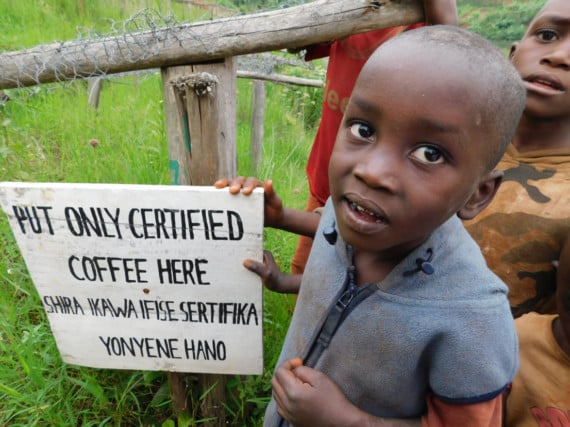
Twungurane Co-operative means win-win in the Kurundi language.
This is a coffee drying station where local farmers bring their fresh coffee beans for the first part of the process in making it to your coffee cup.
The word ’farmers’ gives the wrong impression, these families that farm coffee in Burundi only have very small parcels of land, half to one hectare, so achieving any sort of economies of scale is virtually impossible.


.jpeg?width=209&height=140&crop=209:145,smart&quality=75)
It is a rural society with 87% of the population living outside the main towns and cities.
Thanks in part to the support of the government in the deregulation of the coffee industry in Burundi, groups of passionate local individuals have been able to work together and form co-operatives with the help of non-governmental organisations (NGOs).
Manariyo Patrice, president of one co-operative, said: ’In 2006 I tried to start a farmers’ co-operative by starting a farmers’ union in the villages.
’The farmers would take their cherries to the public weighing stations but there was a lot of fraud because you would take 10kg and they would say it was only 5kg.
’The farmers were not treated with respect. So, I began to set up a cooperative.
’We, the leaders of the co-operative sold shares and another NGO gave the project a kickstart grant when the opportunity came from the coffee sector being privatised.
’So, we continued to collect the shares and by 2011 we had a washing station! But still not enough shares sold, so we asked for further help.
’The co-operative was funded 51-49%.
’It was a start! When we began we had very poor equipment, drying tables and infrastructure. And now look at how far we have come!’
Before I went to Burundi, I of course supported Fairtrade but, if I am honest, only in passing, as a ’nice’ thing to do.
After meeting the farming families and seeing the difference the Fairtrade payments make to them I will never buy anything other than Fairtrade.
The raw beans from the tree they receive 500 Burundian francs per kg. This equates to $0.20.
To put this in perspective, coffee is harvested only once a year, the yield from a tree is between 0.8 and 3.69kg, depending on husbandry, maturity and weather.
On average a farmer will have between 50 and 580 trees.
Fairtrade farmers get a bonus payment of between 100-150 Burundian francs per kg.
This is the difference between being able to pay school fees and not.
This is the difference between being able to pay for the families’ medication and not.
So, when I am looking for coffee in our local supermarket, the very least I can do, standing in our beautiful, bountiful island, is to buy the Fairtrade products.
Kabanyana Jacqueline, 43, who has six children, said: ’Before the co-operative life was very bad.
’I was short of money, I was starving and my family struggling with no money for shoes or clothes.
’The co-operative saved my life and with access to loans I am now able to send my children to school and support my husband.
’In an emergency I know that I can go to the co-operative for a loan.
’With the co-operative we have organised small groups and then gone out and trained the locals on how to plant new trees and how to make their own coffee plantation.
’One problem we have is that there is not enough fertiliser to help the coffee grow.
’We require livestock to help with this problem.’
Kabanyana also grows maize, beans and potatoes to help support her family through the year.
Asked what she wishes for she replied: ’Transportation to make harvesting the crop easier.’
Nahimana Virgimie, 42, who has four children, said: ’Being together in the co-operative I got room to have a voice.
’I also have enhanced income, from the parchment as well as the coffee.
’I am always looking for ways to increase the production, to getting diversified income and also excited about the support to get small loans for small projects.
’This is a massive advantage compared to working on your own.’
When you are sitting down to a cup of coffee, think about the coffee growers.
They love and nurture their coffee plants throughout the year, farming organically, by hand and with no machinery this is truly a family affair.
A child goes from being a baby to an active member of the farming family as soon as they are able to walk and are given a miniature sythe to help tend the family’s land.
When the beans are ready to harvest this is where the challenge of logistics comes in.
None of the families I met had either a vehicle or an animal to help.
If they are lucky they may have access to a bicycle but mostly the transportation of the picked coffee beans is done by carrying each 25-30kg sack on their heads.
This walk is neither straightforward nor fast.
Farmers come from up to 30km away on roads that are barely more than goat tracks, which undulate up and down steep hills.
This is in the searing temperatures of the day.
To further complicate matters, the coffee beans must be processed within eight hours of being picked, otherwise they begin to ferment and spoil.
How good does your coffee taste? I am finding the taste of anything other than Fairtrade very bitter indeed.
â?¢This year’s Christian Aid Week appeal (May 13-19) is a health promotion project in the north of Burundi.
The charity wants to raise funds to buy bicycles, DVD players and solar panels to enable educational messages to be taken into remote villages.
Contact Louise by ringing 474275.
Comments
This article has no comments yet. Be the first to leave a comment.