
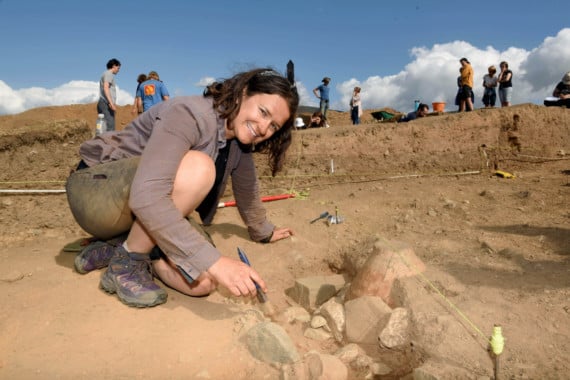
A four-week project which digs into the island’s Bronze Age past is coming to a close. Reporter Jess Ward speaks to a team of archaeologists and volunteers about their discoveries.
The gentle sounds of brushing, scraping and hushed tones of excited chatter became more and more audible the closer our tour group got to the ancient burial site.
Once we reached the hilltop, located off the coast road between Peel and Kirk Michael, we were greeted by a scene of people all working hard to bring a part of Manx history to life.
Inside the dug-out trenches were the Round Mounds Isle of Man Project team which is a mix of Newcastle and Leicester university students, volunteers and researchers.
.jpeg?width=209&height=140&crop=209:145,smart&quality=75)
In just four weeks they have uncovered a ’cordoned urn’ used for burial along with bits of human bone fragments, teeth and a large number of flint tools and weapons.
Luckily for us on the tour we had the chance to watch members of the project carefully work on removing another prehistoric cist from the ground.
’Having the burial urns come out has been especially fantastic,’ said Rachel Crellin, one of the project leaders. ’You really cannot beat that kind of stuff.’
Pointing at the partially-buried urn, she said; ’We’ve just discovered an upturned early Bronze Age pot with cremated remains.
’At the moment we are in the process of understanding the urn and lifting it out of the Cronk Guckley site. We’ll then get it to a specialist and have them look at it. We’ll be able to get a lot more information about it that way.’
Rachel, an archaeologist based at the University of Leicester, is originally from Port Erin.
She has been keenly studying Neolithic and Bronze Age history as part of her PhD.
She felt that more information about this prehistoric period could be discovered on her home turf and set up the project along with others including Dr Chris Fowler, an archaeologist based at the Newcastle University.
After examining three years worth of 3D scans and radar maps of the site which has three distinct mounds they came to the conclusion that it would be ’a brilliant area’ to explore.
Last year the team began its excavations and thanks to further sponsorship from the Manx National Heritage and Steam Packet Company they have been able to continue.
Rachel added: ’It’s absolutely fantastic to be home.
’The subject of the site does pop up in my lectures and sometimes even in my exams,’ she laughed.
’You learn so much about the excavation of people from any part of the past. We’re bringing their bones out and being able to bring this history alive.
’There has been lots of community involvement last year and it’s continued. There are more local volunteers than last year.
’We’re back filling [the site] on Friday (tomorrow) and very much hope to come back next year, dig some more and make another trench.’
Our tour guide Amber Roy, a PhD student at Newcastle University, later shared some of the team’s findings around the group.
Some included flint arrowheads and Ronaldsway pottery.
’The pottery was first found in the Ronaldsway area and from my knowledge it’s only found in the Isle of Man,’ the site supervisor and outreach officer explained to the group.
’It’s down to the style so that’s the thickness, colour and other aspects.’
Speaking with me afterwards, she said: ’I’ve been around schools in the island teaching kids about archaeology during the first two weeks of the project, which was brilliant.
’I’ve then been guiding tours around the site in the last two weeks.
’It’s important to talk about our findings especially with children. At that age they will be beginning to love history and the past. I was young when I wanted to become an archaeologist and now I’m here.’
One Newcastle student, who is Manx himself, is taking part in the project as part of his mandatory field work course.
The archaeology student said: ’Being Manx the archeology of the island and in particular of prehistory is a prime interest of mine.’
About the project, he added: ’It’s been all new stuff this year which is very exciting.
’Someone said to me, figuratively speaking, "that it could’ve been your great-great-great however many times over grandfather who had a part in this burial site".
’It then really hit home when we excavated the pot with real pieces of human inside.’
For more information about the project search roundmounds.wordpress.com
Comments
This article has no comments yet. Be the first to leave a comment.