
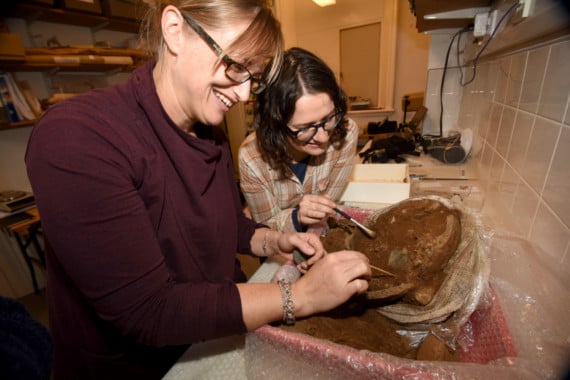
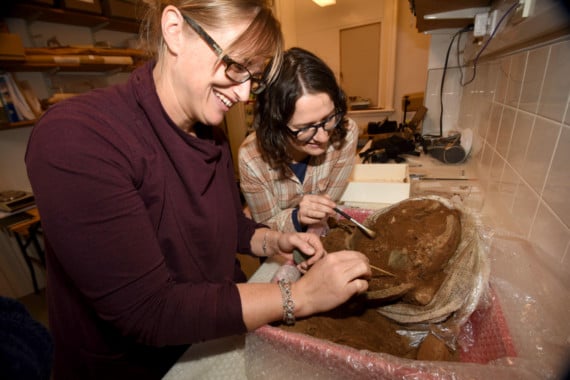
The latest stage of the Round Mounds of the Isle of Man project has unfolded at the Manx Museum with the opening of a 4,000 year old cist.
During the summer the project team excavated a site just outside Kirk Michael in order to explore prehistoric burial practices on the Isle of Man.
The site is a burial mound constructed by prehistoric communities and the excavations revealed several stages of construction - the mound is made up of at least three layers of earth and turf and has a rubbly ring of stones surrounding its edge.
Inserted into the rubbly cairn around the edge of the mound the team discovered an Early Bronze Age burial cist. A cist is a kind of stone grave that was usually built to receive a burial.


-(2).jpeg?width=209&height=140&crop=209:145,smart&quality=75)
.jpeg?width=209&height=140&crop=209:145,smart&quality=75)
Careful excavation allowed the team to reveal a ceramic vessel.
Dr Rachel Crellin, the project co-director said:’It was really exciting to find the cist this summer on the site and confirm that what we were digging was indeed a prehistoric burial site.
’We carefully excavated the cist to reveal a Collared urn within.
’Collared urns are a kind of Early Bronze Age pottery vessel.
’Like most other examples the urn was turned upside down so that its rim was placed on the floor of the cist.
’We lifted the vessel and the soil that surrounded it as a single block, wrapping it in bandages and plastic to hold it together, and took it to the museum to await excavation in controlled conditions by an expert.’ Last week, Rachel, along with project osteologist Michelle Gamble and Rachel carried out the excavation.
The careful process revealed that the vessel had collapsed inwards on itself over time but protected within the base of the urn were numerous small fragments of cremated bone.
Most of the base of the vessel has been preserved and the rim is decorated with stunning geometric designs.
Michelle’s analysis confirms the bones belong to an infant who was under 18 months old when they died.
Some of the cranial fragments showed signs of significant porosity which suggests the individual may have suffered from a disease such as anaemia or another nutritional deficiency.
Dr Crellin said: ’It has been an exciting few days seeing the pottery vessel revealed.
’To think that no one has seen this vessel for nearly 4,000 years is really quite humbling.
’ The cherry on top is finding the cremated remains of an infant within the vessel.’
She added: ’We’d like to thank Manx National Heritage, Culture Vannin and the Isle of Man Steam Packet for their support with the project.’
Comments
This article has no comments yet. Be the first to leave a comment.