
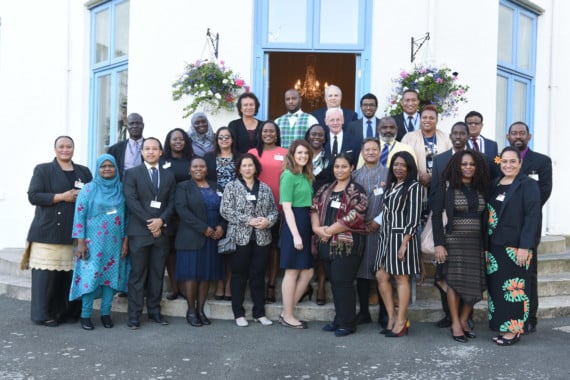
A pioneering island based scheme for finance officials from small countries has been given a clean bill of health in a new independent evaluation report.
The programme has seen dozens of people travel thousands of miles to the island over the last decade.
This year’s event was cancelled because of the pandemic and no decision has yet been made on next year.
Lieutenant Governor Sir Richard Gozney has enjoyed hosting receptions and once told delegates: ’It would be very hard to find any other event, even in London or Manchester, or wherever, that brought together people from the West Indies, the Indian Ocean, from small countries in southern Africa and from a great chunk of the Pacific Ocean as well.’

.png?width=209&height=140&crop=209:145,smart&quality=75)
The Small Countries Financial Management Centre (SCFMC) is praised in the report for work with senior financial regulators and public officials from small, developing states around the world.
The SCFMC was set up in 2009 by the Isle of Man Treasury as an independent charity, ’with the objective of reducing poverty and improving financial governance through the promotion of education relating to the government financial sector in small countries or countries whose economy or infrastructure has been adversely affected by wars or conflicts’. The SCFMC runs the Small Countries Financial Management Programme (SCFMP) which every year takes place in the summer over a fortnight - one week in the island and one week in Oxford. The board of the SCFMC instigated the review led by Mr Bruce Murray, formerly head of evaluation at the Asian Development Bank.
The evaluation focused on the question: ’Has the SCFMP delivered an identifiable and sustained improvement in the capacity and performance of individual participants and organisations?’
The report’s overall conclusion was that the SCFMC has developed and delivered very good products and is having the desired effect of improving the on-the-job performance of participants and contributing to building the capacity of ministries of finance and financial regulators in small countries and has delivered identifiable and sustained improvements in the capacity and performance of both participants and organisations.
The board said it considers the evaluation to be a rigorous and comprehensive report and particularly innovative in its approach to the difficult question of identifying and evaluating an organisation’s effectiveness in delivering sustained improvement in the capacity and performance of not only individuals but also their organisations; an area that tends not to have been addressed as fully by other executive education providers.
The evaluation tracked the career paths of programme alumni, the high rates of retention within government service and the transferability of acquired skills.
SCFMC chairman Steve Pickford said: ’We’re trying to help people develop a common set of skills and attributes which people need in order to be effective in their countries. One of the really interesting things is that it shows pretty conclusively that not only does it benefit individuals who’ve gone on the programme, but that it also increases the capacity of the organisations they work for.
’Because central banks and finance ministries are very key institutions in these countries, it’s improving the overall administrative capacity of the countries and that should be a very good thing for their citizens. What it does is demonstrate that we’re clearly on the right track in terms of providing a fairly unique offering which actually helps and which is tailored to what those participating can benefit from most.’
Executive director Mark Shimmin said: ’We aim to make a tangible contribution to development in a wide range of small countries in different parts of the world. The evaluation provides strong evidence and data that we are achieving this aim. Through the our annual programme of two weeks’ study on the Isle of Man and in Oxford, regulators and public finance officials from small nations deepen their technical knowledge and their capacity for strategic analysis, transformational change, negotiation and leadership.’
Leena Doman, a 2018 participant, formerly head of licensing and now playing a leading development role at the Mauritius Financial Services Commission, said: ’On the technical side, the programme is really robust. Being taught by experts who had actually been involved in these processes was so useful for my understanding of what these external assessment missions are looking for. And the experience of spending two weeks in the Isle of Man and Oxford with colleagues from other small countries around the world brought the added dimension of shared experience.’
The report made four recommendations but emphasised that the main lessons and its recommendations were more in the way of fine-tuning an already good product, rather than strategic recommendations that would have a major impact on the SCFMC.
The SCFMC board has fully accepted all the findings of the evaluation and agreed with its recommendations. It says it is already actively addressing the report’s recommendations, for example by diversifying the membership of the board.
As to the future the centre says it isn’t intending to stand still, and plans to evolve the SCFMP as the circumstances demand. Programme director Paul Fisher said: ’The programme is in really good shape. But we are always looking to keep that balance between the theoretical and the practical, between hard skills and soft skills and to build up our network through which participants present and past, in small countries around the world, can share their experiences and ideas.’
Comments
This article has no comments yet. Be the first to leave a comment.