
Some people have an inborn drive to achieve their full potential.
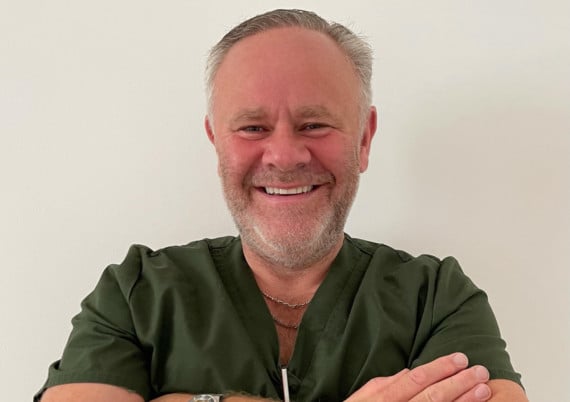
In James Garritt’s case it was his partner’s pestering that made him take up the challenge of furthering his dental career by pursuing a Masters degree on the verge of his sixth decade.
’She always winds me up, saying: "You’re very good - you could have been someone!"’ laughs James.
To be fair, James’ partner is Tracey Bell, who takes the phrase ’high achiever’ to a new level. One of the best-known names in UK dentistry with her eponymous dental and aesthetics clinics she also lectures all over the country.


.jpg?width=209&height=140&crop=209:145,smart&quality=75)

She and James got together more than a dozen years ago. Between them they have 10 children: Tracey has five, James has four and now they have nine year old JJ between them. As well as their busy working life they have two houses, one of which they have been renovating. James is in the charge of the gardens and loving it.
’I’ve always been good with my hands,’ he says.
He studied dentistry at Liverpool University and qualified in 1993. Having won one of the major prizes in his year he looked set to be a highflyer in dentistry but his life took a different direction, as he explains:
’I was ill the first year I qualified. I got chicken pox and it floored me.
’I ended up having post-viral syndrome - they didn’t know what it was back then - and I was in bed for eight months. It took me a long time to get back to work but then I realised I wanted a good work-life balance so I only worked three days a week.
’I built a very successful NHS practice in Yorkshire. I worked with the Health Authority, sat on their trust board and I built my own practice from the ground - literally designed it, built it, funded it - and it became a model practice in West Yorkshire.’
When James relocated to the island in 2010 he started working in the Tracey Bell Kensington Road practice, initially doing general dentistry.
’And I haven’t looked back,’ he says.
’But then the guy who was doing orthodontics was leaving so I started to do braces, which I’d done before. I started doing Invisalign in 2011 and, by 2012, I’d become a Platinum Elite provider and then I decided to teach myself fixed braces,’ he says.
When their endodontics specialist left, Tracey decided that this was another skill James should learn.
’We needed someone to do good endodontics so she pestered me and, altogether on the same day, I enrolled on a Diploma, Certificate and Masters course which is quite unheard of.
’I did the certificate and the diploma together and I was properly thrown into the deep end: I was going for four or five days a month over to Formby to a school called Simply Endo.
’When I first qualified there wasn’t masses of private dentistry: it was a matter of you either went off to be a houseman or you went out into the big wide world to work in the NHS.
’Now, because of private dentistry, people want to specialise either in endodontics, orthodontics or periodontics and I think I was the oldest person on the course I did to finish a Masters. They were all young pups and I was like the grandad.’
Fortunately James managed to get his course attendances finished just before Covid and he was able to write his dissertation during lockdown.
’I passed the diploma and certificate with merit and, when I finally finished my dissertation and sent it off, I passed that with merit too.’
Now 51, and with everything else going on in his life, James says this is definitely the last extra qualification he will undertake: ’I’m sure this will last me out till I retire.’
What is endodontics?
James explains:’Endodontics is the section of dentistry concerned with the pulp of the tooth.
’The pulp contains a blood supply and nerves so, if that becomes infected through decay you end up getting pulpitis, which is inflammation of the nerves, and that’s when you get pain. If it becomes infected the only way it can go is down into the bone and that’s when you get an abscess.
’When you hear about people having abscesses needing root canal work, people go into panic mode and horror stories because historically it used to be very painful but now there’s many techniques where we have profound anaesthesia and we’ve got special instruments.
’We can normally complete the root canal therapy in an hour and they have a 90% success rate and then, when we’ve saved the root, we can either put a crown on top or a bridge to fill the gaps.’