
Freedom of the press and freedom of speech are ‘vital freedoms in a democracy’ says the island’s outgoing First Deemster.
But Deemster David Doyle adds there are ‘many concerns’ among the judiciary and law makers over social media abuse.
He said: ‘Trial by Twitter is virtually instantaneous and is frequently fuelled by faceless trolls who make unsubstantiated and abuse claims egged on by their digital reach and anonymity.’
He is due to stand down from office on July 31.
.jpeg?width=209&height=140&crop=209:145,smart&quality=75)



The First Deemster is president of the High Court of Justice of the Isle of Man and also holds the positions of Clerk of the Rolls and Deputy Lieutenant Governor, acting for His Excellency the Lieutenant Governor when required.
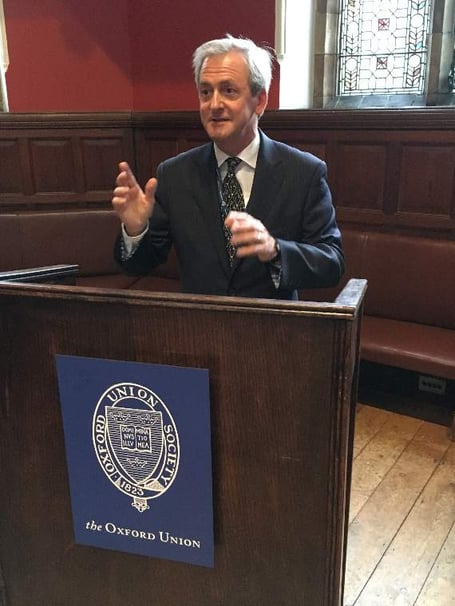
Deemster Doyle spoke out in a lecture delivered at the Oxford Union as part of this year’s Small Countries Financial Management Programme.
The leading judge addressed the importance of the media during his wide-ranging lecture.
He said that in modern democracies ‘every channel of the media performs an extremely important role in keeping the public informed and keeping judges on their toes.’
He said: ‘Social media, broadcast and the traditional press are the communication conduits that feed public perception, and when open justice is working properly the judicial system will, and should, be scrutinised, hopefully on an informed and objective basis.’
The man who was appointed as First Deemster in December 2010 having spent the previous 12 months as Acting First Deemster, added: ‘Long gone are the days when citizens could have their ears cut off if they wrongly criticised or defamed the Deemsters and other chief officers of the Isle of Man.
‘The customary laws of 1601 were repealed in 1876 otherwise, as Judge of Appeal Hytner once said ‘‘any self-respecting journalist today would doubtless regard the possession of both ears as a badge of shame.’’ ’
Deemster Doyle points out that ‘when open justice opens the door to court proceedings and judgments, the judiciary must brace itself to be judged by individuals using social media and journalists in mainstream media.’
He added: ‘In the online community knee-jerk judgments are made in a heartbeat in an environment that could not be further from the objective and regulated environment of a courtroom.’
He says social media abuse ‘rightly continues to raise many concerns among the judiciary and law makers.
‘But despite all these concerns we must all remember that freedom of the press and freedom of speech are vital freedoms in a democracy.’
He asks: ‘So, what can be done in respect of the potential abuse of social media? 24/7 news and lightning quick online channels of communication should drive the judiciary to provide clear information and wherever possible promote a greater understanding of the rule of law and the functioning of the legal system.’
Deemster Doyle believes the media is of ‘crucial importance’ in ensuring that open justice is a reality.
Judiciaries and court administration teams in small jurisdictions should do everything they reasonably and legitimately can to assist the media in fulfilling their important role.
‘In my experience the way to ensure accurate media coverage is to help the media in their task.
‘If this is done properly and responsibly it will enhance confidence in the rule of law and the judiciary, which in turn will help us all to have a more civilised existence.’
‘Open justice is not always an easy or popular road to travel, especially in countries with a relatively small naturally interconnected population.
‘For example, there may, in some countries, be inappropriate moves to suppress names or hold proceedings in private to spare the blushes of prominent individuals or companies, which in the spirit of open justice must be refused.
‘However, the proliferation of digital media has in practical terms enabled individuals to be interconnected in a way that can make large countries behave like small local communities.
‘In doing so the pressures on the judiciary more often associated with smaller countries are now felt by all countries in the ‘‘global’’ community.’
Deemster Doyle goes on to say: ‘Justice must be administered in open court to which the public and media shouldhave access.
‘This access should enable anyone who has an interest,to observe judges doing their best to deliver justice according to their judicial oaths.
‘In doing so they can have confidence in the impartiality of the judiciary and the administration of justice.
‘This impartiality is uniquely described in the judicial oath of the Deemsters in the Isle of Man as, the need to execute the laws of the land as indifferently (as impartially) as ‘‘the herring backbone doth lie in the midst of the fish.’’ ’
Deemster Doyle had this message for delegates from the Small Countries Financial Management Programme: ‘Please remember, to be sure open justice really works in your community, judicial activities need to be adequately funded so they can be held in public, deliver clear and accessible judgments and be supported by an appropriate information resource.’
The lecture in Oxford was entitled: ‘The Rule of Law and Open Justice.’
It came during the second week of the Small Countries Financial Management Programme.
As reported previously in Business News the first week of the scheme took place in the island.
It included a reception at Government House where Deemster Doyle planted a silver birch tree in commemoration of the 10 year anniversary of the programme which has seen dozens of high-ranking finance officials from small countries, come to study here.
Prior to becoming First Deemster he held office as Second Deemster from March 2003.
When news broke of Deemster Doyle’s decision to stand down, the Lieutenant Governor, Sir Richard Gozney, expressed his enormous gratitude to him for 15 years of exemplary service first as Second Deemster and then as First Deemster.
It has emerged David Doyle will take up a position as a senior lawyer within the law firm Cains’ litigation department, after the three month period within which he is not allowed to practice law of any kind after stepping down.
Deemster Doyle has also indicated he will not appear in court in his new role.
Following Deemster Corlett’s appointment, the island will also now be looking for a new Second Deemster.
Last week it was announced and reported that Deemster Andrew Corlett has been appointed as Her Majesty’s First Deemster and Clerk of the Rolls in the Isle of Man.
Deemster Corlett has served as the island’s Second Deemster since 2011, having been appointed to the office of Deputy Deemster in 2007 and to that of Deemster in 2009.
Prior to this he was Government Advocate in the Attorney General’s Chambers and had worked for 17 years in private practice.
Deemster Corlett will need to be officially sworn into office, at a date yet to be announced, before taking up the role.
Comments
This article has no comments yet. Be the first to leave a comment.