
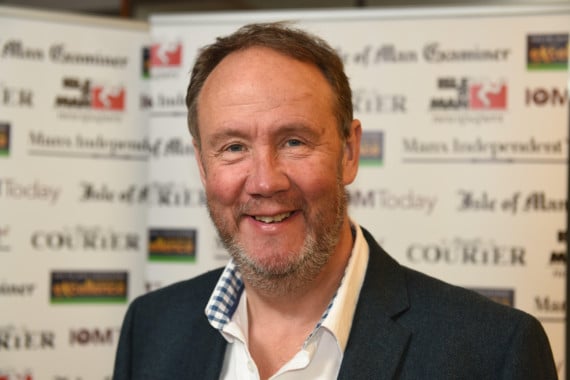
Our island must be responsive and adaptable to change in the wake of Brexit and looking to the future, the latest Topical Talks roundtable heard.
Businessman Stephen Bradley said: ’We have to be as responsive and adaptable as possible.’
’My feeling is that we are not as adaptable as we could be and we do want to try and put back, grow or maintain what we had before.
’It’s about flexibility and adaptability going forward.

’I recall the quote from Charles Darwin: "It is not the strongest of the species that survives, nor the most intelligent; it is the one most adaptable to change." ’
He added: ’We spend a lot of time predicting the future and I think an area in which we can work is on our skills base.’
Mr Bradley, who is chairman of the Business Isle of Man executive agency, was one of an impressive line-up of island figures who took part in a virtual Topical Talks, sponsored by Manx Telecom, and held during the ’circuit breaker’ lockdown.
Isle of Man Newspapers editor Richard Butt, who chaired the meeting on Zoom, asked how our relationship was going to work with the EU in the wake of Brexit, Britain’s exit from the European Union at the start of the year.
He asserted that we need to have some sort of relationship with the EU.
Tax consultant Paul Hotchkiss said he wondered whether the island’s relationship would change at all.
Mr Hotchkiss, managing director of Hotchkiss Associates, said: ’We are still going to be a ’’third country’’ as far as the EU is concerned. There are issues concerning customs and borders and VAT but I can’t see things changing in terms of our relationship.’
He added: ’I can see the EU becoming slightly more antagonistic towards us and so there could be risks coming from that.’
Mr Butt asked about political issues in view of the fact that Britain no longer had any MEPs in the EU.
He asked: ’Does that leave the Isle of Man in a more precarious position? And he questioned whether there might be a position in the future where the island might be blacklisted.
challenge
MHK Lawrie Hooper, who is a member of the Cabinet Office said: ’I think we shall see a bit more challenge probably from the EU going forward.
’But the Isle of Man really has always pitched itself as actually ’’we will do what we have to do in terms of international compliance’’.
’I’m not that overly concerned as the Isle of Man’s approach has always been ’’if they need us to do something we will crack on’’.
’The area for me that is a little bit of concern is the UK might now start to diverge from the EU on some of its requirements and going in a different direction and so we will probably as an island end up having to comply with different sets of rules depending on who you want to do business with. And most of our trade is UK based so obviously that is the key thing for us. Maintaining that link and keeping it as frictionless as possible.
’But if the UK government decides to start taking a slightly different tack to the EU then we might find businesses in the Isle of Man having to decide which set of rules they apply.
’It will just make things just that little bit extra complex for us.’
Paul Hotchkiss argued that if that happens then decisions will have to be made by affected businesses, because the Isle of Man might not be seen as the the best place to be located.
one step ahead
Mr Hooper claimed the island was one step ahead of the UK in terms of GDPR (data protection).
He added: ’It might be that this new world creates a slight grey area between the EU and UK, then maybe the Isle of Man might be well placed to say that it can act as the middle man.’
Tim Groves, residential director at Black Grace Cowley, turned to the property markets and said they appear to adapt to changing conditions.
He said: ’Covid has changed everything in terms of people’s willingness to move, time frames etc, but the market is still there and it is still performing.’
He referred to the recent sale of the PokerStars building at King Edward Bay.
He believed that indicated there was ’activity which shows confidence in the island in the wider sense’.
But he argued there were lots of commentators out there who were short termist and reacting to events as opposed to trying to predict the future. He said: ’I think it is very difficult to nail your colours to the mast in one particular way or another. Adaptability is the right word’
Mr Groves added: ’I am not an economist, I am an estate agent, but there are these grey areas where we fall potentially between two stools. The island in my view has got to be able to adapt and able to jump into a position that allows it to exploit opportunities where they arise.
’How you do that is difficult to know because we don’t understand quite yet what those opportunities are going to be. But we need to be able to quickly recognise them if we see it to our advantage.’
Paul Hotchkiss said: ’I think in that regard we are going to have to appreciate that we are going to have to change as a country to compete. Other countries are going to be changing partly through necessity because of their financial position after the pandemic. I can see many such countries tightening up their laws particularly given possible public scrutiny of offshore financial centres such as ourselves.
’We have to expect that is going to happen and we need to put ourselves in a position where we can react quickly to any such changes. That may result in us having to change our own laws and relationships with other jurisdictions very quickly.’
Referring to the property market Tim Groves pointed out that they are seeing interest from the UK in terms of investment opportunities here in the island.
He said: ’I don’t know a huge amount about Brexit, to me it has happened, but for me it is now about the future, and I think our best hope is that there is a limited impact on the island that allows us to seek out opportunities.
’I appreciate that sounds a little vague but there is no crystal ball on these issues.
’To me this is all about opportunity, about looking for the positives and looking at the island as a community and a business community to market ourselves and seek out the opportunities where we can find advantage. It’s an opportunity to ramp up the island’s PR, to put our heads above the the parapet and to maximise our potential. This will then lead to an influx of people and generate investment growth from the top down.’