
What links successful British entrepreneurs Lord Sugar, Sir Richard Branson, Simon Cowell, Karren Brady and Mary Portas?
They all shunned university to go straight in to the world of work and business where they have all made a name for themselves.
And it seems that going to study in higher education is not always the be all and end all for youngsters after they have finished schooling in the Isle of Man.
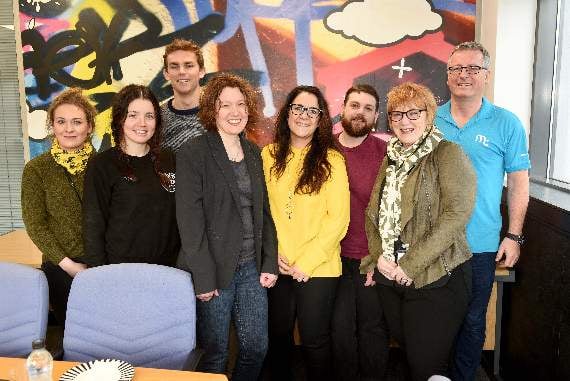
That was the impression during the latest in the series of Topical Talks, sponsored by Manx Telecom, at Isle of Man Newspapers.

.jpg?width=209&height=140&crop=209:145,smart&quality=75)

The varied panel that took part ranged from young entrepreneurs to experienced business people such as Manx Telecom chief executive Gary Lamb.
The discussion about university came about after Kylie Rollins, who works with about 10 people at the Secret Pizza Company in Castletown, said she has an ’awesome team’ at the business. She said: ’They are absolutely brilliant.’
’But now we are looking for people in certain focused skill sets and it has been very difficult to find them.’
This led to Gary Lamb pointing out that problems in recruiting people is sometimes an issue because schools seem to encourage youngsters to go and get a degree.
He told the meeting: ’I don’t have a degree because I knew what I wanted to do when I left school.’
Mr Lamb said a positive message about an entrepreneurial career should start in schools.
’The message has to go out that you don’t need to get a degree, you can go out and set up your own businesses and be successful. And you will enjoy it, it can be a great life experience.’
Mr Lamb added that ’some of the best people I’ve ever recruited did not have a university degree . . . you do not need to have a university degree to be successful.’
Kylie Rollins of The Secret Pizza Company said she had learned from an early age to be ’authentic with yourself’.
She said in her opinion, people were often expected to fit into a certain mould at school.
She said: ’It’s about giving kids the confidence to do what they want to do and giving them time to have part-time jobs and having the time to explore different things.
’Customer service, manufacturing, things like that can be fun.’
The panel agreed that having a paper round was a great part-time job for school students.
Talking about career paths, Emma Mann, newspaper sales manager, from Isle of Man Newspapers said she also chose not to go to university.
She said: ’I found that among my friends I was the only one not to go to university. I went straight in to work. But I found many of my friends came back from university and they were actually lower down, they were behind me in the workplace.
’And for some of them, what they ended up doing was in fact completely irrelevant to their degree.’
Kylie Rollins said: ’It is such a commitment at the age of 18 to be taking on a degree.
’You find yourself moving somewhere else, you take on a debt and you spend three or years doing a course that you might not benefit from.’
Gary Lamb said: ’I hear stories where people are told that they have to go to university but there is the risk that they will end up with loads of debt, they could get back to where they live in the Isle of Man where they might get a job at a lower level than those people who haven’t gone to university.
Miss Mann said she has helped organise work placements at Isle of Man Newspapers for people who have studied at university.
But she said their work ethic, compared to people who had gone straight into work, was sometimes different and even difficult to deal with.
’It’s as if I have to retrain their brain how to work because they are still in school mind,’ she explained.
Chairman Carol Glover, who coaches and mentors entrepreneurs, told the roundtable meeting that she got a ’’sandwich’’ degree from what was Teesside Polytechnic.
’But do you know what got me a job was the year I did working in industry.’
Miss Rollins said: ’It is about life experience and the people you meet.
’I never went to university but I feel it was far more valuable to build a career.’
Mrs Glover said a recent US study has shown 42% of under-21s want to be entrepreneurs, and 75% of Gen Zers say college isn’t the only path to a good education plus they fear taking on debt for education.
’They are going to have to be resilient if they want to stop the prevailing education system saying they need to go to university.
’And this includes parents, who may not have gone to university themselves, so want their youngsters to go to university.
’I’ve mentored two successful youngsters who’d previously stood against both in their young lives, it’s certainly made them stronger as entrepreneurs.’
Guy Wood, director and manager of recruitment firm Ascentiom, said it was important that members of the Manx population have the opportunity to get off the island and to be able to experience other places.
He said it was all about the people, with the links to the island, coming back here when the time is right.
He said: ’It is really important to get global aspirations and bring those experiences back to the island.’
Miss Rollins revealed she used to work at a leading island online gaming company before helping to set up the Secret Pizza Company.
Gary Lamb said it was about ’having an informed choice. I think at the moment the balance is far too weighted towards having a degree.
’If we could just help people understand there are a bunch of choices and actually going and setting up your own business and not going to university is a good option and suits some people.’
Accountant Pauline Smith from Greenwave, based in the south of the island, said she went to university.
’I studied Zoology with German. It would have helped, I suppose, if I ended up working in a German zoo! University can bring other benefits and allowed me to train as a Chartered Accountant and ultimately to reach where I am now.’
Guy Wood agreed saying that was a huge point to make.
brand
Chairman Carol Glover then turned the conversation to asking the question: ’How do you protect your brand when you are a start-up business? She said she had seen ’some terrible things’ happen to people she mentors in the last two years.
Miss Rollins said she had seen some of her branding copied, identically, by a company in the UK.
Voirrey Barron, of Manx Marketing Exchange, said: ’There is always a risk of others copying what you do even down to the creation of similar brand identities.
’It’s important to protect your IP (intellectual property). However remember that if you have a strong internal culture, stay true to your values as well as understand and communicate your points of difference, you will create a brand and customer experience that is incredibly difficult to imitate.’
She said that to some extent you can be flattered that others copy your brand identity or proposition. However this can also pose a decent amount of risk, if you haven’t taken necessary measures to protect your IP, whether that’s registering similar domain names or doing a full audit of the competitor landscape before you start out.
Gary Lamb says copying of brands ’happens everywhere.
’You only have to google something and you will see multiple companies with the same name.’
Chairman Carol Glover asked the group what they thought the key issues were to being an entrepreneur in the island.
She said: ’I’ve made a list and I will be interested how many of my ideas come up.
’Let’s see what you come up with, not everybody will agree but let us see what the list is.’
Guy Wood of Ascentiom said: ’I personally found that having quite a good structure is an answer.
’I also found it easy to access government when I came up with ideas and it was relatively easy to bounce ideas with government officials.
’Things like ’’What can I do to get things going?’’
’The support was very good and there are not many places in the world where you can have such access to high- ranking officials so early on in your career.
’Then you can back that with the fact that it is the Isle of Man with its international businesses and leaders based here.
’They are all accessible if you take the time to hunt them down, and ask the right questions.
’I think sometimes you get some negativity around starting up a business.
’But depending on what you are doing, I think that if you can get in front of the right people, which is much more available here than say the centre of London, it’s a real nice little microcosm in which to start exploring ideas.’â?©
Voirrey Barron from Manx Marketing Exchange said there will always be challenges when you set up a new business, it’s part of the journey.
’When you are starting out it can be quite isolating, which is why you often see new business owners frequenting cafes and coffee shops. The new co-working spaces are also great for those needing dedicated low cost office space, as well as environments to meet other like-minded people.’
She referred to places such as the Eagle Lab in Douglas and the Engine House in Castletown in addition to Noa Bakehouse and Cycle 360.
’You start out wearing many different hats.
’You’re the accountant, business development, client liaison, marketing, sales, as well as actually doing the all-important client work, so there is a lot of plate spinning, understandably.
’There may be moments when you feel overwhelmed and others when you’re coasting along famously, which is completely normal in business but not perhaps something you knew on day one, when you started out. I’d say resilience is hugely important.
’Once you realise that the ups and downs are part of building and managing a business, you quickly settle into it all.’
Carol Glover told of people she has mentored under the age of 25, who have struggled to get going and get support.
Guy Wood of Ascentiom said he is always very honest with people he deals with.
He said he was fortunate to have received some valuable mentoring advice from his businessman father.
’What I did do was create a group of people around me that I can draw upon, to ask the obvious questions.’
That had been the ’key thing’ for him.
Carol Glover said that was a really interesting point and it was important that people starting out in business should have people around them that they can trust.
Gary Lamb said there was ’huge value’ in having people around you that you can trust.
Carol Glover said the Chamber of Commerce was doing a lot of work on this subject at the moment, through its new Business Connex service.
Pauline Smith of Greenwave Accountants said: ’What I am finding now is that being an entrepreneur has become quite trendy.
’That is great. When I started six years ago that was not the case.
’People used to say to me : ’’Starting your own business? Why are you doing that?’’ ’
Mrs Smith said the hard fact is that starting a business is hard work and often not a lot of fun. ’I get people I know phoning ing me in tears and saying: ’’This is horrendous, I
can’t do this any more.’’ ’
Mrs Smith, who has helped mentor people, said she had to be honest and tell people in reply that it is not easy to set up your own business.
Kylie Rollins, from the Secret Pizza Company, said one of the things she has learned is that everybody feels the same.
She said: ’Once you break down that barrier and stop thinking that everybody else is organised and that they have got their lives together, once you realise that behind that wall there is somebody there in tears, who is stressed about their businesses as well, it is kind of liberating.
’You realise that people whose businesses all seem to look amazing, are in fact struggling too.’
Gary Lamb said that it’s often the same story for some bigger businesses too, they can struggle too.
He said: ’In many ways everyone is in the same boat, and they are sharing and talking about their experiences.’
Miss Rollins said: ’Sharing that experience is something that helps you bond with people very quickly.
’Someone might say they think they are going mental. Well, it’s happening to other people too. It’s that kind of situation.
’And you can end up making some very good friends because of bonding and talking.’
Carol Glover said that people have to know who they can trust.
Mr Lamb said budding entrepreneurs needed the focus,confidence and determination to keep going.
Mrs Barron talked about the importance of talking to other people who were in the same boat.
Carol Glover said it was a sign of strength and a growth mindset in people if they accepted help from other people and mentors.
She said from her experience: ’I enjoy being entrepreneurial and the company I work for is like that.’
She turned the conversation around to the finance and funding areas and asked everyone in the room how they had found that in relation to running a business.
Miss Rollins said her company received a loan from an island bank and that was amazing. ’They were very good to us.
’But I think they took a gamble in backing us .’
Mrs Barron said she received financial support from the Isle of Man Government’s Department for Enterprise business grant scheme and that was really helpful.
’The financial support was ideal, helping me to purchase office and professional equipment to help get the business going. The mentorship was also superb.’
Ben Thornton from Print and Press said when he first started he got involved in the micro-business start-up course run by the government’s Department for Enterprise.
’I started the business with no money. That was the problem.’
Talking about finance and funding Pauline Smith from Greenwave said: ’It is definitely more challenging in the Isle of Man than it is in the UK.
’This is because in the UK there is a lot more competition, there is crowdfunding and there’s more banks.
’To be honest, there is more choice in the UK.
’There are grants available here in the island but it can be incredibly difficult to meet the criteria needed.’
She knew of one person who spent hundreds of thousands to relocate to the island but had yet to receive a penny in grants.
She said: ’It is challenging.’
Mr Lamb stressed the importance of a mentoring network.
He said: ’If you build up a mentoring network you find that those who tend to mentor who have been successful in business, will often be interested in actually investing in those businesses.
’I’ve got involved in quite a few businesses and you find you want to start supporting them.’
Guy Wood said he knew of people in the UK who have a vested interest in the Isle of Man who wanted to help.
He talked of ’old boys networks that were operating in places such as South Africa and New Zealand.
’So there are external networks and investors around and it would be quite powerful if they were brought under one umbrella.
’It is something we have looked at, through the business, to sell the island as a place to live and work.’
Mrs Glover referred to something she had come across called ’HOF’ otherwise known as the ’hang out factor’.
And she said: ’It is really important to be different and the Isle of Man has to celebrate its differences.
’As an international coach it is different for me to say I am from the Isle of Man. I can bring up subjects like the Bee Gees, Pilates and the TT Races.
’By doing that it establishes a level of memorability that helps you stand out.’
The group was then asked this question: ’If we want to have a community that wants its entrepreneurs to succeed at world class level, what is the one thing that you would like to see improved in the Isle of Man?
Kylie Rollins said: ’I think that it is the community, that is so important.’
This led Mrs Glover to throw in another question to consider, which was : ’What do we need to do to build a supportive community?’
Guy Wood of Ascentiom replied in one word: ’Mentorship.’
Pauline Smith from Greenwave Accountants said: ’Entrepreneur culture. Make it basically OK to be an entrepreneur.’
Ben Thornton from Print and Press said: ’Community.’
Kylie Rollins said: ’I don’t think it is something that can be forced, it has to be natural and authentic.’
Voirrey Barron said: ’Continue to create opportunities to allow us to network and collaborate. Mentorship is also important.’
Mrs Glover referred to what she sees as the importance of social media and how her posts about entrepreneurship in the island were read by thousands of people around the world.
She asked if anybody knew the average amount of time it takes for a start-up business to be successful?
She said it was 12 years for a business to ’get to the point of maturity on the growth pattern they are on and not having any borrowings.
Miss Rollins from the Secret Pizza Company in Castletown said: ’We are not there yet.’
Mrs Glover then asked: ’How could we build a supportive community?
Gary Lamb said he knew of one ’very successful guy’ who had moved to the island and really wanted to ’give’ something to the Isle of Man, ’but how do you do that?’
Mr Lamb said: ’As you get older and you get greyer you want to give back, there are loads of people like that.’
Mrs Glover returned to a subject she raised at a previous Topical Talks gathering before Christmas and that was her admiration of ’funky’ Iceland, the country.
She asked what the Topical Talks panel think they can do to attract under-35s to the Isle of Man?
Emma Mann from Isle of Man Newspapers said a lot related to lifestyle. She referred to the ’Destination’ series of newspaper supplements which centred on people who had relocated here from so many different places.
’It is the lifestyle element that we could move on.’
Emma added the island could ’be a lot more sexier’ for the under-35s.
She praised what was happening on the seafront in Port Erin where there are businesses such as Foraging Vintners, the Bay Hotel and South restaurant, attracting attention.
’It makes you want to get on the train and go down south. That is attracting younger people.’
best kept secret
Mrs Glover said: ’The thing about this is that we are almost like the best kept secret here in the island.’
Voirrey Barron, from Manx Marketing Exchange, said she had noticed in the last year or two, there had been some positive changes to showcase the Isle of Man through the likes of Destination IoM and initiatives such as the Isle of Man Graduate Fair organised by Locate.im but much more needs to be done.
Miss Mann said people were talking more to each other.
’It’s all about the ability to relate. In London people don’t leave their 20 mile radius.’
Ben said people wanted to be able to have more fun, and places to meet, such as Liverpool where so many popular places are popping up.
Mrs Glover said she was handed a list showing the top three things that are important to millennials.
The top choice was apparently the environment.
She said: ’Saving the planet is such a big issue among young people I talk to.’
She referred to biosphere being promoted in the island.
Kylie Rollins said she had been to two meetings about biosphere and still did not understand what it was about.
Mrs Smith said other countries really pushed the biosphere subject strongly.
Mrs Glover said many thought biosphere was about the environment but she believes it is also about lifestyle and a sustainable future.
The environment is the core, however so much radiates out from this.
She said she recently read a book called Live Big.
’We are very guilty of not ’’living big’’ and celebrating the things that are really good about being on the Isle of Man.’
Guy Wood said: ’Employers need to showcase achievable career pathway and opportunities to progress so they may attract workers in their 20s and 30s.
’Even if this means a year or two working in areas/jobs/sectors that they hadn’t previously considered.’
Kylie Rollins said we have to be careful over grants that they are not just sold on a financial basis.
She said: ’There are so many jobs here that you could have and be really successful in and get a great bank balance from, but not necessarily a very fulfilling life.
’I do think that is something missing from the culture that is spread across the Isle of Man.
’It is finance driven and so many people I have worked with, hate their job and live for the weekend. What sort of a way is that to live?
Ben said as an employer it is important to sell not just the tasks you are doing in a job but what you might be able to do in five years’ time, pathways for the future, offerings that are really attractive to under-25s.
Kylie Rollins said: ’I think a lot of that connection is missing from modern life, because people interact on their phones, on social media they present this perfect life.
’Church on a Sunday until recently would have been the base for so many communities, people talked and had shared values from going to that shared place every single week and that is not there.’
Voirrey said that with technology developments, even as basic as contactless bank cards in retail, she noticed how fewer and fewer people now made eye contact at the point of sale or truly spoke to each other.
’It is frightening. And it is not ideal for anyone who is isolated, elderly or otherwise.
’Human interaction and networking for start-ups is so important.’
Wrapping up, the panel was asked what they would like to happen to build the community.
Kylie Rollins said: ’Naturally entrepreneurs are quite curious people and want to learn more and develop themselves.’
Voirrey Barron said it was important for entrepreneurs to know where to find the information and support that is out there and to take advantage of free advice and financial support if this is needed.
Guy Wood said there had been a massive generational change over the last few years with the development of technology including podcasts.
Comments
This article has no comments yet. Be the first to leave a comment.