
Most of us, if asked to name the most precious thing in our lives, would say without hesitation: ’Our children’.
So how is it that the pre-school childcare sector - and its workers - are so undervalued?
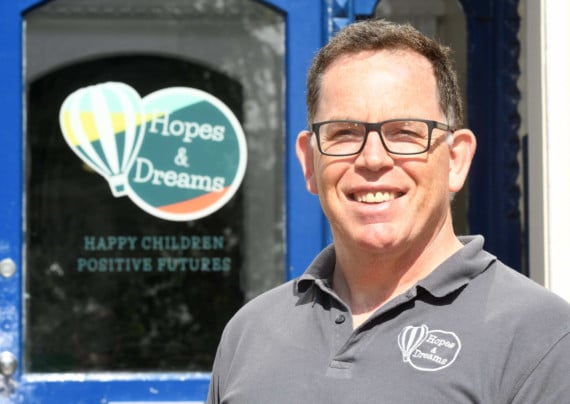
Working Week talks to Gary and Laura Peirce, owners of Hopes and Dreams nurseries.
’I think Covid has produced a number of interesting outcomes. One is a better understanding of the role childcare plays, for the island, for the children, for our economy,’ says Gary Peirce.


.jpeg?width=209&height=140&crop=209:145,smart&quality=75)
.jpeg?width=209&height=140&crop=209:145,smart&quality=75)
He and his wife, Laura, operate six nurseries around the island: Parklands at Mooragh Park, Woodbourne Road and Tennis Road in Douglas and at Ballasalla, Ashley Hills and Rushen schools. They also run Buzz, an after-school and holiday club. In total they are registered to care for 335 children.
Covid saw the pre-school sector designated by government as a sector of strategic national importance, as a number of nurseries remained open during lockdown to look after the children of key workers.
Gary now represents the sector on the government’s childcare strategy working group, along with representatives from the Chamber of Commerce, Department for Enterprise, Education, Treasury and Social Services.
He says: ’They’ve recognised that it’s important to work with the sector which is all very positive and we’re delighted we’re playing our part in that.’
However, for Gary the working group’s remit is problematic as he explains: ’We are looking at the provision of childcare for the under-twos. My concern is that what’s best for the children isn’t actually the remit of the group, which is to fix a problem of there not being enough childcare.
’There is a demand and a lack of supply for under-two provision and that impacts on people’s ability to go back to work.
’We don’t do under-twos in our nurseries and the reason is personal, it’s our stance. We don’t believe that a nursery is the best place for children to be when they’re under two. Child development doesn’t provide a need for them to have that group care environment.
’Whilst accepting that not everybody has the option to make the choice that they want, for us it’s best for under-twos is to be with parents; then extended family members such as grandparents, and beyond that childminders because they’re the closest to a family home environment. Nurseries then come fourth on the list.’
Gary’s preferred option would be for schemes to incentivise and mentor child minders, to increase the numbers.
Care for the under twos is also simply not profitable for nurseries, because of the staffing ratios but, as Gary says, workers in the pre-school sector are still woefully under-valued.
He says: ’Nursery costs an awful lot of money for parents, it’s not cheap.
’Government do recognise the value of it and provide that preschool year because they know it’s really important for children and saves them money further down the line, but still there’s not enough money in the sector to pay people what they’re worth which is such a shame.
’We’ve fought hard to build up the recognition for what they do, the value they bring and how important their role is.
’Looking after somebody else’s child and helping them get prepared for life, there’s nothing more important, but the world doesn’t value that the same way as someone sitting in an office moving money around on a screen and getting comparatively very well paid.
’But our people aren’t driven by the money, they’re driven by just loving what they do, which is very fortunate for us.’
There has been much research in recent years showing the importance of the pre-school years in children’s development. The Duchess of Cambridge has famously championed recognition of this. Earlier this year she launched The Royal Foundation Centre for Early Childhood, a new initiative dedicated to raising awareness of this crucial period in a child’s life.
It’s all part of an increasing acknowledgement that it is not enough just for a young child to be kept safe and occupied whilst we are at work.
As Gary says: ’For us this isn’t about getting children ready for school, this is about getting them ready for life, and actually the children’s brain’s develop the most between the ages of three and five so it is an absolutely key element of a child’s development, the age range that we want to focus on and be expert in.’
Gary’s wife, Laura, was a primary school teacher and deputy head for 25 years before joining the business. This included three years in pre-school assessment. She also sits on the Special Needs Early Years Code of Practice Working Group.
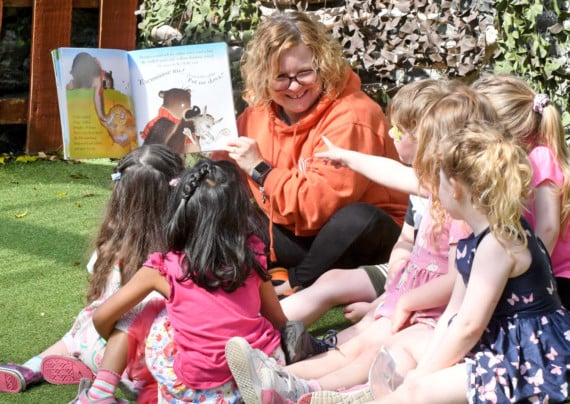
She and Gary have been implementing the Curiosity Approach at their nurseries. This turns on its head much of the traditional thinking around preschool provision. Modern toys and technology are removed from the learning environment and replaced with everyday items to encourage children’s natural curiosity and imagination and their eagerness to explore and create.’
Laura explains: ’We want to encourage children with a growth mindset not a fixed mindset.
’It’s allowing children to value their own curiosity through a lot of things, for example ’loose parts’. When you put children’s clothes in the washing machine, their pockets are full of stones, sticks, string, pine cones, all those kinds of things, and there’s a real clear lack of plastic.
’In the nursery there’s also a real clear lack of plastic and it’s not about getting rid of plastic it’s about getting those children to be creative. So instead of having a [toy] garage that could only be a garage, we give children planks, blocks, ramps and they could make it anything.’
Gary adds: ’What we’re trying to influence is give the power of learning to the children rather than ’do the learning to them’. If they’re tagging along with 10 other children we’re getting them to sit down and paint in this half hour block and then we’re getting them to go somewhere else, that’s programming children just to be occupied.
’Children are born with an innate curiosity about the world, that’s how they learn, through their play typically so we want to make sure that they’re engaged with that. Children will engage, deeply, in learning when they’re playing, as long as it’s something they’re interested in.’
Laura says: ’Children really need two hours of uninterrupted play where they can really get into their learning and the adults are there to help the children facilitate that. It’s about letting children have that time.’
There are a growing number of ’curiosity based’ nurseries in the UK but so far Hopes and Dreams are accredited to offer this appraoch on the island.
Gary said: ’We introduced it two years ago and and it’s changed dramatically what we’re able to do for the children.’
Laura added: ’We have a real passion for the children and for the sector. We want to provide top quality childcare because children desrve it and families deserve it.’
In separate box:
The Isle of Man Government’s Child Day Care Centres Registration & Inspection Unit sets minimum standards for nurseries and other early years childcare environments.
These include standards concerning qualifications and staff ratios.
The recognised qualifications are Level 2 and Level 3 Diplomas in children care and education.
All supervisors must hold a level 3 Diploma qualification appropriate for the care or development of children whilst at least 50% of all other child care staff on duty at any one time must hold, as a minimum, a level 2 qualification appropriate for the care or development of children in an early years setting.
Staff ratios should be: one member of staff for every three children under 2 years and one to every eight children aged 2-7 years.
Each nursery will set its own pay rates but for a 37 1/2 week average pay for the sector ranges from £16,000 - £19,000.