
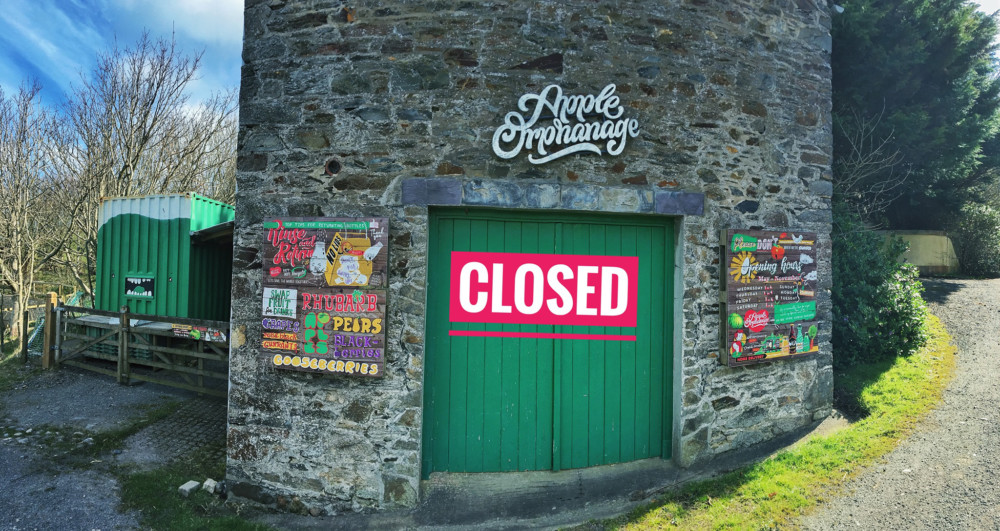
When Charlotte Traynor and Will Faulds started on a journey, nearly two years ago, to expand their fruit exchange and drinks business they had no idea how long it would take and how many problems they would have to overcome along the way.
They still haven’t come to the end of that journey but hard work, adaptability and a make-do-and-mend approach in keeping with their environmental ethos have kept them battling on.
It was a message on their Facebook page a few weeks ago which summed it all up, the announcement they ’were hoping not to make’: ’Sadly we’re not going to be able to open the Fruit Exchange in 2021’.
Rewind to early 2020 and the couple were full of optimism for a number of new projects they had planned.
.jpeg?width=209&height=140&crop=209:145,smart&quality=75)
Will, a design engineer, had been working on machinery that would enable them to start canning their sparkling drinks: ciders, keshals and presses, that April.
Charlotte says: ’We had spent all our time, money and resources gearing up for that so when Covid hit we had nothing in reserve.’
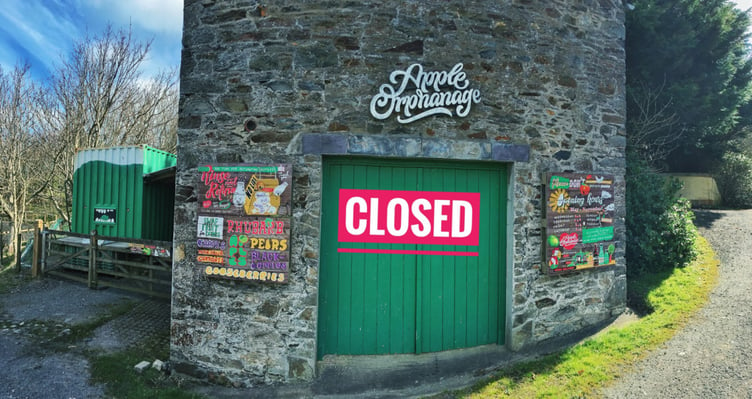
The Apple Orphanage is primarily based at Will’s parents’ property on the Peel to Kirk Michael coast road. But the access isn’t ideal and they were outgrowing the building they were using so Charlotte and Will had also been engaged in developing a new site across the road.
It is this which has been hit hardest by financial and supply problems caused directly or indirectly by the pandemic. These have added an extra layer to all the usual things that arise over planning and other issues which are an expected part of any development project.
Take the entrance and driveway into the site: ’It’s much larger in scope than we’d imagined,’ says Charlotte.
The speed of the road outside and the fact that there is only one way in and out have meant them almost doubling the width of the driveway and providing a 26m turning circle outside their new building, which is still not completed.
Charlotte says: ’Planning permission was much more complicated than we had thought. Because there had never been building on the site there was no premises for building, so this was totally understandable.’
Planning permission was finally granted at the end of October 2020 by which time the apple season was effectively over with nowhere for people to bring their surplus fruit and this left Will and Charlotte with no raw material for making drinks.
Then followed by two more lockdowns during which it became increasingly difficult to get hold of building materials.
They did try and use as much recycled material as possible: ’Because we work with wasted fruit, this is in the true spirit of the Apple Orphanage.’
Charlotte likes the fact that some of the stone in hard core that forms the driveway was ’a bit of the old Douglas promenade’ and that they also acquired a collection of old benches that were being thrown away.
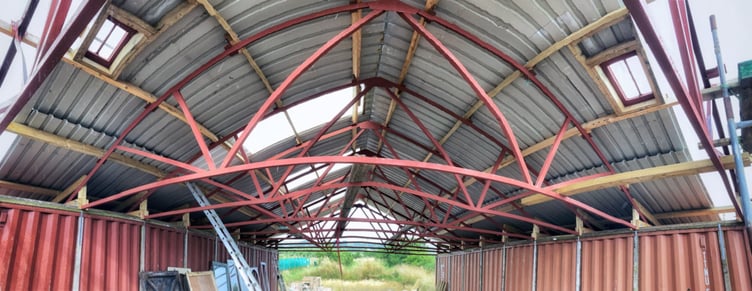
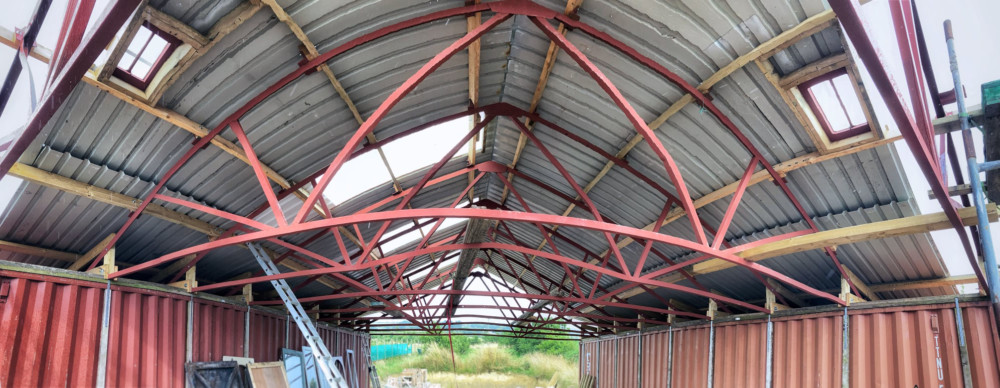
The new shed they are building will accommodate a shop and tasting area, product storage and somewhere for people to drop off fruit where it can be stored along with orchard tools.
The shed is formed from two old 40’ containers bridged by steel roof trusses, also recycled. It is typical of the lockdown-related delays that, although only coming from Stockport, the trusses took seven months to arrive.
The roof itself was from the old Derby Castle tram station, supplied to them by Collins Steel: ’They reached out to us and we can’t thank them enough,’ says Charlotte.
Despite the delays, she hasn’t lost sight of their vision for the future and she likes to envisage her customers sitting on one of the benches outside the shed on a fine day, sipping apple juice and enjoying the stunning views over the west coast to Peel Castle.
She also says that they have enjoyed the whole process of developing the site:
’It was such a different project to immerse ourselves in so much fun learning all the different skills and tools.’
Being on an exposed site they have planted an extensive windbreak each side of the drive, using mostly native trees, especially alders which do well in wet ground.
’It was such a damp site there were only reeds growing on it. You couldn’t even drive a tractor or a 4x4 in without it getting stuck in sludgy mud,’ says Charlotte, adding: ’We were very lucky that, out of more than one hundred alders planted, we only lost two in the end.’
They have also planted willows, the only non-native trees they have used but which are clearly an obvious choice for wet ground and are doing well.
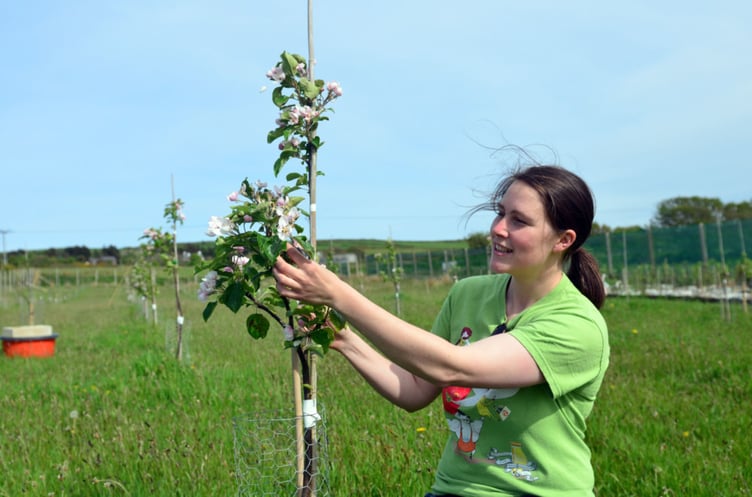
This new site has given them the space to plant several acres of their own apple trees, as Charlotte explains: ’This is a long term plan. We have planted around 120 different varieties of British and Manx apple trees. This is to preserve the heritage varieties which are largely dying out.’
Throughout all the delays with the development, the fact that people couldn’t bring their surplus fruit to them meant that she and Will had no products of their own to sell. They decided to start wholesaling as a temporary measure and contacted businesses similar to their own in the UK.
For once their timing couldn’t have been better: the UK was still in lockdown, with pubs and restaurants closed, so these businesses had a stock of products they couldn’t sell. On the island everything had just opened up again so there was a ready market for them.
’We only brought in drinks of Apple Orphanage quality,’ says Charlotte.
These were from Flawesome, which only uses ’wonky’ fruit and Kombucha Kat, who supply one of the only raw, unpasteurised kombuchas in the UK.
Even this has not been without its delivery-related difficulties and, added to all of this they had a burst water pipe in the office above their processing area which flooded the place and they will now have to redo the whole ceiling.
But they are still smiling and, until they can get the fruit exchange up and running again next years, they are currently working on a project to update their website with the Flawesome and Kombucha Kat products so that customers can order them direct. They have also both been teaching a couple of days a week at UCM to supplement their income.
Charlotte says she has been sad to see that some of their friends in the artisan food business have not been so fortunate: ’For some of them it’s just been one thing too many. We’re all in it for the love of it there’s no huge financial reward.’
And, for all their determination she is not willing to put any kind of date when everything will be completed, saying: ’So many things have cropped up I can’t imagine when things will be running smoothly again.’
Comments
This article has no comments yet. Be the first to leave a comment.