
We last visited the Children’s Centre Farm back in 2019. At the time they were looking at some projects that would make them more sustainable. They were also starting to introduce a commercial element that would bring a small amount of income into the farm.
This has seen the farm developing into an interesting model which incorporates some good ideas for anyone wanting to run their own smallholding.
For head of The Children’s Centre, Joff Whitten, the development of the farm is a fine balance as it has to be done without losing sight of their core purpose, to provide therapeutic and learning experiences for the children and families who attend the centre.
The animals at the farm, including chickens, donkeys, goats and pigs, are a good example of this ethos.
.jpeg?width=209&height=140&crop=209:145,smart&quality=75) Best pictures as 'special' Guys and Dolls show captivates Gaiety audience
Best pictures as 'special' Guys and Dolls show captivates Gaiety audience Offensive graffiti daubed outside the home of Michelle Mone and Doug Barrowman
 Charity appeal for information after barrier removed from playing fields
 After days of normality, bus drivers will return to the picket line on Friday
Joff says: ’All our animals are essentially pets. It’s not a petting zoo but that’s not a bad analogy because they are therapeutic animals and they are company.
’Animals need food, shelter, warmth and company just much as people do.
More often than not, our animals are used because they can reduce stress, anxiety, and depression, ease loneliness, encourage exercise and playfulness. Children are referred to us for wide ranging reasons such as; additional learning needs, mental health challenges, domestic abuse, bullying, poverty, substance misuse and other family challenges. So the animals give us a way to work with children to help them learn how to manage their own emotional wellbeing and support their self-regulation, eventually transporting these skills back into daily life.’
The children learn some of the basics of caring for the animals whilst forming relationships with them that they often find hard to do with other people.
They also learn about growing and caring for plants.
In the farm’s polytunnels they grow an astonishing variety of chillies, including the infamous Carolina Reaper. They have done so well with them that they are starting a trial to supply local food producers such as Radcliffe Butchers, Noa Bakery, Davidson’s Ice Cream and Versa who will use them in their products
And they have also started to make a variety of jams, pickles and chutneys in the farm kitchen from the chillies and other fruits and vegetables they grow. Going back to the farm’s core purpose this has to remain primarily a learning opportunity for the children but, as it turns out, their chilli jam is so good it won first prize in its section at this year’s Royal Show.
Joff says: ’Our model is not one of production, we do it to order. So when we’re leading up to something like the Royal Show we’ll maybe up our output slightly.
’For us, this is the future: if we can set up a nice online shop, for example. And if somebody wants to buy jam, and they’re happy for it to be a charity that’s benefitting from it, then they might not be bothered if the jam arrives on Wednesday rather than today.
’We’re putting the principle of what we’re doing behind it.
’We are also working in partnership with one of our volunteers Chris Brown, a beekeeper who now has three active hives at the farm and we are looking at developing these skills at the centre further so we could make our own honey,’ says Joff.
The farm is on a windy site and their soil is ’not the best’ so a project to plant fruit trees, again primarily as a learning experience for the children, has had to be tailored accordingly, as Joff explains: ’Rather than just putting apples in and hoping they’ll be fine, we put in about 10 different things - cherries, apples and pears, various different fruit trees, just to see what will take. The trial began with planting at the beginning of the summer and they seem to be doing OK.’
The farm’s small flock of sheep weren’t tupped last year because of uncertainties to do with Covid. Joff says: ’We’re not sure whether they will be tupped this year either. We may just get some megs. Our neighbouring farmer, Adam Kelly is superb and he generously gives us his time as and when he can.
’It suits our needs really - having lambs around is lovely and glorious in the spring but there’s also the element of possibly losing one and having to explain this to the children.’
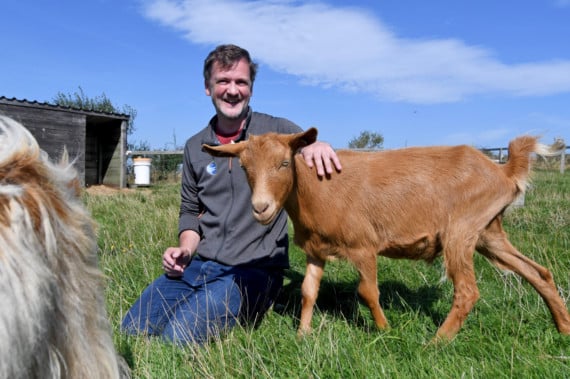
The farm’s two goats, Andrew and George, are hand reared Golden Guernseys from Close Leece Farm: ’They’re very friendly and lead trained so kids can take them round the site,’ says Joff.
Precious the pig who we met on our last visit to the farm is now getting on a bit.
’She was retired when we got her and we think she is 17 so we’re very chuffed she survived last winter,’ he adds.
They also have two New Zealand Kune Kune pigs, Rodney and Paddy; two donkeys, Dougal and Juan, chickens and some Indian Runner ducks. They are currently working on a winter stabling area for the donkeys, again with input from the children: ’Animal habitats are really important to us and we try to build them, as much as possible with young people and, if not with young people, with volunteers,’ says Joff.
A major project since our last visit has been the installation of a solar energy system which makes a big contribution to the farm’s sustainability, which resulted in the centre winning the Energy Category at this year’s Biosphere awards..
Joff says: ’Thirty-six metres of solar cells runs the whole farm. Our power costs were £10,000 a year: we can cover that and also return £1,000s worth of electricity back to the grid.
’We’re self-sufficient, we’re off-grid, and we’re going to do a big project around grey water capture. The polytunnels will be partially watered by grey water.
’We grow enough food for our needs, we’ve got a forge and a furnace, and we’ve got our woodworking shop.
’But actually, the way we are thinking of it, it’s a 360 degree therapeutic learning environment. We have everything that a child might find inspiring, and our job is to find inspiration with them.’
Comments
This article has no comments yet. Be the first to leave a comment.