

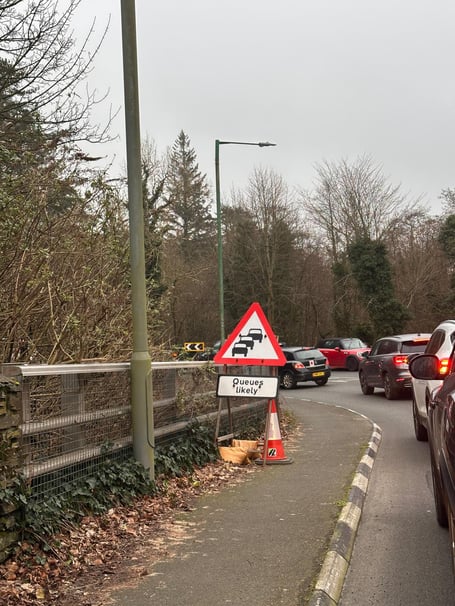
Motorists say traffic congestion in and out of Douglas remains a major issue at peak times despite changes introduced to traffic light timings earlier this week.
The adjustments were made to traffic lights at Anagh Coar, Groves Road, Pulrose Road junction, Brown Bobby, Lord Street and Quine’s Corner.
However, some drivers have taken to social media to claim the changes have done little to improve the flow of traffic.
.png?width=209&height=140&crop=209:145,smart&quality=75)


.jpeg?width=209&height=140&crop=209:145,smart&quality=75)
One reader told Isle of Man Today that their usual morning commute from Peel to Douglas took almost an hour on Thursday morning, when it would normally take less than half that time.
‘I was queuing more than 25 minutes to get through the Quarterbridge roundabout,’ he said.
Meanwhile, another reader said: ‘Total chaos caused by bad planning, no risk analysis or alternate traffic plans, heads need to roll. This is costing the islands businesses a lot of money.’
Another added: ‘There’s no common sense used whatsoever with all these road works going on at the exact same time’.
Traffic delays have been widely reported this week, with congestion stretching along the A1 Peel Road as vehicles approach Quarterbridge and Braddan Bridge.
All week traffic coming from Peel has reportedly been backed up as far as Glen Vine during busy periods.
Motorists travelling from the south of the island also faced lengthy delays earlier in the week after the closure of a key route into town.
At one stage on Monday, the tailback from Fort North Roundabout stretched back as far as Fairy Bridge.
The bus strike, set to continue from 2am tomorrow (Friday), likely won’t help matters.
The disruption follows the closure of Old Castletown Road at White Hoe while Manx Utilities carries out essential maintenance work at a pumping station in the area.
Elsewhere, a number of other roadworks and closures are currently affecting routes around the Island, including work at Braddan School, Kewaigue Hill, Glen Helen, Bray Hill, Sulby Bridge and Braddan Bridge.
Ongoing works at Braddan Road and Cooil Road have also added to delays during rush hour.
A spokesperson for the Department of Infrastructure said: ‘The DoI has made changes to the timings on the traffic lights at Anagh Coar, Groves Road, Pulrose Road junction, Brown Bobby, Lord Street and Quine’s Corner to try to mitigate the increases in traffic volumes caused by the closure.’
Meanwhile, Manx Utilities said the work taking place at White Hoe forms part of an ongoing programme to ensure the island’s wastewater infrastructure remains ‘reliable, resilient and fit for the future’.
Access to the White Hoe Industrial Estate is being maintained via Kewaigue Hill Road, while access into Douglas is being directed via Quarterbridge.
A spokesperson for Manx Utilities apologised for the disruption caused and explained the complexity of the work.
They said: ‘Manx Utilities is carrying out essential maintenance at White Hoe to replace a large access cover located above an underground chamber measuring approximately 6m long, 2.5m wide and 3m deep.
‘This chamber contains key valves for the wastewater main running from Douglas to Meary Veg.
‘Because of the chamber’s size, depth and position within the roadway, the access cover must be removed and reinstated in multiple precisely aligned sections, with time required for new concrete to cure without vibration.
‘A full road closure is essential because the installation must take place in a completely controlled, vibration-free environment.
‘Even minor traffic movements would transmit vibrations through the carriageway, increasing the risk of misalignment during the precise reinstatement process and undermining the long-term integrity of the structure.
‘A temporary working platform has been installed within the chamber to facilitate safe working at depth.
‘While the road is closed, three additional manhole covers are being replaced on behalf of the DoI.
‘This work has been intentionally scheduled now to eliminate the need for further disruptive closures in this area at a later date, ensuring the wider reinstatement is completed efficiently and with minimal future impact.’