

There are many traditions, stories and customs in the Isle of Man, some of which are still enacted and recognised today, and some of which have vanished into the mists of time.
Very soon, hopefully we will all be hearing a familiar song, sung by children, as they make their way from house to house, dressed as ghouls, ghosts and witches.
’Jinny the witch flew over the house, to fetch a stick to lather the mouseâ?¦’
But did she, though?
.jpeg?width=209&height=140&crop=209:145,smart&quality=75) Best pictures as 'special' Guys and Dolls show captivates Gaiety audience
Best pictures as 'special' Guys and Dolls show captivates Gaiety audience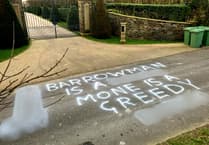 Offensive graffiti daubed outside the home of Michelle Mone and Doug Barrowman
 Charity appeal for information after barrier removed from playing fields
 After days of normality, bus drivers will return to the picket line on Friday
As the end of October looms, people all over the Isle of Man will soon start discussing what the ’true’ Hop tu Naa song is.
Is it your mother who’s gone away? How did get Jinny get over the house? And was it even Jinny?
There’s a lot we can learn from looking at the song, like where the name of the song itself actually comes from.
Some of the earliest versions of the song, from the 1840s, begin ’Noght Oie Houney’ - ’Tonight is Houney/Hollantide Eve.’
This ’Hollantide Eve’ name for the evening remained through to the mid-20th century, when it was displaced by ’Hop tu Naa’,
Of course, this name comes from the song’s refrain-’it’s Hop tu Naa (singing) night’.
In fact, one set of the words, dating back perhaps 200 years, speaks of ’Tonight is New Year’s night.’
This supports the theory that ’Hop tu Naa’ relates to ’Hogmanay,’ Scottish New Year’s Eve.
The thought is that in pre-Christian times the year was measured from November to October. So, October 31 was indeed ’New Year’s Night’.
Scholars might debate this, but one thing beyond doubt will surprise many: Jinny the Witch is a relatively recent addition.
Versions of the song were recorded for decades before Jinny arrived, and even then - in the 1890s - she was ’Jenny Swinny’ or ’Jinny Squinney’.
It was only in the 1950s that she emerged at last as a witch.
Admittedly, Jinny appears to be witch-like in going over the house.
But one of the earliest versions of this comes from T. E. Brown in the 1890s:
’Jinny Squinney went over the wall, to get a rod to beat the foal,
Jinny Squinney went over the house, to get a rod to beat the mouse,
Jinny Squinney went up to the claddagh, to get an apron full of barragh.’
The more you look into it, things don’t clarify; they are confused - crazy cats appear, Jinny begins to eat horses and dogs and even fingers turn up.
In fact, there never has been a single ’true’ Hop tu Naa song. There is a riot of change and difference all the way back.
If one version of the song were ever to become the ’correct’ version, something would be wrong!
So, it’s right that we should disagree about the ’true’ words for our Hop tu Naa songs each year.
Let’s sing, but let’s not sing in unison. Let’s celebrate our glorious difference!
More information about the song and other aspects of Hop tu Naa is available courtesy of Stephen Miller on the Culture Vannin website.
by James franklin
Educational Resources Officer
www.culturevannin.im
Comments
We've recently changed our login process. If you have an account for commenting, you will need to re-register on the login window.
This article has no comments yet. Be the first to leave a comment.