
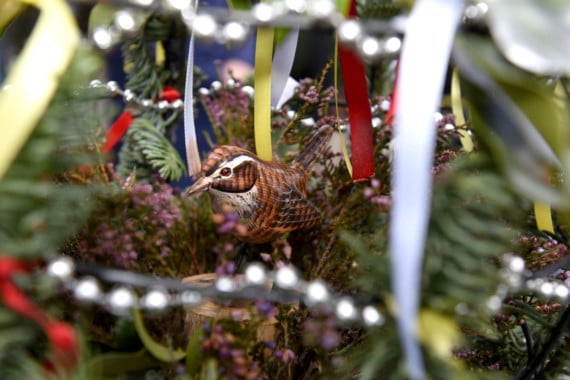
You have heard of the Moddey Dhoo of Peel Castle, but how about St Catherine’s hen of Colby?
Although there are many animals in Manx folklore, it is birds which start to dominate at this time of year.
Of course, the most important we hear from is the ’King of All Birds’.
When all the birds held a competition to determine who should be king, it was the eagle who flew higher than all the others, but it was the clever wren who hid under his wing and flew a short space above him!



This is mentioned at the end of the Hunt the Wren song: ’The wren, the wren, the king of all birds
Was caught St Stephen’s Day in the furze!
’Although he is little, his family is great
We pray you, good dame, to give us a treat!’
Another Hunt the Wren story is of the enchantress whose beauty mesmerised all the Manxmen.
But inevitably she grew tired of them and tricked them into drowning in a stream.
She then changed herself into a wren and escaped the vengeance of the Manx women.
In memory of this, the Manx people go out dancing and singing around the wren on St Stephen’s Day, or Boxing day, on December 26.
Another popular bird in Manx folklore is the lhondhoo, or the blackbird, who features in a lovely Manx song:
’Lhondhoo, lhondoo
Vel oo cheet?
Vel oo cheet?’
This is translated as:
’Blackbird, Blackbird,
Are you coming?
Are you coming?’ This is sung by the mother, waiting on her nest.
But there she waits as her husband fails to return to help with the children.
If you listen closely to the bird’s song in the wild, you will still be able to hear her singing this song.
The lhondhoo also caught out a crooked miller in Baldwin.
It spotted him taking a double measure of corn and cried out noisily in Manx from the bush outside:
’The miller of Baldwin is a bad rascal!
He is the biggest thief on the earth!’
The miller hastily put back the stolen corn.
Another worthy bird was the curlew, who helped St Patrick when he was lost in mist at sea with a sea-beast after him.
The curlew called out from Peel Hill: ’Come you! Come you!’ and, recognising the call, St Patrick leapt to safety on the hill.
In repayment, the saint declared that no one would ever find the curlew’s nest.
Rather less fortunate was the afore-mentioned hen at Colby.
A group of young men used to walk around the long-gone Colby fair on December 6, which was then known as ’Laa’l Catreeney’, or St Catherine’s Day, carrying a dead hen whilst singing the sad, mournful song, ’Kiark Catreeney Marroo’:
’Catherine’s hen is dead,
You take the head
And I’ll take the feet,
And we’ll put her under the ground’.
This mock funeral was for what was dubbed ’Kiark Catreeney’ (Catherine’s Hen), and after the parade the men chopped up the bird and buried the head and feet.
The feathers were kept for good luck, and the rest they took to the pub, where they enjoyed a chicken dinner and a lot of ale!
by james Franklin
Online and Educational Resources Officer
www.culturevannin.im
Comments
This article has no comments yet. Be the first to leave a comment.