
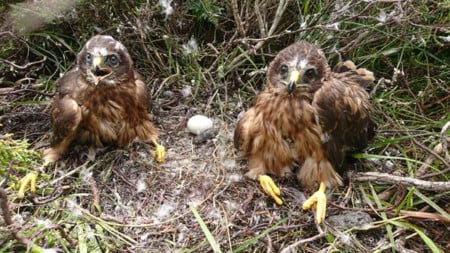
Two Manx hen harriers that had been satellite-tagged as part of conservation efforts to protect the endangered species have died.
Mannin and his sister Grayse were fitted with satellite transmitters at the beginning of July by members of the Scottish Raptor Study Group and Manx Ringing Group in a project coordinated by Manx Birdlife and RSPB.
Neil Morris, managing director of Manx Birdlife said: ’Everyone involved in the project is desperately sad that Grayse and Mannin have perished.
’Their early demise highlights the vulnerability of young birds learning to fend for themselves in the first few weeks and months after leaving the nest.
.jpeg?width=209&height=140&crop=209:145,smart&quality=75)
.jpeg?width=209&height=140&crop=209:145,smart&quality=75)
.jpeg?width=209&height=140&crop=209:145,smart&quality=75)
.jpeg?width=209&height=140&crop=209:145,smart&quality=75)
’It desperately underlines the vital need for large healthy populations that can withstand such losses.’
He explained that after leaving the nest, Mannin explored his island home until mid-August. His satellite tag showed him heading north towards the Galloway coast in southwest Scotland. But he dropped into the sea just 5km short of the Scottish coast.
RSPB staff found Mannin’s remains washed up on the shoreline near Kirkcudbright and a post mortem was conducted at Scotland’s Rural College (SRUC) Veterinary Laboratory. It revealed no evidence of trauma or health problems and that Mannin had recently eaten.
Mr Morris said: ’There cannot be any certainty as to what caused Mannin to go down in the sea. He might simply have been too exhausted to continue. Or he might have been caught in heavy rain or in a head-on wind. With nowhere to land, he would have dropped exhausted into the sea, becoming waterlogged.’
Meanwhile, Grayse’s tag showed she had become motionless in the island’s hills a few weeks after fledging.
Her body was recovered and the cause of death is believed to be natural causes.
Mr Morris said the charity was pleased to see Aalin, the hen harrier tag last year, doing well: ’It’s wonderful to see Aalin coming through her first year so well, and to get detailed insights to her behaviour and movements.
’We need to know so much more about these wonderful birds of prey in order to formulate effective, joined-up conservation strategies.
’We shall continue to work with RSPB and others to study Hen Harriers here in the Isle of Man and beyond.
Find out more at www.rspb.org.uk/our-work/conservation/henharrierlife/
Comments
This article has no comments yet. Be the first to leave a comment.