
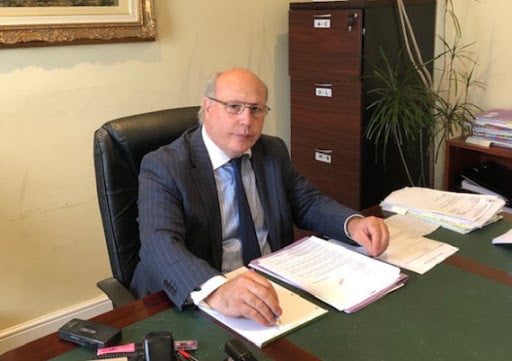
Advocate Ian Kermode has criticised the practice of routine Covid-19 testing using lateral flow tests (LFTs) in island schools.
Mr Kermode said he had been contacted by ’a number of parents’ who were ’seriously concerned’ about LFT use, which began as a pilot scheme in June.
The Manx advocate expressed a wide range of concerns about LFDs in an eight-page open letter to the Department of Education, Sport and Culture (DESC).
Firstly, he pointed out that children are being subjected to LFTs ’not for their own benefit but for the supposed benefit of elderly and vulnerable people’, to prevent asymptomatic children spreading the virus to this group.




Mr Kermode then raised a number of issues around the accuracy of LFTs.
He highlighted the problem of false positives - citing that out of the 39,904 positive cases identified by LFTs in one month in England, 18% of follow up PCR tests were negative.
Likewise, the advocate pointed out the issue of false negatives - that the British Medical Journal reported in December that LFTs were only ’49% effective in picking up infections in the asymptomatic people’.
The BMJ had examined a pilot scheme for mass testing in Liverpool in November.
Another study he found, from the Oxford University in November, reported that the sensitivity of LFTs dropped by 21% when used by untrained members of the public as opposed to trained laboratory scientists.
Mr Kermode pointed out that Director of Public Health Dr Henrietta Ewart previously rejected the idea of using LFDs for the mass testing of asymptomatic people in the island, on the grounds of the same Liverpool study, which she said showed the evidence for LFT use was ’not robust’.
However, Dr Ewart was speaking in the context of there being ’no or very low community transmission’ in the island - a situation which has changed now that the island has moved into a mitigation strategy for fighting Covid, and case numbers are rising rapidly.
Nonetheless, Mr Kermode questions why, having ’given such clear clinical opinion’ from Dr Ewart, the DESC has pursued a policy contrary to her scientific advice given in April.
The Douglas-based advocate also put forward concerns about the effect of LFD testing on the mental health of students, saying that parents had expressed concern that their teenagers will be ’at risk of psychological harm’.
Mr Kermode argues that frequent testing will make children fear that they are themselves at risk of harm from the virus, despite government scientific advice making clear the risk to them is ’miniscule’.
In addition, the advocate points out that the testing may cause students anxiety about the possibility of testing positive and needing to isolate.
Finally, Mr Kermode raised concerns about the ’eye-watering’ cost, calculating that twice a week testing of all secondary school pupils would cost a minimum of £50,000 per week (based on £5 tests).
In the DESC’s response, chief executive officer Graham Kinrade stressed that the LFT pilot scheme is completely voluntary, with no burden on the pupils or parents to participate unless they wish to.
He also pointed out the utility of LFTs in the mitigation phase, to detect positives from community transmission which can be confirmed by PCR tests.
Mr Kinrade noted that their were ’certain unknowns’ around LFT use, hence the pilot scheme, but in addressing Mr Kermode’s concerns about their accuracy, he pointed him to the UK’s Medicines and Healthcare products Regulatory Agency (MHRA) review which authorised LFTs for NHS Test and Trace.