
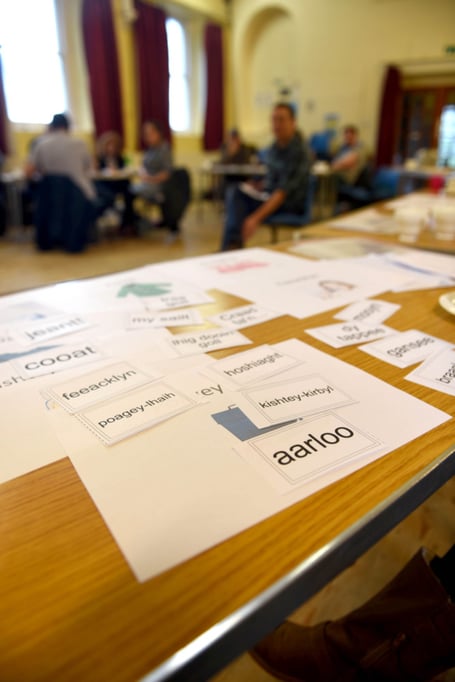
The future of the native Manx tongue has been further strengthened after it received the backing and protection from a European body which helps to protect minority languages.
After work from a number of educational, cultural and governmental bodies, it has been announced that ’Part III of the European Charter for Regional or Minority Languages (ECRML), will be applied to Manx Gaelic, which will further help protect and strengthen the long-term future of the language for generations to come.
Based around the belief that ’regional or minority languages are part of Europe’s cultural heritage and their protection and promotion contribute to the building of a Europe based on democracy and cultural diversity’, ECRML came into being in 1998 after being adopted by the Council of Europe and has since helped to protect and promote many regional and minority European languages.
The submission to the ECRML was made by the Manx Language network Jeebin, a body made up from members of the the Department of Education, Sport and Culture, the Bunscoill Ghaelgagh and Manx Language Unit, Mooinjer Veggey and Culture Vannin, who work alongside the language community.
.jpeg?width=209&height=140&crop=209:145,smart&quality=75)



The decision was welcomed by all parties involved, with Jeebin saying that it ’significantly strengthens the protection and promotion of the Manx Gaelic language, and recognises its revival in recent years thanks to community-based initiatives and targeted Isle of Man Government support.’
The Manx government has pledged to undertake 37 measures to safeguard, promote and use the Manx language, including more work in pre-school education, using the language in official documents and using more Manx Gaelic in press and public announcements, as well as in other cultural activities.
’The Manx language is one of the island’s most important cultural assets; it is an island success story that we can all be proud of,’ said Dr Alex Allinson MHK, Minister for Education, Sport and Culture.
’Regional or minority languages are part of Europe’s cultural heritage and their protection and promotion are an important part of cultural diversity.
’Whatever your age, it is now possible to learn Manx in nurseries, schools and the wider community.’
It marks a further remarkable turnaround in the fortunes of the Manx language which, in 2009, was declared an ’extinct’ language by the UNESCO’s Atlas of the World’s Languages in Danger.
Letters written by the-then pupils at the Bunscoill Ghaelgagh helped to put the language back on the map and, since then, has attracted hundreds of new speakers, not just in the Isle of Man but around the world.
by Mike Wade
Twitter:@iomnewspapers
Comments
This article has no comments yet. Be the first to leave a comment.