
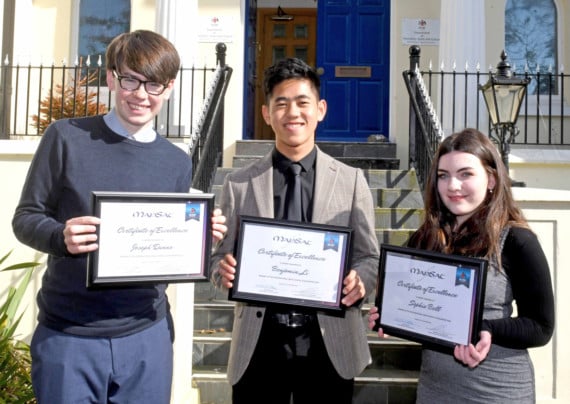
Over the summer three Isle of Man students remotely took part in NASA’s United Space School.
The Manx trio worked for two weeks alongside peers from around the world and interacted with space industry professionals including astronauts, NASA engineers and scientists.
Last week Sophie Bell, Joseph Dunne and Benjamin Li were awarded certificates marking their achievement by the Minister for Education, Sport and Culture Dr Alex Allinson MHK.
The mission involved each team planning a trip to an asteroid, investigating how humanity can commercialise space to reduce Earth pollution and further scientific discoveries.


.jpeg?width=209&height=140&crop=209:145,smart&quality=75)
Because of Covid-19, this year’s Space School was held online via video conferences rather than physically in Houston, Texas.
However, provided the space school is held as normal in 2021, the three students will still have the opportunity to travel to Houston next July.
Joseph, from Ramsey Grammar School, said: ’Our team worked on the mining aspect, looking at the equipment and robots needed and considering how much it would cost, how much mass it would take and whether it was feasible. One issue we had was that our asteroid didn’t contain a lot of water, and so we were considering whether it was worth taking a water extractor robot which would help obtain water which is pretty valuable in space.
’Meeting the astronauts and asking them questions was a big highlight. I remember asking them what it was like to make a spacewalk and that was just amazing to hear.’
Joseph plans to study computer science, and added: ’The project has pushed me a bit more towards the area of physics. Looking at the mining robots was very interesting though, and that links in to computer science and that will be useful towards university.’
Benjamin, also from Ramsey Grammar, said: ’My team was concerned with the transport aspect of the mission, and a lot of that comes down to how long is it going to take, can we carry enough material and resources to sustain the crew, are we going to have enough fuel to make that mission.
’The best part was meeting experts with such a high level of knowledge.
’There was a scientist from the NASA Jet Propulsion Laboratory who was talking about space radiation, and I asked him about this material I was reading up on as a potential radiation shield, Aerogel - and he turned out to be the guy who initially proposed it.
’I was just taken aback.’
Benjamin, who plans to study engineering, added: ’The space school definitely helped me understand more about aerospace, which is a specialist area I’d be interested in pursuing.’
Sophie, from Queen Elizabeth II High School, said: ’I worked on the crew health aspects: making sure the astronauts are safe - mentally and physically - as well space law, making sure we didn’t break any international laws.’
For her, the highlight was the speaker Q&As.
She said: ’It was very interesting to hear from people who are experts in their fields - and also working with my project team.’
The programme also made her think about her future career plans, saying: ’I’m looking at studying biology, but after this I’ve also been thinking about space law - which is quite an interesting topic that I hadn’t really considered before.’
Dr Allinson said: ’The United Space School programme has been going for several years now and I think it’s a brilliant example of the way of inspiring young people - particularly in terms of science and technology - making it very relevant for them, even though we’re a small island.’
Asked about the significance of the program during the uncertainty caused by Covid-19, Dr Allinson said: ’This year more than any other it’s so relevant, and although the young students haven’t been able to physically go to meet each other, they’ve been interacting online, cooperating, problem solving across huge distances.
’I think that shows a real example of the way the whole world has had to adapt to coronavirus, in terms of using technology like video conferencing to stay connected.
’They were communicating with people on the other side of the world who were going through the same experiences as they were in terms of anxieties, lockdowns, problems with communications. But they were able to work together.
’I think the students have learned a huge amount not only about the science and technology aspects, but about the human aspect - and with space travel that’s very relevant.
’ It’s very easy to blast someone off on their way to mars, but you then have to look after that person during times of isolation - and we’ve seen that on the Isle of Man, that during the lockdown a lot of people struggled with that lack of human contact.
’So I think some of the work the students did was incredibly relevant to us here on the island, as well as a real opportunity for them to reach out further than the confines of the Isle of Man.’
ManSat limited is a Manx-registered and owned company which offers consultancy services, carrying out satellite filings for Iceland and the Isle of Man under contract with the Isle of Man Government’s Communications Commission.
ManSat has awarded the annual United Space School scholarships to Manx students since 2000, in cooperation with the Department of Education, Sport and Culture.
Comments
This article has no comments yet. Be the first to leave a comment.