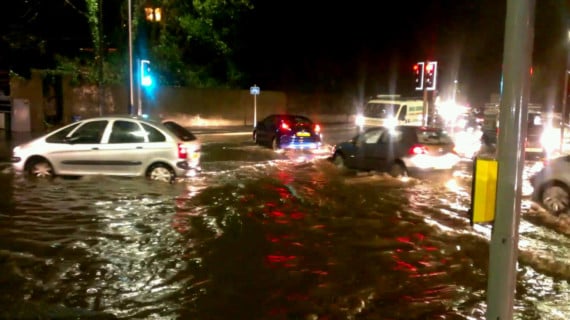
An end could be in sight at last to the flood risk misery of firms on a Douglas industrial estate.
Businesses on the Hills Meadow industrial estate and along Peel Road were last devastated by flash floods three years ago.
Units were left under several feet of water and silt and many hundreds of thousands of pounds of stock were destroyed.
Now construction work has begun to install an underground stormwater storage tank at the Old Noble’s Hospital car park.
.png?width=209&height=140&crop=209:145,smart&quality=75)

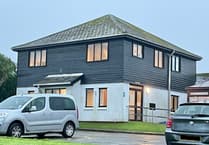
It will help manage flood flows from the Ballakermeen Road catchment and will serve to reduce the flooding on Peel Road and Hills Meadow.
The scheme is expected to be completed in May 2019.
During the last major flooding in December 2015, at least £150,000 worth of damage was caused at KC Foods which saw six vans, three fork lift trucks and 50 tonnes of food lost to 4ft of floodwater.
Other businesses in Hills Meadow struggled to get re-insured. Some blamed the flooding on insufficient drainage in the newly reconstructed Peel Road.
Manx Utilities chairman Dr Alex Allinson said businesses in the natural flood plain of Hills Meadow should see a significant reduction in storm flows in the future - and the scheme will also help reduce the build-up of flood water on Peel Road.
He said: ’I am pleased to see this important project progressing.’
Extensive feasibility studies for the Douglas catchment are also being carried out ahead of future flood risk works relating to the River Glass, River Dhoo and Middle River.
During the floods on Peel Road in 2015, motorists became stranded near to the Quarterbridge as the rivers Dhoo and Glass burst their banks and cars were at risk of being swept away.
Police rescued two people who were clinging desperately to lamp posts as they were enveloped by fast flowing floodwater.
The DEFA and Manx Utilities are looking into what can be put in place in the streams that feed the main rivers to ’slow the flow’ using natural flood risk management measures. In addition, Manx Utilities has also been working closely with the Department of Infrastructure in the design of the new Pulrose Bridge to ensure flood risk considerations are taken into account there.
Work is also planned in the area around the National Sports Centre.
This will involve reducing the height of the man-made grass and earth features in the river channel to improve water flow along the stretch of the River Glass.
Work will be carried out once detailed designs have been agreed and when invasive Japanese knotweed has been cleared from the gravel bank. The weed can take up to three years to eradicate.
Dr Allinson said: ’The flood risk feasibility study is a huge undertaking which will involve several phases including financing, planning, consultation, design and construction.
’We are hopeful we can commence with the less complex projects quite quickly. However, some of the more challenging and complex projects could be up to five years before coming to fruition.’
He said that there are regular requests for river dredging to alleviate the threat of flooding but he said this is not always the solution.
Dr Allinson said gravel movement is constantly monitored and computer modelling used to establish whether gravel removal will benefit the island’s rivers.
Comments
This article has no comments yet. Be the first to leave a comment.