
The 2020-21 Douglas Chess Championships are now well underway, with three of the seven rounds having been completed so far.
With 14 players taking part, Henrik Fabri and John Costello currently lead the field with 2.5 points from 3, ahead of Keith Allen, Zahed Miah and Paul Smith just behind with two.
Unlike the Manx Chess Championships, in this competition there is one round every month until the end of the season. With four more rounds remaining, there is enough time for those players who lose a game in the early rounds to catch up to those at the top of the table.
All games have shorter time controls, with all moves having to be played in 75 minutes with a 30-second increment for each player.


.jpeg?width=209&height=140&crop=209:145,smart&quality=75)

An increment is simply the addition of 30 seconds to the player’s clock every time they make a move and press their clock, so in theory if a player made a move in less than 30 seconds the game could last forever.
Although it might look easy, finding the correct move when you have limited time to think deeply often results in mistakes and, more often than not, horrendous blunders are made when players are under time pressure.
Round three did not have any shocking results as such. At the top board the two strongest players, Fabri and Allen, played a Semi-Slav opening which was actually a tight match and, although the former looked as though he had a slight space advantage, Allen defended well for a draw.
The most exciting game of the round was between Sanjay Gummireddy with the white pieces against Zahed Miah who, as black, played a well-known solid theoretical opening called the Caro-Kann Defence.
Unusually, Gummireddy moved some of his pieces twice in the opening, while Miah developed very quickly giving him a slight advantage.
In order to complete development, Gummireddy had to move his king to F2. Normally one defends their king by ’castling’ but he was unable to do this as Miah had a knight on square C4.
This would have been able to jump to E3 on this next move, thereby attacking Gummireddy’s queen, rook and bishop simultaneously and attacking many key squares.
Since a knight can potentially move up to eight squares, it is often compared to an octopus. Furthermore, if the knight is deep into the opponent’s position and it cannot be dislodged, the knight in effect restricts the opponent’s pieces as they are not able to coordinate effectively.
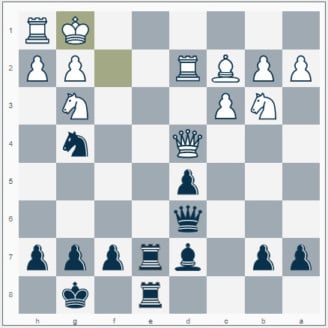
After a few more moves, Miah played a knight sacrifice which exposed Gummireddy’s king which had to move back to the square G1 (as pictured below).
Despite being a piece down, Miah then sacrificed his queen. Such moves are not common as players do not give away their most powerful piece unless they gain some compensation.
But checkmating the opponent’s king is the main objective of the game and therefore the sacrifice was justified. After the black queen took the white knight on G3, Gummireddy could have taken his opponent’s queen with his pawn on H2.
But the point of the ’sacrifice’ was that Miah was able to simply deliver checkmate by moving his rook from E7 to E1, with the white knight covering the black king’s escape on F2. Although a few more moves were played, the game ended sooner after.
l For details of the results and club events can be viewed on the website http://www.iomchessclub.co.uk/home-page/
The club meets every Wednesday at Braddan Church, 7.30pm. Contact chairman Howard Dobson on 233303 for more details.
Comments
This article has no comments yet. Be the first to leave a comment.